


Argentine Air War in the Falklands 1982: Complete Field Guide — Skyhawks, Daggers, Mirages, Super Étendards & San Carlos
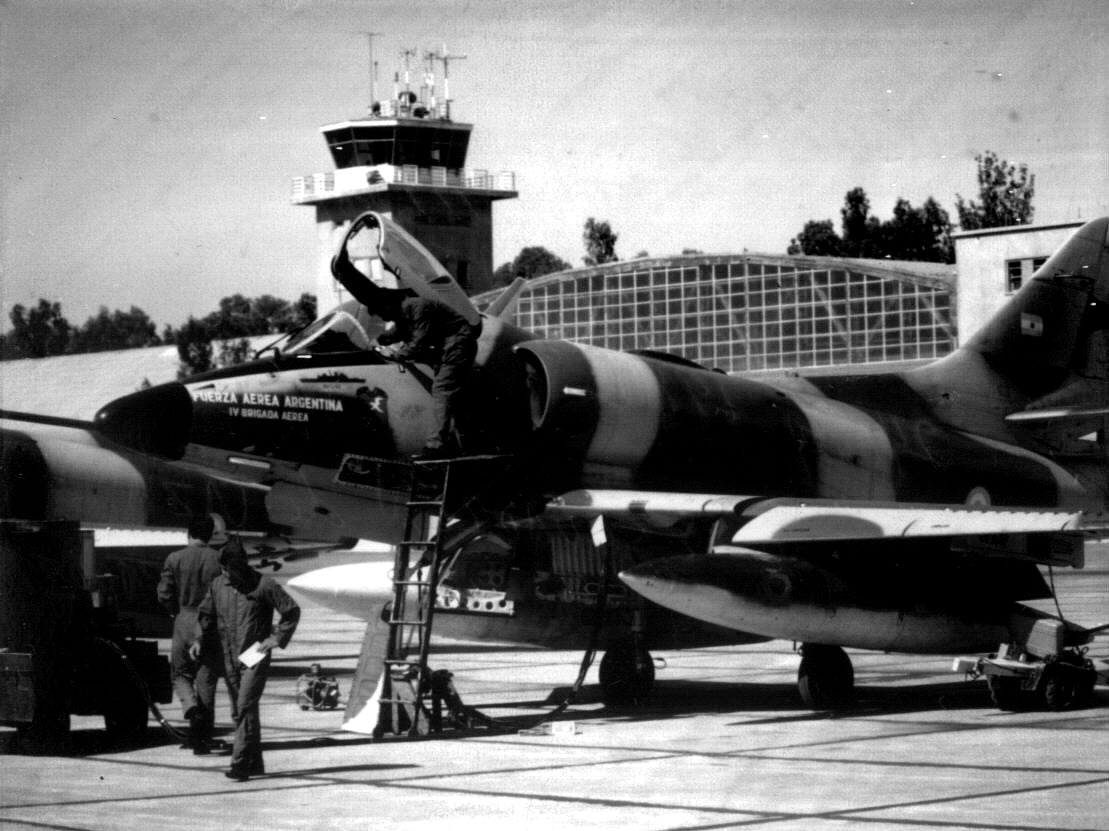
The Argentine air war of 1982 is often reduced to two statements: the pilots were brave, and too many bombs failed to explode.
Both are true. Neither explains the campaign.
Argentina fielded two separate air arms with different responsibilities, aircraft, doctrine and training. It possessed some modern weapons but only in tiny numbers. Many strike pilots had almost no peacetime anti-shipping experience. Mainland bases imposed severe range limits. Maritime reconnaissance was fragile. Inter-service boundaries made it harder to combine sensors and attackers. Yet Argentine aircraft still sank or helped sink major British ships and repeatedly forced the Task Force to alter how it fought.
This Field Note looks at the air war as a system: aircraft, bases, tankers, reconnaissance, weapons, training, navigation, command and the men who had to make all of it work.
At a glance
- Principal services: Fuerza Aérea Argentina (FAA) and Comando de Aviación Naval (COAN).
- Main strike types: A-4 Skyhawk, IAI Dagger, Super Étendard.
- Fighter type: Mirage IIIEA.
- Other combat aircraft: Canberra bombers, IA 58 Pucarás, Aermacchi MB-339s and naval A-4Qs.
- Precision anti-ship weapon: AM39 Exocet carried by Super Étendard.
- Major successes: Sheffield, Ardent, Antelope, Coventry, Atlantic Conveyor, damage to numerous other ships, and repeated disruption of British amphibious operations.
- Major limitations: range, reconnaissance, inter-service coordination, obsolete equipment, small precision-weapon inventory, bomb-fuze problems and difficulty sustaining fighter cover over the islands.

Two air arms, two cultures
The first point is structural. Argentina did not fight one unified air campaign.
The FAA controlled most land-based combat aircraft. COAN — Naval Aviation — was responsible for maritime air warfare and operated the carrier aviation and Super Étendard/Exocet force.
David Jordan's later reassessment stresses how much this separation mattered. The service that operated most of the strike aircraft had little responsibility for anti-surface warfare in peacetime. FAA Skyhawk and Dagger crews therefore had to learn anti-ship attack rapidly during the war.
COAN, by contrast, had carrier and maritime strike experience, but far fewer aircraft and only a handful of Exocet missiles.
The Skyhawk
The A-4 Skyhawk was the workhorse of the Argentine strike effort.
Jordan notes that Argentina had bought more than ninety from the 1960s onward, but by 1982 the surviving fleet was ageing and affected by financial constraints and US sanctions. The FAA operated the A-4B and A-4C; COAN operated the A-4Q.
The aircraft's small size and low-level performance made it suitable for the kind of attack demanded by the Falklands: long transit, very low final approach, rapid visual attack and immediate escape.
It also demanded exceptional discipline. Fuel margins were often small. Navigation over featureless water was difficult. Pilots had only seconds to identify a ship, align the attack and release conventional bombs while flying through guns and missiles.
The Dagger
The IAI Dagger was an Israeli-built derivative of the Mirage V. Argentina had thirty-nine, making it another major part of the strike force.
Unlike the Skyhawk it was fast and capable, but it lacked the range and loiter time needed to contest the islands for long. Jordan also notes that many pilots were relatively inexperienced on type.
Daggers were therefore frequently used in rapid attack missions rather than prolonged fighter patrols.
The Mirage III problem
Mirage IIIEAs were the most obvious conventional fighters in the Argentine inventory, but their practical usefulness over the Falklands was restricted by range.
They had no air-to-air refuelling capability. Some were retained for homeland defence because Argentine commanders feared possible Vulcan attacks against the mainland.
That left only a small number able to operate from southern bases toward the islands, with very little time to remain in the combat area.
The result was one of the central asymmetries of the air war: Argentina possessed fast fighters on the mainland, while Britain had fewer fighters but could keep Sea Harriers close to the Task Force on carriers.
Super Étendard and Exocet
The Super Étendard was the one Argentine aircraft able to carry a modern precision stand-off anti-ship weapon.
Five aircraft and five AM39 Exocets had arrived before the war. France then embargoed the next batch. COAN had to keep the small fleet operational with limited spares and incomplete training.
The force still achieved two of the campaign's most strategically significant naval strikes: HMS Sheffield on 4 May and Atlantic Conveyor on 25 May.
The weapon mattered because the launching aircraft did not need to fly directly over the target ship. A Super Étendard could briefly climb, use Agave radar, launch and turn away while the missile completed the final approach.
Atlantic Conveyor 25 May 1982 →
The reconnaissance problem
Finding the British fleet was often harder than attacking it.
Argentina possessed only a small maritime patrol force. Two elderly P-2 Neptunes were available early in the war. Their targeting contribution was decisive in the successful Sheffield attack, but reliability and vulnerability soon forced them out of service.
Trackers were moved ashore after the Argentine carrier withdrew, but their endurance and sensor reach were limited. Two Brazilian-built Bandeirante patrol aircraft arrived later, but not early enough to solve the pre-landing search problem.
Jordan's conclusion is important: many sorties did not fail because British fighters shot them down. They failed because the attackers never found the target.
Explore this history
Continue from this Field Note into the closest Gallus campaign and military-history collection.
The carrier that did not fight
ARA Veinticinco de Mayo had the potential to put A-4Q Skyhawks closer to the Task Force, but wind, aircraft load limits and the submarine threat reduced its freedom of action.
After HMS Conqueror sank General Belgrano on 2 May, the Argentine surface fleet withdrew from the main battle area.
Naval aircraft then had to fight predominantly from mainland bases, increasing distance and fuel pressure.
1 May: the air war opens
The Argentine Air Force's official history records 58 combat missions on 1 May using Pucarás, A-4Bs and A-4Cs, Mirage IIIs, Daggers and Canberras.
That day demonstrated both capability and limitation. Argentine aircraft could reach the islands in numbers, but establishing control of the air was another matter. Mirage endurance was short and the Sea Harriers were operating close to their ships.
The war did not become a conventional fighter contest in which one side swept the other from the sky. It became a series of brief interceptions around strike missions.
Why the British carriers stayed east
The Argentine air threat shaped British behaviour even when no bombs were falling.
Hermes and Invincible were kept farther east to reduce their exposure to mainland-based aircraft and Exocet. That protected the carriers but reduced Sea Harrier time on station over the islands and San Carlos.
In other words, Argentine range limitations also created British range limitations.
San Carlos changed the problem
Before 21 May the Argentines struggled to locate a fleet moving in open ocean. Once the British entered San Carlos Water, the targets became easier to find.
The attackers now knew roughly where the amphibious ships and escorts would be.
The disadvantage was that the same concentration helped British fighter direction. Sea Harriers could patrol likely approach routes, and ship radars could vector them onto incoming raids.
San Carlos therefore made the target easier to find and harder to survive attacking.
21 May: the scale of the effort
The landings triggered the largest sustained Argentine anti-ship effort of the campaign.
Aircraft approached at very low level over West Falkland, crossed the Sound and attacked warships and amphibious shipping.
HMS Ardent was lost. Argonaut, Broadsword, Brilliant and other ships were damaged. Argentine aircraft were also destroyed by Sea Harriers and ship/shore air defences.
The British beachhead survived, which was the decisive operational fact. But the cost showed that pre-war assessments describing the Argentine air threat as only moderate had been too optimistic.
The bomb-fuze problem
Several British ships survived direct bomb hits because the weapons failed to explode.
The reason was not simply defective bombs. The low-level attack method made fuze arming difficult. The aircraft needed to stay low to survive; bombs released that low had very little time before impact.
The official history preserves an Argentine explanation of the dilemma: the delay had to be long enough to prevent one aircraft being hit by the previous aircraft's bomb blast, but short enough for the weapon to arm and function inside the ship.
The problem was not fully solved until late in the campaign.
That matters when judging effectiveness. The Argentine pilots repeatedly achieved the hardest part — reaching and physically hitting ships — but many of those hits did not convert into explosions.
Ardent and Antelope
HMS Ardent was struck repeatedly on 21 May; enough bombs exploded to overwhelm the frigate.
HMS Antelope was hit on 23 May by bombs that did not detonate on impact. One exploded later during EOD work and destroyed the ship.
These two losses are almost mirror images of the fuze issue.
25 May: Coventry
The British response to low-level raids included placing HMS Coventry and HMS Broadsword forward as a combined Sea Dart/Sea Wolf missile trap.
The system inflicted losses before a second Skyhawk wave got through. In the final moments Coventry manoeuvred across Broadsword's line of sight, preventing a Sea Wolf engagement.
The destroyer was hit and capsized. Nineteen men died.
The Navy's Exocet campaign was different
COAN's Super Étendard missions should be separated from the mass Skyhawk/Dagger effort.
The Super Étendard force flew fewer attacks, used more complex reconnaissance and tanker support, and relied on a weapon inventory that could be counted on one hand.
That scarcity drove careful target selection and an intelligence campaign around the British carrier group.
The result was disproportionate effect from very few missile launches.
Air-to-air: why 20–0 is not the whole story
No Sea Harrier was lost in air-to-air combat. That is an important result.
But the famous score does not mean the Argentines attempted a symmetrical fighter campaign and lost it 20–0. Mirage range, basing, tanker availability and mission priorities meant many Argentine aircraft were trying to reach ships, not establish a standing fighter patrol over the islands.
The Sea Harrier force performed extremely well. The operational question is broader: did British fighters prevent enough strike aircraft from releasing weapons?
At San Carlos, the answer was often yes — but not always.
Sea Harrier in the Falklands 1982 →
Inter-service separation
Jordan identifies Argentine service boundaries as one of the campaign's major self-imposed weaknesses.
Maritime patrol aircraft belonged to the Navy's maritime-war system. Most of the mass attack aircraft belonged to the Air Force. That meant the sensors best suited to finding ships were not naturally integrated with the aircraft best able to generate large strike packages.
COAN and FAA did cooperate during the war, but much of that cooperation had to be invented under combat pressure.
The human factor
None of the technical limitations changes the courage demanded of the crews.
A Skyhawk or Dagger pilot approaching San Carlos knew the final run might pass through Sea Harriers, Sea Dart, Sea Wolf, Sea Cat, Rapier, 4.5-inch and 20mm guns, machine guns and rifle fire.
Many still pressed the attack.
That is not the same as saying the system around them was optimal. One of the central lessons of the air war is that individual skill and courage can produce tactical success while command, doctrine and logistics still waste opportunities.
What Argentina achieved
- Sank or contributed directly to the loss of major British ships including Sheffield, Ardent, Antelope, Coventry and Atlantic Conveyor.
- Damaged numerous other warships and amphibious/support vessels.
- Forced British carriers to operate conservatively and shaped Sea Harrier patrol planning.
- Made San Carlos an attritional air-defence battle rather than an uncontested landing.
- Created a lasting naval concern around Exocet and low-level attack.
What Argentina failed to achieve
- It did not destroy either British carrier.
- It did not stop the San Carlos landing or destroy the beachhead.
- It did not establish sustained control of the air over the islands.
- It did not integrate reconnaissance, fighter defence and mass anti-shipping attack as efficiently as its aircraft inventory theoretically allowed.
- It did not solve the bomb-fuze problem early enough to convert many direct hits into ship kills.
Myths and anti-myths
Myth: Argentine pilots were ineffective because many bombs failed.
The direct-hit record says otherwise. The fuze issue reduced the damage those hits produced.
Myth: the Sea Harrier's air-to-air record proves complete British control.
The Sea Harrier dominated the engagements it fought, but British ships were still repeatedly hit.
Myth: Exocet was the whole Argentine air threat.
Conventional A-4 and Dagger attacks caused most of the daily pressure around San Carlos.
Myth: Argentina had the numbers to overwhelm Britain automatically.
Raw aircraft totals conceal range, serviceability, tanker, reconnaissance and training constraints.
The Iron Standard conclusion
The Argentine air war was dangerous precisely because it was uneven.
It combined obsolete aircraft and modern missiles, improvised anti-shipping training and highly skilled low-level flying, weak inter-service integration and individual tactical excellence.
The British ultimately held the beachhead and carriers, so the Argentine air campaign failed to stop the reconquest. But that outcome should not be confused with an easy or one-sided air war.
The evidence shows a force that repeatedly got close to changing the campaign, and just as repeatedly lost opportunities through limitations that existed before the first aircraft took off.
Related Falklands Field Notes
- Sea Harrier in the Falklands 1982
- HMS Sheffield 4 May 1982
- San Carlos 21 May 1982
- HMS Ardent 21 May 1982
- HMS Antelope 23–24 May 1982
- HMS Coventry 25 May 1982
- Atlantic Conveyor 25 May 1982
Return to the Falklands War 1982 complete campaign guide →
Continue exploring
Sources & further reading
- David Jordan, “Corporate Lessons? Reflections on Some of the Myths, Anti-Myths and Omissions of Britain's Falklands Air War, 1982,” Air and Space Power Review — principal reassessment of service structures, aircraft limitations, targeting and post-war myth.
- Lawrence Freedman, The Official History of the Falklands Campaign, Volume II — British operational record, air threat assessments, San Carlos losses and later analysis.
- Rowland White, Harrier 809 — operational narrative of Sea Harriers, Argentine Naval Aviation, Super Étendards and low-level strike tactics.
- Fuerza Aérea Argentina — Gesta de Malvinas — official Argentine Air Force chronology and institutional perspective.
