


Atlantic Conveyor 25 May 1982: Complete Field Guide — Exocet, Aircraft, Helicopters & the Falklands Logistics War

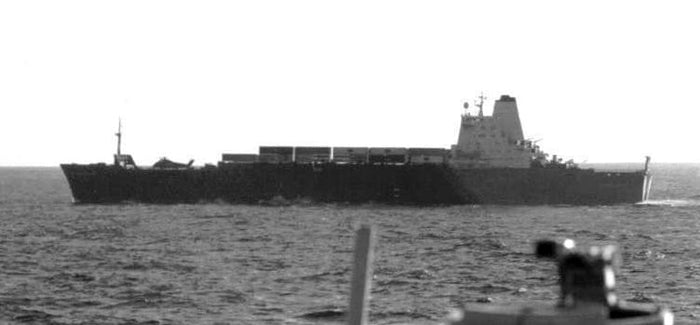
South Atlantic, 25 May 1982. Atlantic Conveyor was not a warship. She was a merchant container ship taken up from trade and converted at speed into one of the most important logistics platforms in the Falklands Task Force.
By the time two Argentine Navy Super Étendards found her, she had already delivered the most important part of her aviation cargo: Sea Harriers and RAF Harrier GR.3s had flown off to the carriers. What burned with the ship was different but just as consequential — helicopter lift, spares, engineering material, aviation support equipment and much of the kit intended to make the land campaign faster and more mobile.
The loss did not force every British soldier to walk across East Falkland, and it did not single-handedly determine the land campaign. But it sharply reduced the lift available to commanders just as the Army was trying to break out of San Carlos and move east.
At a glance
- Date attacked: 25 May 1982.
- Ship: SS Atlantic Conveyor, requisitioned merchant container ship.
- Master: Captain Ian North.
- Senior Naval Officer: Commander Michael Layard RN.
- Attacking aircraft: two Argentine Navy Super Étendards.
- Pilots: Capitán de Corbeta Roberto “Toro” Curilovic and Teniente de Navío Julio “Mate” Barraza.
- Weapon: AM39 Exocet.
- British dead: 12.
- Ship lost: sank on 28 May after the attack and fire.
- Operational significance: major loss of helicopter lift, spares, stores and forward aviation-support equipment.

STUFT: a merchant ship turned into a war asset
The Falklands campaign depended on Ships Taken Up From Trade — STUFT. Britain did not possess enough dedicated military shipping to move an expeditionary force, its aircraft, vehicles, ammunition and stores 8,000 miles into the South Atlantic at short notice.
Atlantic Conveyor was converted rapidly into an improvised aviation transport and flying-off platform. It was not a carrier in the normal sense: there was no hangar system, no armoured flight deck and no purpose-designed magazine complex. Containers, aircraft, fuel systems and military stores had to be arranged around the structure of a commercial ship.
That improvisation was one of the campaign's strengths and one of its vulnerabilities.
What she carried
Rowland White's Harrier 809 gives an unusually detailed picture of the load-out. Before sailing south, the ship carried:
- Sea Harriers for the newly re-formed 809 Naval Air Squadron;
- RAF Harrier GR.3 ground-attack aircraft;
- Chinook HC.1 heavy-lift helicopters;
- Wessex HU.5 troop-carrying helicopters;
- ground support equipment and aircraft spares;
- large quantities of aluminium matting intended for a forward Harrier operating strip, taxiways and hardstandings;
- fuel-storage and pumping equipment;
- boats, forklifts, tents and other campaign infrastructure;
- later-added ammunition and explosive stores.
The ship was therefore carrying much more than aircraft. It carried part of the infrastructure intended to turn the British bridgehead into a mobile force.
809 Naval Air Squadron
809 NAS had effectively been recreated for the war. Pilots and aircraft were gathered from different sources, trained and moved south with extraordinary speed.
White describes the squadron travelling aboard Atlantic Conveyor as a unit before its aircraft were split between Hermes and Invincible. Eight 809 Sea Harriers were among the reinforcement package carried south, alongside six RAF Harrier GR.3s.
The critical point is that the Harriers were flown off before the ship was hit. The Exocet attack did not wipe out the reinforcement fighter force. By then the aircraft had already increased the strength and resilience of the carrier air groups.
Read the Sea Harrier Falklands Field Note →
The helicopter package
The helicopter story is more complicated.
White records that Atlantic Conveyor originally embarked five Chinook HC.1s and six Wessex HU.5s. As the campaign developed, aircraft were flown off and tasking changed. By the time of the attack, the land campaign expected a major air-mobile capability from the Chinooks and Wessex package.
The official history later described the most serious specific loss from the ship as three Chinooks together with their ground-support equipment and spares. One Chinook, ZA718 — Bravo November — was away from the ship and survived.
That apparent difference between original embarkation figures and the official operational-loss figure is worth preserving rather than flattening. The ship sailed with one aircraft package; by 25 May some aircraft had already moved, and the operational consequence was determined by what remained aboard when the missiles hit.
Bravo November
Bravo November became one of the best-known individual aircraft of the campaign because it was the Chinook left available after the loss.
White records that by the end of the war the surviving aircraft had carried around 1,500 troops, 95 casualties, 650 prisoners of war and roughly 550 tons of cargo. On one lift it carried 81 paratroopers from Goose Green toward Fitzroy.
Those numbers illustrate the capability British commanders had expected several Chinooks to provide. One aircraft could perform remarkable work; it could not recreate the lift capacity of the package lost with the ship.
Explore this history
Continue from this Field Note into the closest Gallus campaign and military-history collection.
25 May: Argentina goes looking for the carriers
For Argentina, 25 May — its national day — became one of the most consequential days of the naval air war. The Argentine Navy still regarded the British carriers as the most valuable targets in the Task Force.
After earlier efforts to locate the carrier group, 2 Escuadrilla prepared another Exocet mission. Roberto Curilovic and Julio Barraza flew the two Super Étendards.
The mission depended on long-range navigation, KC-130 tanker support and intelligence from radar and other sources. The aircraft flew a deliberately indirect route, refuelled over the South Atlantic and then descended to extremely low altitude for the final approach.

“Go for the biggest”
White's reconstruction follows Curilovic and Barraza as they made a brief climb to use their Agave radars. They saw several contacts and selected the largest return, believing it might be one of the British carriers.
This point matters. Atlantic Conveyor was not selected because Argentina knew exactly what cargo she carried and deliberately chose to cripple British helicopter lift. The attackers were trying to reach the carrier battle group and attacked a large radar contact.
The ship they found happened to be one of the most valuable logistics targets in the fleet.
The warning
British electronic-support equipment detected the Super Étendards' Agave radar transmissions. The codeword “Handbrake” warned ships that the Exocet threat was present.
Escorts began manoeuvring and deploying chaff. Atlantic Conveyor, however, had none of the layered self-defence systems of a purpose-built warship. Her survivability depended heavily on the surrounding fleet.
Chaff was fired by nearby escorts to seduce or confuse the incoming missiles. The exact interaction between decoys, seeker logic and ship positions remains part of the technical discussion around the attack, but the result is clear: the missiles did not hit a carrier.
The strike
Two Exocets struck Atlantic Conveyor around the aft port quarter.
Fire spread quickly through a ship carrying aircraft-support equipment, fuel-related stores and ammunition. Captain Ian North and the ship's emergency teams attempted to control the situation, but the fire became unmanageable.
North ordered abandon ship.
The twelve
Twelve men died in the attack, including Captain Ian North.
The ship's later fame as a logistics turning point can obscure that human cost. Merchant seamen were serving in the same threat environment as the Royal Navy, Royal Fleet Auxiliary and embarked military personnel.
Falklands War Dead — Roll of Honour & Remembrance →
The ship sinks
The burnt-out ship remained afloat after abandonment but could not be saved. Atlantic Conveyor sank on 28 May.
By then the Task Force had lost not merely a transport but a concentrated block of capability that could not be replaced quickly in theatre.
What was actually lost?
The most important distinction is between aircraft already delivered and capability still aboard.
The Sea Harriers and RAF Harrier GR.3s had already flown to the carriers. Their loss was avoided.
What disappeared included much of the remaining heavy-lift helicopter capability and associated support, Wessex aircraft, engineering equipment, aviation stores and material for the planned forward Harrier strip.
The loss of stores was almost as important as the aircraft. A helicopter without specialist support equipment, spares or ground crew infrastructure is not simply an aircraft waiting to fly. It is a capability with a clock running against it.
Did Atlantic Conveyor cause the yomp?
The common version says that the loss of the Chinooks forced 3 Commando Brigade to march across East Falkland.
That is partly true and too simple.
The ground plan already depended on a mixture of walking, helicopters, landing ships, landing craft and forward logistics nodes. Weather repeatedly grounded aircraft. Helicopter numbers were never unlimited. Terrain and the need to support multiple formations already constrained mobility.
The loss of Atlantic Conveyor removed a large part of the heavy-lift margin that could have accelerated movement and concentrated forces. It therefore worsened the movement problem and altered commanders' calculations, but British infantry were not transformed from a fully air-mobile force into pedestrians by one missile strike.
Falklands 1982 — Terrain, Routes & Logistics →
Mount Kent and the change in calculations
Immediately after the loss, Julian Thompson had to reconsider plans to push forces rapidly toward the high ground west of Stanley.
The official history records that a move which looked bold but achievable with helicopter support now appeared far more dangerous. With fewer aircraft available, initial troops on forward ground could be left isolated with limited ammunition and support if weather prevented follow-up lifts.
That is the operational significance of Atlantic Conveyor: not “the advance stopped,” but the safety margins around rapid manoeuvre became much thinner.
The forward airstrip that was diminished
The loss of aluminium matting and aviation-support equipment also affected plans to establish a more substantial forward operating base for Harriers.
A forward strip offered several advantages: faster response, reduced demand on carrier deck cycles and less fuel burned simply reaching the land battle. Some forward Harrier capability was created later, but not at the scale originally envisaged with the material carried by Atlantic Conveyor.
Why the ship mattered before she was hit
It is easy to remember Atlantic Conveyor only for what was lost. White's account makes clear how much she had already achieved.
She had transported Harrier reinforcements into theatre. Her improvised flight deck had allowed the aircraft to operate from a merchant hull. Her embarked personnel turned a commercial ship into part of the air campaign in a matter of weeks.
That achievement is part of the wider STUFT story: civilian hulls, civilian crews and improvised military organisations extending a fleet that otherwise could not have carried the campaign.
Was Atlantic Conveyor protecting Hermes?
Some later accounts argue that chaff and ship geometry effectively diverted the Exocets away from Hermes and toward Atlantic Conveyor. White presents a strong version of this interpretation.
It is safer to separate what is known from what is inferred. The Argentine pilots intended to attack a major radar contact and believed the largest return might be a carrier. British ships deployed chaff after detecting the threat. The missiles ultimately struck Atlantic Conveyor.
What cannot be proved with the same confidence is the exact counterfactual path each missile would have followed had particular ships not deployed particular decoys. The carriers were the intended high-value objective; Atlantic Conveyor absorbed the successful strike.
The strategic irony
Argentina had only a tiny Exocet inventory. Two missiles had hit Sheffield's group on 4 May; two more were used on 25 May. The attack on Atlantic Conveyor caused a major British logistics problem, but it did not eliminate a carrier.
From the Argentine perspective it was therefore both a major success and an incomplete one. From the British perspective it was a severe blow that did not prevent the campaign from continuing.
The Iron Standard conclusion
Atlantic Conveyor is one of the clearest examples in the Falklands of why logistics is combat power.
No battalion was defeated when she burned. No defensive position fell that evening. But future options narrowed. Helicopter lift became scarcer. Forward aviation plans lost equipment. Commanders had less margin against weather, distance and fatigue.
The ship had already delivered the Harriers that strengthened the air war. What she could not deliver became part of the land war.
Related Falklands Field Notes
- Falklands War 1982 — Complete Campaign Field Guide
- HMS Sheffield 4 May 1982 — Exocet & the Air-Defence Gap
- Sea Harrier in the Falklands 1982
- Falklands Terrain, Routes & Logistics
- Fitzroy & Bluff Cove 8 June 1982 — Sir Galahad & 5 Infantry Brigade
Also on 25 May: HMS Coventry — the Type 42/22 missile-trap battle →
Continue exploring
Sources & further reading
- Rowland White, Harrier 809 — principal source for 809 NAS, the conversion and loading of Atlantic Conveyor, the Super Étendard attack, Ian North and the aviation consequences.
- Lawrence Freedman, The Official History of the Falklands Campaign, Volume II: War and Diplomacy — used for the operational effect on the land campaign, helicopter availability and higher-command decisions.
- David Jordan, “Corporate Lessons?”, Air and Space Power Review — used for the wider air-power, mobility and airborne-early-warning context.
