


HMS Sheffield 4 May 1982: Complete Field Guide — Exocet, Early Warning & the Falklands Naval War
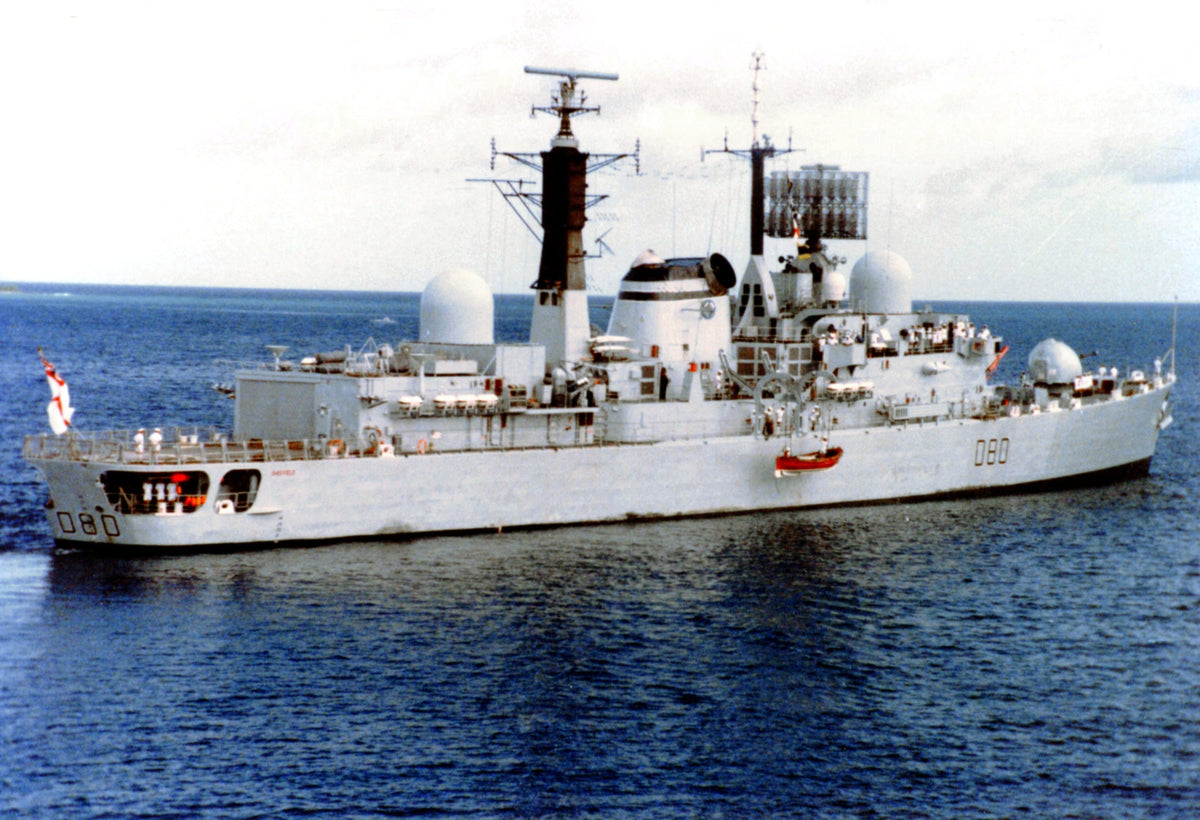
South Atlantic, 4 May 1982. HMS Sheffield was the first British warship lost to enemy action in the Falklands War. The weapon that hit her — the French-built AM39 Exocet — instantly became a symbol of the campaign. But the importance of the attack goes well beyond the missile itself.
The loss exposed a gap in British airborne early warning, demonstrated how difficult it was to detect a sea-skimming attack over the radar horizon, tested damage control under catastrophic conditions and changed how every ship in the Task Force thought about the Argentine Super Étendard threat.
It also became wrapped in myths. One of the most persistent concerns the missile warhead: early official investigations said the evidence suggested it may not have detonated, while a much later technical reassessment concluded that it did. An Iron Standard account has to preserve that distinction rather than pretend the record was always settled.
At a glance
- Date: 4 May 1982.
- Ship: HMS Sheffield (D80), Type 42 guided-missile destroyer.
- Commanding officer: Captain Sam Salt RN.
- Attacking aircraft: two Argentine Navy Super Étendards.
- Aircrew: Capitán de Corbeta Augusto Bedacarratz and Teniente de Fragata Armando Mayora.
- Weapon: AM39 Exocet anti-ship missile.
- Targeting support: Argentine Navy SP-2H Neptune maritime patrol aircraft.
- British dead: 20.
- Immediate result: ship abandoned after fire spread beyond the crew's ability to contain it; later sank while under tow.

The Type 42's job
Sheffield was a Type 42 destroyer built around the Sea Dart surface-to-air missile system. Her principal wartime function in the Task Force was air defence: detect hostile aircraft at range, contribute to the radar picture and engage targets before they could reach the high-value units.
The design reflected Cold War assumptions. In a NATO war, British ships expected to operate within a broader alliance system, including airborne early warning and other layers of surveillance. The South Atlantic removed much of that supporting architecture. The Task Force had fighter aircraft and powerful shipborne radars, but it did not have a dedicated airborne early-warning aircraft looking down from altitude.
The Argentine weapon system
The attack was not simply “an Exocet finding a ship.” It was a chain of sensors, aircraft, people and rehearsed procedures.
The Argentine Navy's 2 Escuadrilla Aeronaval de Caza y Ataque had received Dassault-Breguet Super Étendards and AM39 Exocets shortly before the war. Its crews had trained in France and then compressed further training into the opening weeks of the crisis. They developed long over-water profiles flown at very low altitude and in radio silence, supported by KC-130 tanker aircraft and maritime reconnaissance.
On 4 May the crucial targeting information came from an elderly SP-2H Neptune. Its crew detected surface contacts, plotted their position and transmitted coordinates to the incoming Super Étendards.

The approach
Bedacarratz and Mayora approached at very low level through poor South Atlantic weather. Rowland White reconstructs the final run with the aircraft below 100 feet and around 500 knots, remaining electronically quiet for as long as possible.
This was fundamental to the tactic. A sea-skimming aircraft could remain below a ship's radar horizon until comparatively close. The Super Étendard then had to climb briefly, use its Agave radar to acquire a target, launch and descend again.
The British problem was time. A short radar contact was not automatically enough to create a complete track, identify it, vector fighters, obtain an interception and engage before missile release.
The missing layer: airborne early warning
The Royal Navy had no dedicated airborne early-warning aircraft in the Task Force. Sea Harriers were flying combat air patrols and destroyers/frigates provided fighter direction and radar coverage, but the geometry favoured a low-level attacker coming from beyond the shipborne radar horizon.
HMS Glasgow obtained a brief radar indication associated with the incoming threat, but the contact did not become an interception in time. Sea Harriers were vectored toward an estimated position and found nothing.
White records Mayora reflecting afterwards that airborne early warning might have allowed the British to catch them. The Royal Navy drew the same broad lesson. The post-war conversion of Sea Kings to provide airborne early warning was one of the clearest material responses to the Falklands experience.
Read the Sea Harrier Falklands Field Note →
Explore this history
Continue from this Field Note into the closest Gallus campaign and military-history collection.
Launch
The Neptune's targeting data brought the Super Étendards into the correct area. At the final run-in, Bedacarratz and Mayora climbed enough to use their Agave radars, selected contacts and each launched an AM39 Exocet.
The missiles descended toward the sea and continued at very low level. One struck Sheffield on the starboard side amidships.
The other did not hit the destroyer.
The impact
The missile tore into the ship near the galley and machinery spaces. The impact and subsequent fire disabled critical services. Electrical power, communications and the ability to move water around the ship were badly affected at exactly the moment they were needed most.
Unspent missile propellant and combustible material intensified the fire. Smoke moved through internal spaces and the crew fought for hours to control a casualty that was spreading faster than the ship's systems could support them.
Did the Exocet warhead explode?
This is one of the details where the historical record changed over time.
The Ministry of Defence told Parliament later in 1982 that it was not possible to establish conclusively whether the warhead had exploded, although the indications then available suggested that it had not. That interpretation became widely repeated and was central to many early accounts of the sinking.
A later Ministry of Defence technical reassessment, publicised decades afterwards, concluded that the warhead did detonate as designed. That finding better fits some of the internal blast evidence, but it does not erase the fact that the original Board of Inquiry had reached a different view.
The responsible way to describe the event is therefore not “the warhead definitely failed,” nor to pretend the later assessment was known in 1982. The early official conclusion was uncertain and leaned toward non-detonation; the later technical reassessment concluded detonation.
The fight to save the ship
The ship's company fought the fire for approximately four hours. The damage was made much worse by the loss of electrical power, internal communications and effective water supply.
Firefighting at sea is always a race between compartmentation and spread. On Sheffield, smoke, heat and the failure of essential systems progressively reduced the areas from which crews could work safely.
Captain Sam Salt eventually ordered the ship abandoned. White records 266 survivors leaving the destroyer; twenty-four were injured, four seriously.
The twenty
Twenty members of Sheffield's ship's company were killed.
The tactical story matters, but those deaths are the reason the ship should never be reduced to a technology case study. The Exocet became famous; the men who died were not components in a weapons trial.
Falklands War Dead — Roll of Honour & Remembrance →
Why the ship was abandoned
The key point is not that a single missile automatically destroyed a Type 42. The combination of impact damage, fire, smoke and the loss of vital services made continued firefighting increasingly impossible.
The crew's inability to generate enough water where it was needed became critical. Internal communications were badly disrupted. Power loss affected pumps and systems. Heat and smoke prevented access to important compartments.
This is why post-war lessons from Sheffield extended far beyond missile defence into fire protection, cable routing, smoke control, material selection and damage-control resilience.
What happened after abandonment?
Sheffield did not sink immediately. Efforts were made to keep the abandoned destroyer afloat and later tow her.
Several days after the attack, while under tow in worsening weather, water entered through the missile-damaged area and the ship finally sank.
That sequence is important. The ship was lost because the damage and fire had made her untenable and because the damaged hull could not survive the later tow — not because she disappeared immediately after impact.
The Argentine perspective
For the pilots of 2 Escuadrilla the mission proved that the Super Étendard/Exocet system could penetrate the British screen and hit a modern warship.
Bedacarratz and Mayora did not know immediately that they had struck Sheffield. White records that their confirmation came from the BBC World Service after they returned to Río Grande.
The attack validated their low-level approach, tanker support, maritime targeting and missile integration. It also changed the psychology of the naval war. Every subsequent suspected Super Étendard launch forced British commanders to consider the possibility that a carrier or major amphibious ship was about to be attacked.
What Sheffield exposed
- Airborne early warning: shipborne radar and fighter patrols could not reliably replace a radar platform at altitude.
- Reaction time: a sea-skimming missile attack could compress the warning cycle to minutes.
- Sensor integration: a fleeting radar contact was useful only if it could be turned rapidly into a coherent track and engagement.
- Damage control: losing power, communications and water simultaneously could be as decisive as the initial physical damage.
- Electronic warfare: chaff, radar emissions, warning receivers and missile seekers became central to every later Exocet encounter.
- Carrier protection: the loss reinforced the determination to keep Hermes and Invincible at a distance whenever possible.
From Sheffield to Atlantic Conveyor
The attack on Sheffield was not the last successful Exocet strike of the war. On 25 May another pair of Super Étendards launched against the British force and hit Atlantic Conveyor.
The difference was operationally profound. Sheffield exposed a vulnerability in fleet air defence and ship survivability. Atlantic Conveyor removed a large package of helicopter lift, engineering material and support equipment that the land campaign expected to use.
Atlantic Conveyor 25 May 1982 — Complete Field Guide →
The Iron Standard conclusion
The sinking of HMS Sheffield is often described as the moment the Falklands War became real to the British public. Militarily, it was also the moment one of the campaign's key weaknesses became impossible to ignore.
The Argentine attack was professionally assembled: reconnaissance, tanker support, low-level navigation, disciplined emissions control and a modern stand-off missile. British defences were not worthless — they were incomplete. Without airborne early warning, the Task Force depended heavily on ship radar horizons and short reaction times.
The lesson was not “Exocet was unstoppable.” Later attacks were met with improved warning, manoeuvre, electronic countermeasures and better understanding of the threat. The lesson was that a modern fleet's defensive system is only as strong as the gaps between its layers.
Related Falklands Field Notes
- Falklands War 1982 — Complete Campaign Field Guide
- Sea Harrier in the Falklands 1982
- Atlantic Conveyor 25 May 1982
- San Carlos 21 May 1982
Argentine Air War 1982 — how the Super Étendard/Exocet force fitted into the wider campaign →
Continue exploring
Sources & further reading
- Rowland White, Harrier 809 — used for the Argentine mission sequence, Neptune targeting, Bedacarratz and Mayora, the Sea Harrier response and the human context around the attack.
- Lawrence Freedman, The Official History of the Falklands Campaign, Volume II: War and Diplomacy — used for Task Force context and the official operational record.
- David Jordan, “Corporate Lessons? Reflections on Some of the Myths, Anti-Myths and Omissions of Britain’s Falklands Air War, 1982”, Air and Space Power Review — used for airborne early warning and post-war air-defence lessons.
- UK Parliament, House of Commons written answer, 22 November 1982 — contemporary MOD position on whether the Exocet warhead detonated.
- Ministry of Defence, Desider, May 2016 — later technical reassessment of the warhead detonation.
- UK Parliament, House of Commons, July 1982 — circumstances of Sheffield's sinking while under tow.
