


Gloster Hill 235 at Imjin River 1951: Last Stand, Breakout & Captivity — Complete Field Guide
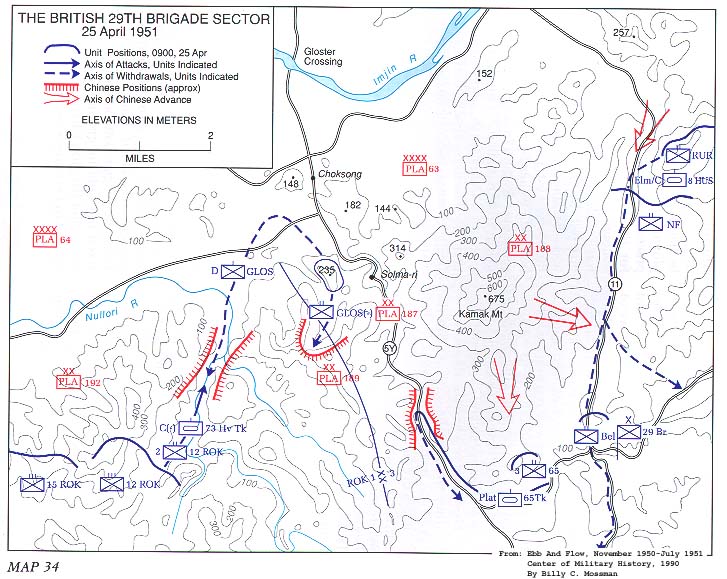
Gloster Hill was not a separate battle from the Imjin. It was the final, concentrated phase of the Gloucestershire Regiment's defence when a brigade battle narrowed into a fight for one ridge.
Between 22 and 25 April 1951, the Chinese Spring Offensive struck the United Nations line north of Seoul. The British 29th Independent Infantry Brigade Group was ordered to hold crossings and high ground around the Imjin River. Its battalions were spread over a wide front. For 1st Battalion, The Gloucestershire Regiment, the battle ended on Hill 235, later remembered as Gloster Hill.
This Field Note should be read with the wider Battle of the Imjin River 1951 complete guide and the Korean War 1950–1953 British & Commonwealth campaign guide. Here the focus is narrower: the ground, the battalion's isolation, the last stand, the attempted breakout and what followed in captivity.
Why Hill 235 mattered
The Imjin position was not a continuous trench line. The brigade held a series of hills, tracks and crossings across broken country. That spacing gave the defenders observation and fields of fire, but it also created gaps that could be exploited by attackers moving at night and using the folds of the ground.
The Gloucesters occupied positions around the Imjin and later concentrated on Hill 235. The ridge dominated approaches and offered a defensible position, but once Chinese forces moved around the battalion the same height that gave observation also made withdrawal increasingly difficult. A hill can be tactically strong and operationally dangerous at the same time.
The wider order of battle
29th Brigade included 1st Gloucestershire Regiment, 1st Royal Northumberland Fusiliers, 1st Royal Ulster Rifles and 8th King's Royal Irish Hussars, supported by artillery and other brigade troops. Chinese forces belonged to the People's Volunteer Army and attacked in strength as part of the Fifth Phase Offensive.
The brigade was not expected to defeat the Chinese offensive by itself. Its task was to delay, disrupt and buy time while the United Nations line adjusted. That distinction matters when judging the battle. A withdrawal after three days does not automatically mean the defence failed in operational terms.
22–23 April: the line begins to close
Chinese forces crossed the Imjin during the night of 22–23 April and began infiltrating between defended localities. The British positions were hit repeatedly. Communications became harder, routes became threatened and ammunition expenditure rose. The defenders could not simply look down a road and see one enemy column approaching. Attacks came through valleys, over slopes and around flanks.
The Gloucesters fought on several features before the battalion contracted toward Hill 235. By then the problem was no longer merely holding a forward position. It was maintaining a route out while under pressure from forces that were increasingly behind and beside the battalion as well as in front.
Hill 235 becomes Gloster Hill
On 24 April the battalion's defence centred on Hill 235. Lieutenant-Colonel James Carne commanded the Gloucesters. Companies were depleted, communications were uncertain and resupply was increasingly difficult. The Chinese continued to attack, often at close range and at night.
The popular image of a last stand can become too theatrical. The reality was more practical and more desperate. Platoons had to redistribute ammunition, move wounded, keep Bren guns and mortars supplied, re-establish positions after local penetrations and try to understand where neighbouring units still were. Men who had already been fighting for two nights faced another cycle of attacks with little sleep.
Carne's leadership became central because a battalion cut off from easy movement needs clear priorities. The Gloucesters were ordered to hold as long as possible. Their resistance delayed Chinese forces and contributed to the wider brigade action, but the price was that the battalion's escape window narrowed.
Explore this history
Continue from this Field Note into the closest Gallus campaign and military-history collection.
The attempted breakout
By 25 April, continued defence of the hill could not be sustained indefinitely. Permission was given to attempt a withdrawal. Small groups tried to break through toward friendly lines. The terrain that had sheltered movement on the way in now favoured the forces surrounding them.
Major Mike Harvey led the remnants of D Company in one of the successful breakout groups. Others were killed, wounded or captured. Carne himself became a prisoner. The battalion effectively ceased to exist as a fighting formation in the immediate aftermath, although survivors and replacements later rebuilt it.
The fact that some men escaped should not obscure how complete the encirclement had become. Nor should the number captured be treated as evidence of a simple collapse. Many were taken only after prolonged fighting, failed breakout attempts or when wounded and without realistic means of escape.
Casualties and prisoners
The Gloucesters suffered very heavy losses at the Imjin. Exact totals vary according to how sources classify killed, wounded, missing and later-confirmed prisoners, but the battalion lost the majority of the men committed to the battle through death, wounds or captivity. Hundreds became prisoners of war.
For those captured, the battle did not end on 25 April. Prisoners faced forced marches, inadequate food, disease, cold, interrogation and long months or years in captivity. The Korean War prisoner experience deserves its own place in the story because treating capture as a line in a casualty table hides what followed.
James Carne and command under encirclement
Lieutenant-Colonel James Carne was awarded the Victoria Cross for his leadership during the battle. His citation emphasised repeated movement around the positions under fire and his role in sustaining the defence. The medal is important, but focusing only on one commander can hide the distributed nature of the battalion's resistance.
Company commanders, platoon commanders, NCOs, signallers, stretcher-bearers and weapon crews all had to keep functioning as the formal battle picture broke apart. On an isolated hill, command is as much about keeping small groups coherent as it is about issuing grand orders.
What the battle achieved
The Imjin defence delayed the Chinese advance toward Seoul and gave United Nations forces time to establish a stronger defensive line. The Gloucesters did not stop the offensive alone, and the Chinese were not defeated on Hill 235. Their stand was one part of a larger defensive action involving the rest of 29th Brigade and neighbouring formations, including fighting around Kapyong.
The correct measure is therefore not 'did they hold the hill permanently?' They did not. The more useful question is whether the time bought and losses imposed helped the wider force avoid a breakthrough. On that measure, the action mattered far beyond the ridge.
Myths and evidence
“The Gloucesters fought alone.”
No. They became isolated, but the battle belonged to 29th Brigade and the wider UN defence.
“Gloster Hill was the whole Battle of the Imjin.”
No. Hill 235 was the final concentration of the Gloucesters' action within a much wider three-day battle.
“The battalion surrendered as a unit.”
No. Groups attempted to break out; some escaped, others were killed or captured. The end came through fragmentation under encirclement rather than one neat parade-ground surrender.
“The battle was pointless because the hill was lost.”
That ignores the operational purpose of delaying a larger offensive. Ground was lost, but time was gained.
Gloster Hill today
Hill 235 lies close to the Imjin battlefield and is remembered through memorials in Korea and by the Gloucestershire Regiment's successors. The terrain remains the best explanation of the action: steep slopes, narrow routes and interlocking hills make clear why a battalion could be simultaneously strong on its position and dangerously isolated from its neighbours.
For battlefield study, use modern mapping only as a starting point. Compare ridgelines and river crossings with period operational maps. The shape of the ground survived; roads, vegetation and settlement have changed.
Remembrance
The Gloucesters' stand became one of the defining British memories of the Korean War. It should not eclipse the other British, Commonwealth, Korean, American and Chinese soldiers who fought across the same offensive. Nor should remembrance end with the killed. The experience of prisoners and families waiting for news belongs to the story as well.
This section is deliberately non-commercial. Names, graves and captivity are not a sales funnel.
Continue exploring
Sources and evidence used
- National Army Museum — Battle of the Imjin River, for the wider battle, 29th Brigade and the stand of the Gloucesters.
- National Army Museum — Korean War, for campaign context, British service and the later fighting around the Hook.
- British official and regimental histories of the Korean War, including Gloucestershire Regiment accounts and 29th Brigade records.
- United Nations and Commonwealth campaign histories for the Chinese Spring Offensive and the wider defensive line north of Seoul.
Evidence note: casualty and prisoner totals differ slightly between contemporary returns, regimental histories and later compilations. Where the evidence is not identical, this Field Note avoids forcing a false precision.
Related Field Notes
CONTINUE THE STORY
More from this campaign
Read it, reference it or wear it — the related pieces are kept together here.
FEATURED DESIGN

Imjin River 1951 T-Shirt — Korean War Heritage
€29,95 EUR
View the design →FIELD NOTES
Get new Field Notes by email
New research, campaign guides and useful references without a daily sales barrage.
