


Korean War 1950–1953: Complete British & Commonwealth Campaign Guide
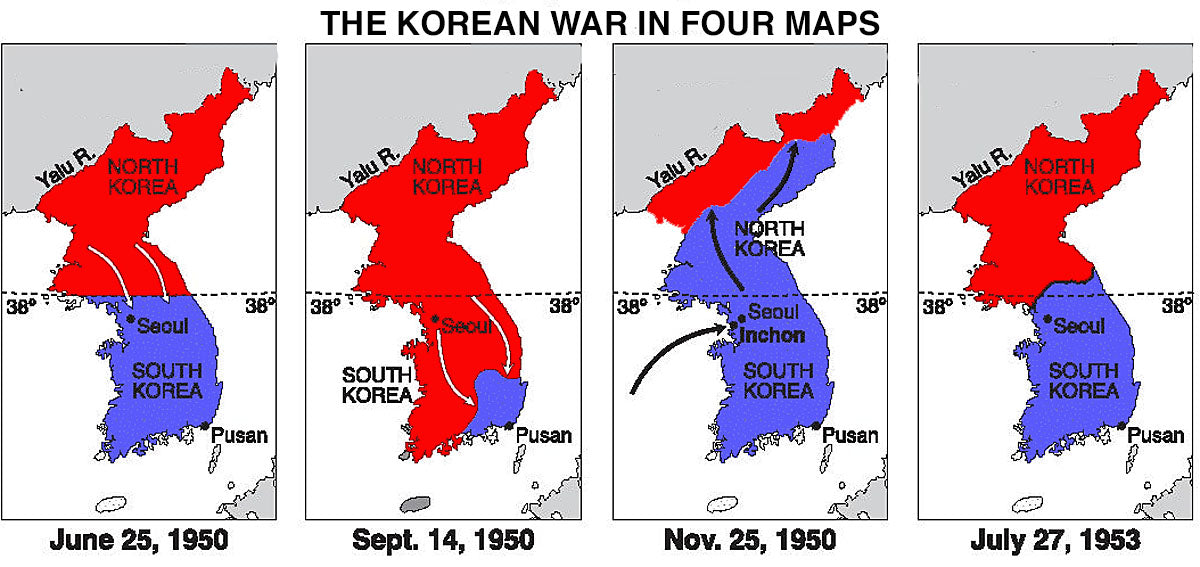
Korea, 1950–1953. The Korean War began as a civil and interstate conflict on a divided peninsula and became the first major shooting war of the Cold War. North Korean invasion, United Nations intervention, Chinese entry, Soviet support, nuclear-age escalation fears and three years of conventional fighting all collided in one theatre.
For Britain, Korea was also a transition war. Men who had grown up during the Second World War were sent east in a force that mixed Regulars, reservists and National Servicemen. British battalions fought first in improvised brigade groups and later inside the 1st Commonwealth Division alongside Australians, Canadians, New Zealanders and other allied contingents.
The British experience cannot be reduced to the Glosters at the Imjin. It began with emergency deployment from Hong Kong, continued through mobile fighting, retreat, counter-offensive and the battles of April 1951, and ended in a static war of trenches, patrols, artillery and contested hills while diplomats negotiated at Panmunjom.

At a glance
- War: Korean War.
- Dates: 25 June 1950 – 27 July 1953.
- Immediate trigger: North Korea's invasion of South Korea.
- UN command: United States-led multinational force acting under United Nations authority.
- Communist forces: North Korea, later reinforced on a vast scale by the Chinese People's Volunteer Army, with major Soviet material, diplomatic and air support.
- British service: around 60,000 members of the British armed forces served in Korea; many were National Servicemen.
- British losses: more than 1,100 killed and around 2,600 wounded according to the National Army Museum.
- End: armistice rather than peace treaty; fighting stopped but the political division of Korea remained.
Before the war: why there were two Koreas
Korea had been under Japanese rule from 1910 until the end of the Second World War. In 1945 Soviet troops entered from the north while American forces moved into the south. The peninsula was divided around the 38th Parallel as an occupation arrangement, but the emerging Cold War turned the temporary division into a political frontier.
Two rival states were established in 1948: the Republic of Korea in the south under Syngman Rhee and the Democratic People's Republic of Korea in the north under Kim Il-sung. Both claimed authority over the entire peninsula. Border clashes, insurgency and political violence preceded the formal outbreak of war.
William Stueck's international history is useful here because it avoids treating Korea as a simple US-Soviet chessboard. Korean political conflict mattered in its own right, but the division became inseparable from superpower competition, the Chinese revolution and the developing Cold War security system.
25 June 1950: invasion
North Korean forces crossed the 38th Parallel on 25 June 1950. Soviet-supplied armour and a better-prepared army gave the North an immediate advantage. Seoul fell quickly and South Korean and American forces were driven down the peninsula.
The United Nations Security Council called for military assistance to South Korea. The United States supplied the majority of UN combat power, but a multinational force developed around it.
The Pusan perimeter
By August 1950 the UN position had contracted to a defensive perimeter around the south-eastern port of Pusan, now Busan. The campaign had become a race between reinforcement and collapse.
The first British ground troops came from Hong Kong. 1st Battalion, Middlesex Regiment and 1st Battalion, Argyll and Sutherland Highlanders sailed in August 1950. They formed 27th British Infantry Brigade and entered combat during the breakout from the perimeter.
3rd Battalion, Royal Australian Regiment arrived shortly afterwards. With its arrival, the formation became the 27th British Commonwealth Infantry Brigade. The arrangement foreshadowed the larger Commonwealth structure that followed.
Inchon and the advance north
On 15 September General Douglas MacArthur launched the amphibious landing at Inchon. The operation struck deep behind North Korean forces while Eighth Army broke out of the Pusan perimeter.
The North Korean army's position collapsed rapidly. Seoul was retaken and UN forces moved north of the 38th Parallel. Pyongyang fell and units advanced toward the Yalu River and the Chinese frontier.
At this point the political aim of the war changed. The original objective had been to repel the invasion and restore South Korea. The advance north opened the possibility of reunifying the peninsula by force.
China enters the war
China had warned that it would not simply accept hostile forces advancing to its frontier. Chinese People's Volunteer Army formations entered Korea and initially fought on a limited scale before launching much larger attacks in November 1950.
The UN advance reversed. In severe winter conditions, forces retreated south. Seoul changed hands again. The war that had seemed close to ending now threatened to escalate beyond Korea.
Stueck shows why this stage mattered internationally. Britain and Canada were among the US allies pressing Washington against steps that could widen the conflict into China and potentially draw in the Soviet Union directly. The United Nations alliance was not simply an American command with passive partners; allied governments sometimes acted as restraints on US escalation.
MacArthur, Truman and limited war
MacArthur argued publicly and privately for a broader approach toward China. President Harry Truman's administration was determined to contain the war.
The dispute was about more than personality. It was about what victory meant in a nuclear age. The United States had the power to expand the conflict, but doing so could produce Chinese escalation, Soviet intervention or a wider world war.
Truman relieved MacArthur on 11 April 1951. Matthew Ridgway succeeded him in the Far East, while James Van Fleet took command of Eighth Army.
Read the Douglas MacArthur Field Note →
Ridgway and the recovery of Eighth Army
Ridgway had taken command of Eighth Army after Lieutenant General Walton Walker was killed in December 1950. He restored confidence, emphasised aggressive patrolling, firepower and limited advances tied to defensible ground rather than another headlong drive toward the Yalu.
Operations including Thunderbolt and subsequent offensives moved the line north again. Seoul was retaken. By April 1951 UN forces had established themselves around the Kansas Line.
The Chinese now prepared their own major effort.
April 1951: Imjin and Kapyong
The Chinese Fifth Phase, or Spring, Offensive began on 22 April. Two battles became central to British and Commonwealth memory.
On the Imjin River, 29th British Independent Infantry Brigade Group faced the Chinese 63rd Army. The brigade held an extended front. Chinese infiltration penetrated gaps between battalions and progressively cut roads and rear areas. 1st Battalion, Gloucestershire Regiment became isolated around Hill 235 and most of the battalion was killed, wounded or captured.
Battle of the Imjin River 1951 — Complete Field Guide →
At Kapyong, 27th British Commonwealth Brigade blocked another route south. 3rd Battalion, Royal Australian Regiment fought around Hill 504 and withdrew under pressure; 2nd Battalion, Princess Patricia's Canadian Light Infantry held Hill 677 through repeated night attacks. New Zealand artillery and American armour were critical to the defence.
Battle of Kapyong 1951 — Complete Field Guide →
Why Imjin and Kapyong need to be read together
S. P. MacKenzie's study is valuable because it refuses to let national memory separate the two actions. They happened at the same time against the same broader offensive.
At both battles, infantry defended isolated hill positions under night attack. Both formations experienced confusion and gaps in knowledge. Yet casualty levels were dramatically different. 29 Brigade at Imjin lost roughly ten times as many men as 27th Commonwealth Brigade at Kapyong in MacKenzie's comparison.
The explanation is not that one force was brave and the other was not. Terrain, Chinese reconnaissance, withdrawal routes, artillery support, higher-command relationships and timing all mattered.
The creation of 1st Commonwealth Division
By mid-1951 Commonwealth forces were consolidated into a divisional structure. The 1st Commonwealth Division brought British, Australian, Canadian and New Zealand forces together under one headquarters.
The Australian War Memorial's war-diary collection preserves the administrative trail of this change. Its records show the 27th British/Commonwealth Brigade in the early phase, the later 28th Commonwealth Brigade and the creation of divisional headquarters during 1951.
This organisation mattered because the war itself was changing. The mobile campaign of sweeping advances and retreats was giving way to a positional struggle.
From mobile war to trenches
By July 1951 armistice negotiations had begun. The front stabilised close to the line eventually used for the Demilitarized Zone.
That did not mean the war became quiet. For the soldier, the later phase was an attritional war of patrols, raids, artillery, bunkers, mines and contested hills. Units still suffered casualties while diplomats argued over the ceasefire line and prisoners of war.
The uploaded British oral histories show just how different this felt from the mobile campaign. Veterans who arrived earlier remembered marching, rapid moves and changing fronts; later arrivals described trench routine, night patrols and sudden violence from apparently static positions. A Forgotten British War explicitly contrasts these experiences.
Operation Commando and the Hook
In October 1951 the 1st Commonwealth Division took part in Operation Commando, a limited offensive intended to improve the UN line and dominate important ground while negotiations continued.
One of the most contested features in the later war became the Hook, a ridge system overlooking approaches in the Imjin sector. British battalions fought repeated defensive actions there, including the Black Watch in November 1952 and the Duke of Wellington's Regiment in May 1953.
The Hook demonstrates how much the character of the war had changed since April 1951. Positions were deeper and more heavily prepared. Artillery plans, bunkers, wire and minefields mattered enormously. The war was now about local ground within a strategic stalemate.
The air war
Air power operated on a scale far beyond the ground battles familiar in British memory. UN aircraft attacked North Korean communications, supply networks and forces. In the north-west, jet combat between F-86 Sabres and MiG-15s created the famous 'MiG Alley'.
Douglas Dildy's Fury from the North is particularly useful because it reconstructs the much less familiar North Korean air-force story. He draws on Soviet records, Chinese archival research and declassified US intelligence to show that the Korean People's Air Force was not simply absent once UN air power gained superiority. It rebuilt, adapted and continued operating, including night missions and jet-era development.
The Soviet role was also deeper than public acknowledgement at the time. Soviet pilots flew combat missions while Soviet and Chinese support helped sustain the Communist air war.
The naval war
Royal Navy and allied naval forces helped maintain the blockade, supported amphibious operations, bombarded coastal targets and flew carrier aircraft. Korea was therefore a genuinely joint war even though British popular memory tends to focus on infantry battles.
Sea control allowed the UN to move men and supplies around the peninsula and made another North Korean attempt to isolate the south by sea extremely difficult.
What British soldiers actually experienced
The strategic maps can make Korea look abstract. The oral histories do the opposite.
National Service
Many British soldiers in Korea were National Servicemen. Some volunteered for deployment or extended service; others simply went where the Army sent them. For young men who had barely travelled within Britain, Korea could be their first experience of Asia, combat and prolonged separation from home.
Cold
Korean winters were severe. Veterans in A Forgotten British War remembered temperatures falling to around -40°C during the 1950–51 winter, frozen food and difficulty handling weapons and equipment. American insulated clothing was highly valued when British kit proved inadequate.
Heat
Summer could be the opposite: heat, insects, mud and monsoon conditions. The same war demanded clothing and field routines for climatic extremes.
Weapons
British soldiers were still using weapons closely associated with the Second World War: Lee-Enfield rifles, Bren guns, Sten guns, Vickers/Browning machine guns, mortars and 25-pounder artillery. Veterans often compared their equipment with American supplies and weapons.
Patrols
Once the line stabilised, night patrols became one of the defining experiences. Veterans described moving in darkness through terrain where silence itself could become threatening. The later war could be monotonous for hours and then suddenly violent at very close range.
A Commonwealth war
British troops did not fight alone. Australians, Canadians and New Zealanders became integral parts of the Commonwealth formation. Indian medical personnel also served, and the wider UN force included troops from many countries.
The soldier-level evidence is useful because it shows coalition warfare as ordinary experience rather than diplomatic abstraction. British veterans remembered American food and clothing, Australian humour, New Zealand artillery and medical support from other allied nations.
The armistice talks
Negotiations opened in July 1951, first at Kaesong and later at Panmunjom. They dragged on for two years.
The core difficulty was not simply where to draw the line. Prisoners of war became one of the most contentious issues. Many Communist prisoners did not want repatriation, while China and North Korea demanded return. Fighting continued while negotiators argued over the terms.
Stueck's book is especially strong on this phase. His chapters move from the origins of the talks through progress, deadlock and the final agreement, showing how military operations and diplomacy were tied together rather than existing as separate stories.
27 July 1953: armistice
The armistice was signed on 27 July 1953. It ended organised large-scale hostilities and created the military arrangements that produced the Demilitarized Zone.
It was not a peace treaty. The political division of the peninsula remained.
Casualties
The Korean War was catastrophic for Koreans. Military and civilian losses ran into the millions, and cities changed hands repeatedly.
For Britain, the National Army Museum records more than 1,100 dead and around 2,600 wounded among roughly 60,000 British personnel who served. More than 880 British dead are buried in the United Nations Memorial Cemetery in Busan.
Numbers for North Korean, Chinese and civilian casualties vary sharply depending on source and methodology. Iron Standard rule applies here too: where historians disagree, a false single number is less useful than explaining the range and why the evidence is difficult.
Why Korea became Britain's 'forgotten war'
The phrase is imperfect, but the problem is real.
The Second World War had ended only five years before Korea began. British public attention was also occupied by austerity, decolonisation, Malaya, the emerging nuclear confrontation and domestic change. Korea was geographically distant and difficult to report visually in an era before television news became routine.
The oral-history collection A Forgotten British War was created specifically because veterans felt their service had faded from British public consciousness even while South Korea continued to honour them. Its contributors describe a striking contrast between Korean gratitude and the weak memory of the war at home.
What the war changed
The Korean War hardened the Cold War. Western rearmament accelerated, NATO became militarily stronger, American commitments in Asia expanded and China emerged as a major military power.
Stueck argues that the conflict's impact was global despite its limited geography. The war drove major Western military expansion and reinforced alliance systems far beyond Korea.
It also demonstrated the logic of limited war. Major powers could fight intensely without pursuing unconditional victory if the risk of escalation became unacceptable. Korea became one of the clearest early examples of that nuclear-age constraint.
The Gallus view
Korea is best understood at three levels at once.
- Strategic: a Cold War confrontation that risked escalation beyond the peninsula.
- Operational: a campaign that swung from invasion to counter-offensive, Chinese intervention, recovery and stalemate.
- Human: young soldiers living in extreme weather, carrying old kit, digging positions, patrolling at night and trying to understand a war thousands of miles from home.
Remove any one of those levels and the story becomes thinner.
Wear the history
Imjin River 1951 T-Shirt — Korean War Heritage →
Kapyong 1951 Battle Scene T-Shirt →
Core Korean War Field Notes
- Battle of the Imjin River 1951 — Gloster Hill, 29 Brigade & the Chinese Spring Offensive
- Battle of Kapyong 1951 — Hill 504, Hill 677 & the Commonwealth Defence
- General Douglas MacArthur — Pacific Command, Japan & Korea
Sources & further reading
- William Stueck, The Korean War: An International History (Princeton University Press, 1995).
- S. P. MacKenzie, The Imjin and Kapyong Battles, Korea, 1951 (Indiana University Press, 2013).
- Gerry van Tonder, Korean War: Imjin River — Fall of the Glosters to the Armistice, April 1951–July 1953 (Pen & Sword Military, 2020).
- Michael Patrick Cullinane and Iain Johnston-White (eds.), A Forgotten British War: The Accounts of Korean War Veterans (Palgrave Macmillan, 2023).
- Stephen F. Kelly, British Soldiers of the Korean War (The History Press, 2013).
- The Korean War 1950–1953, Osprey Essential Histories.
- Douglas C. Dildy, Fury from the North: The North Korean Air Force in the Korean War 1950–1953 (Helion, 2019).
- National Army Museum — Korean War.
- National Army Museum — Battle of the Imjin River.
- Australian War Memorial — Korean War unit diaries, British brigades and Commonwealth Division Headquarters.
CONTINUE THE STORY
More from this campaign
Read it, reference it or wear it — the related pieces are kept together here.
FEATURED DESIGN
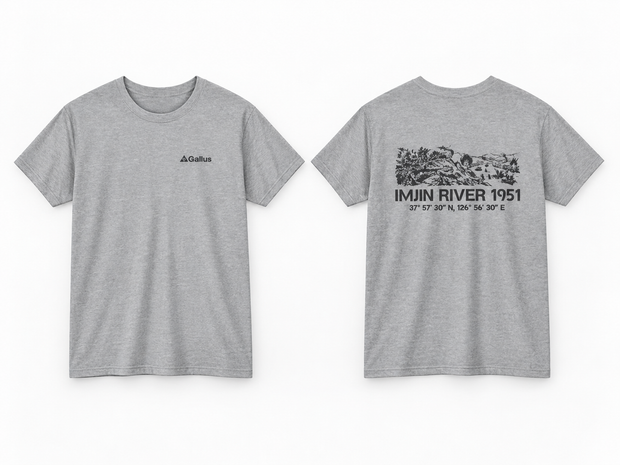
Imjin River 1951 T-Shirt — Korean War Heritage
€29,95 EUR
View the design →FIELD NOTES
Get new Field Notes by email
New research, campaign guides and useful references without a daily sales barrage.
