


Battle of the Imjin River 1951: Complete Field Guide — Gloster Hill, 29 Brigade & the Chinese Spring Offensive
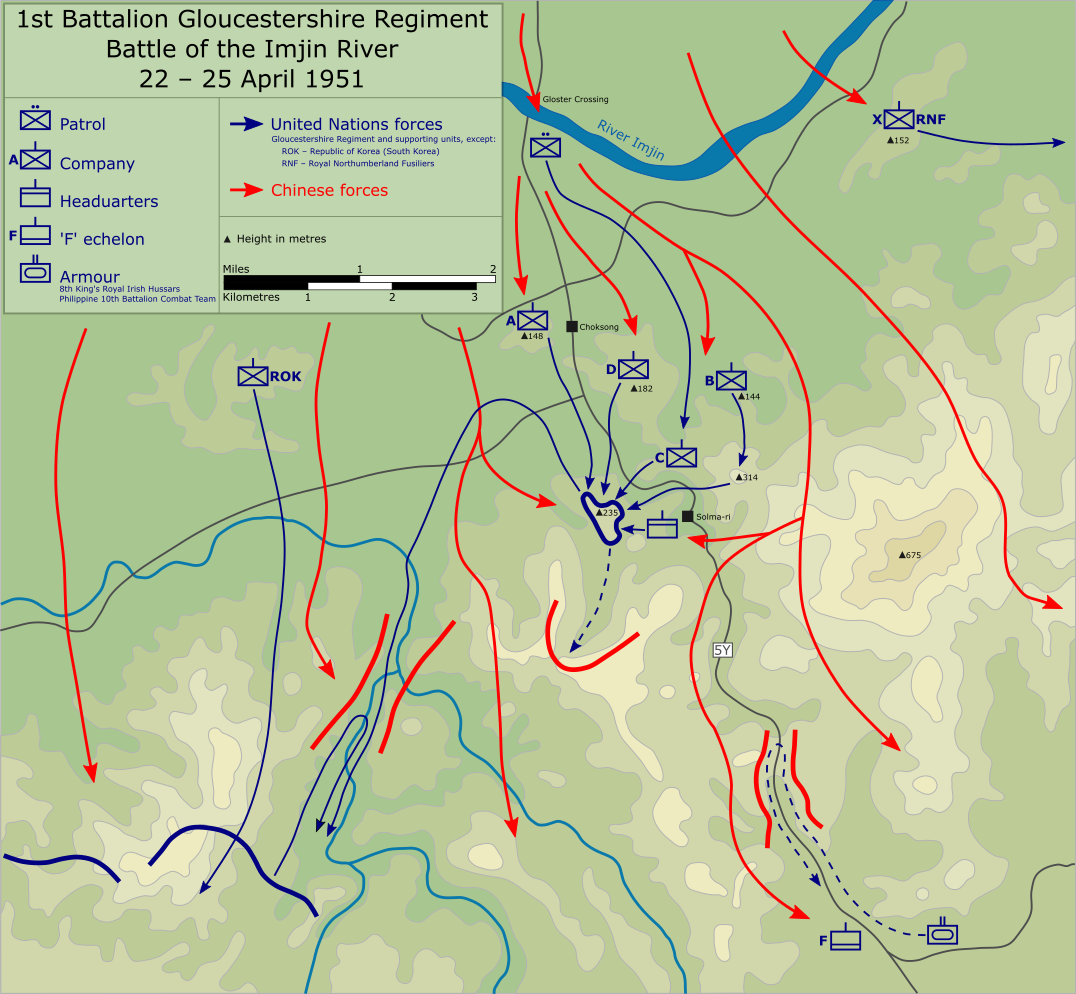
Imjin River, 22–25 April 1951. For British troops in Korea, no battle became more closely associated with sacrifice than the fighting on the Imjin. The last stand of 1st Battalion, The Gloucestershire Regiment on Hill 235 became the dominant image: a battalion surrounded, short of ammunition, still holding while the Chinese Spring Offensive drove south.
That image is real, but it is not the whole battle. The Imjin was fought by an entire brigade group across a frontage too wide for the force available. Royal Northumberland Fusiliers, Royal Ulster Rifles, Belgian troops, Royal Artillery, mortarmen, engineers and Centurion crews all fought through the same crisis. The battle also contained mistakes in intelligence, command and withdrawal planning that later heroic retellings often pushed into the background.
This Field Note treats both parts seriously. The courage deserves remembering. So does the question of why the Glosters were left in a position from which most of them could not escape.
At a glance
- Battle: Battle of the Imjin River, also associated with Solma-ri and Gloster Hill.
- Dates: 22–25 April 1951.
- War: Korean War, 1950–1953.
- UN formation: 29th British Independent Infantry Brigade Group, attached to the US 3rd Infantry Division.
- Principal British infantry: 1st Battalion Royal Northumberland Fusiliers, 1st Battalion Gloucestershire Regiment, 1st Battalion Royal Ulster Rifles.
- Other troops: Belgian United Nations Command battalion, 45th Field Regiment Royal Artillery, 170th Independent Mortar Battery, 8th King's Royal Irish Hussars and supporting engineers and other arms.
- Chinese force: the 63rd Army of the Chinese People's Volunteer Army, part of the wider Chinese Fifth Phase / Spring Offensive.
- Best-known ground: Gloster Crossing, Solma-ri, Kamak-san and Hill 235 — afterwards known as Gloster Hill.

The political road to the Imjin
Korea had been divided at the end of the Second World War after Japanese rule collapsed. Soviet forces occupied the north and American forces the south. Rival governments emerged on either side of the 38th Parallel, each claiming legitimacy over the peninsula.
North Korea invaded South Korea on 25 June 1950. A United Nations force, dominated by the United States but including Britain and other allies, intervened in support of the Republic of Korea. The war then changed direction repeatedly: North Korean forces drove the defenders back to the Pusan perimeter; the Inchon landing and UN counter-offensive carried the war north; Chinese intervention in late 1950 then forced the UN armies back again.
By early 1951 Lieutenant General Matthew Ridgway had rebuilt the fighting confidence of Eighth Army. UN forces pushed north again, recaptured Seoul and established positions around and beyond the 38th Parallel. The war was becoming a contest over whether either side could still generate a decisive breakthrough.
The strategic argument above the battlefield was equally tense. General Douglas MacArthur wanted wider freedom to attack Chinese power. President Harry Truman and allied governments feared escalation into a much larger war. MacArthur was relieved on 11 April 1951, only eleven days before the Chinese offensive struck the Imjin. The battle therefore took place at the point where the Korean War was becoming the defining example of a limited war fought under nuclear-age political constraints.
Read the Korean War 1950–1953 campaign guide →
The Chinese Spring Offensive
The Chinese command sought to regain the initiative after the UN advance of January–April 1951. The offensive that opened on 22 April struck across a broad front. The Imjin sector lay on the western approach toward Seoul.
The Chinese method presented a difficult problem for defenders. Attacks were often launched at night, using infiltration through valleys and gaps rather than simply battering frontally against the strongest point. Bugles, whistles and flares became part of the soundscape remembered by UN troops, but the more important tactical feature was movement: Chinese units tried to get around hill positions, sever roads and attack command posts, guns and supply areas from unexpected directions.
At the Imjin, this mattered because 29 Brigade was holding a frontage better suited to a larger formation.
The ground: why the map matters
The Imjin River curved across the brigade front. South of it rose a series of steep hills divided by valleys and tracks. Kamak-san dominated the area between British battalions. Hilltop positions could be strong locally, but a battalion on one feature could be physically separated from the next.
The British line had been treated as temporary. Positions were not protected by the depth of wire, mines and prepared communications that a long-term defensive zone would normally demand. The battalions were dispersed and could not always support each other directly.
Roads were equally important. Route 11 became the main withdrawal axis for much of the brigade. In the Gloster sector, the valley south from Solma-ri was both a line of supply and, once Chinese troops occupied surrounding heights, a trap.
The key point is that isolated hill positions were not automatically isolated tactically. They became isolated when Chinese infiltration took the valleys, cut communications and threatened the roads behind them.
29 Brigade: order of battle
| Formation / unit | Role at the Imjin |
|---|---|
| 29th British Independent Infantry Brigade Group | Brigade formation holding the Imjin sector under Brigadier Tom Brodie. |
| 1st Battalion, Royal Northumberland Fusiliers | Infantry defending the central/eastern portion of the brigade front. |
| 1st Battalion, Gloucestershire Regiment | Infantry on the western sector around Gloster Crossing and Solma-ri. |
| 1st Battalion, Royal Ulster Rifles | Infantry holding ground around Hill 398 and Route 11 and later fighting through the withdrawal. |
| Belgian United Nations Command battalion | Initially north of the river, later withdrew and took blocking positions. |
| 45th Field Regiment, Royal Artillery | 25-pounder fire support across the brigade front. |
| 170th Independent Mortar Battery, Royal Artillery | 4.2-inch heavy mortar support; C Troop fought with the Glosters and shared their US Presidential Unit Citation. |
| 8th King's Royal Irish Hussars | Centurion tanks used for direct fire, casualty evacuation, route clearance and withdrawal support. |
Key personalities
Brigadier Tom Brodie
Brodie commanded 29 Brigade. His problem was larger than the Glosters: he had to maintain an extended front while Chinese forces penetrated between his battalions and threatened the brigade's withdrawal routes. Post-war analysis has focused heavily on how information about the scale of the Chinese penetration moved between battalion, brigade, US divisional and corps headquarters.
Lieutenant-Colonel James Power Carne VC DSO
Carne commanded 1st Gloucesters. His battalion bore the most famous part of the battle and was eventually concentrated on Hill 235. Carne remained with his men after encirclement and was captured. He later received the Victoria Cross.

Lance-Bombardier Tommy Clough — 170th Independent Mortar Battery
Tommy Clough was only nineteen during the Imjin fighting, but he was already a Regular soldier. He served with 170th Independent Mortar Battery, Royal Artillery, whose 4.2-inch mortar troops were attached directly to the infantry battalions. Clough's troop supported the Gloucesters so closely that, as he later remembered, the mortarmen effectively became part of the battalion's fighting system rather than a detached artillery element.
His testimony is valuable because it sits below brigade and battalion headquarters. He remembered cold, kit shortages, overextended positions, the shock of seeing the scale of the Chinese advance, the physical work of keeping heavy mortars firing, Hill 235, the failed breakout and more than two years as a prisoner of war. Where his later recollections move into strategic or casualty estimates, this Field Note keeps them separate from the stronger documentary evidence used elsewhere.
Major Mike Harvey
Harvey commanded D Company during the final breakout. Instead of taking the obvious direct route south, his party initially moved north and then west before turning toward friendly lines. A portion of the group survived the difficult movement through Chinese-held ground. D Company's escape became the principal exception to the capture of most of the battalion.
Peng Dehuai and the Chinese command
Peng Dehuai commanded Chinese forces in Korea. In the Imjin sector, the 63rd Army drove against 29 Brigade as one part of the much larger offensive. The Chinese achievement was not simply numerical pressure: reconnaissance before the attack had identified gaps between British positions, and the attackers repeatedly exploited ground the brigade could not continuously occupy.
22 April: the crossings begin
During 22 April there were signs of enemy movement north of the river. Listening posts and patrols detected activity, but the full scale of the offensive was not yet clear across the brigade.
In the Gloster sector, Carne reacted cautiously to reports near Gloster Crossing. A patrol under Lieutenant Guy Temple was placed near the river. Late that night Chinese soldiers began crossing. The patrol engaged them and called for artillery support. The crossing developed from a small contact into a major assault.
The 25-pounders of 45th Field Regiment fired heavily. The Chinese continued to cross.
Elsewhere the Royal Northumberland Fusiliers were also attacked. What initially looked like separate local battles was becoming a brigade-wide penetration.
23 April: the brigade front starts to come apart
By daylight the Chinese were inside the British defensive system. Some attackers lay up during daylight to reduce exposure to UN air power; others occupied heights and moved through gaps.
The Fusiliers fought on exposed hill positions. The Glosters' forward companies were under growing pressure. The Royal Ulster Rifles moved to strengthen the eastern side of the brigade sector and the withdrawal route.
Kamak-san became one of the critical features. It separated sectors and offered the Chinese an avenue from which to move behind British positions. British patrols reported large enemy concentrations, but the speed and depth of the infiltration were difficult to appreciate from headquarters further south.
The Belgian battalion, which had been north of the river, fought its way back and crossed south.
The artillery battle
Artillery was indispensable. During the first nights, 45th Field Regiment fired huge quantities of ammunition in support of battalions it could not always see. Forward observers and radio links translated reports from isolated companies into defensive fire.
But guns themselves became vulnerable as Chinese troops appeared on high ground behind the infantry line. The regiment had to displace south in stages while attempting to keep fire available. Each move reduced the weight and immediacy of support that could reach the isolated infantry.
This is one of the less dramatic but most important parts of the battle. An infantry position that still exists on the map can already be losing its combat system if its guns, supply route and evacuation chain are being forced away.
A mortar man's battle: Tommy Clough
Clough's account puts flesh on what “supporting arms” meant in practice. His 4.2-inch mortar troop normally moved with the Glosters and was expected to support them wherever they went. Before the battle, he remembered the front as badly stretched, with conspicuous gaps between companies and battalions. Patrols had found little, but the Chinese had been observing the British positions and the spaces between them.
When the offensive began, Clough saw the scale of the Chinese movement through an officer's binoculars. He later described being frightened by what he saw but returning to the mortar line and carrying on because there was nothing else to do. The crews fired so hard that barrels became dangerously hot. That is the soldier-level version of the artillery picture: not arrows and range fans on a map, but small teams physically keeping weapons in action while the tactical position around them deteriorated.
His recollections also underline how improvised life in Korea could be. He had arrived without proper winter kit, had seen refugees moving through a devastated country, and had already experienced friendly fire before the Imjin. By April 1951, a nineteen-year-old gunner who had never known where Korea was before deployment had become part of one of the British Army's hardest post-war battles.
A modern mortar-line perspective — Ryan Small
There is a useful modern echo here from Gallus co-owner Ryan Small, who served as a mortarman with The Royal Welsh. On 26 August 2009, at PB Minden in Afghanistan, Ryan was No. 1 on one of the mortars during the contact involving Alex Jones's M4 call sign.
The sequence Ryan remembers is the practical chain behind indirect fire. Mortar Fire Controller Jock Morris observed the fight and passed fire-control information back to the mortar section commander. The section commander turned that information into orders for the line. Ryan's job at the weapon was to apply those orders accurately and keep the mortar working as part of the crew.
The equipment, doctrine and battlefield were very different from Korea in 1951, so this is not a claim that the two actions were the same. The continuity is in the work: somebody forward has to see and communicate the problem; somebody on the line has to turn that information into a correctly laid weapon; ammunition has to arrive; the crew has to keep functioning; and the infantry at the far end depends on all of it happening quickly and correctly. That is what Clough's account of 170th Independent Mortar Battery makes tangible across the decades.
24 April: Hill 235 becomes Gloster Hill
The Glosters' forward companies had suffered heavily. A Company on Hill 148 and D Company on Hill 182 were pulled back. Survivors concentrated around Solma-ri and the higher ground, with A and D companies moving onto Hill 235.
The ground on the hill was hard and stony. Men who had left tools behind during earlier withdrawals could only scrape shallow positions. The battalion was already short of sleep, food, ammunition and medical capacity.
Chinese troops meanwhile moved behind the battalion. The Glosters' forward echelon and supply arrangements were compromised. The valley south was increasingly controlled from surrounding heights.
Clough's mortar detachment carried its 4.2-inch barrels up onto the shrinking position rather than abandon them below. He remembered each barrel as a heavy, awkward load. The decision was not only practical. In the Royal Artillery tradition the guns themselves are treated as the regiment's colours, and Clough later described getting them onto the hill as a point of honour. Once there, the mortarmen faced the same problems as the infantry: water, ammunition, wounded men and an ever-smaller perimeter.
The famous last stand was therefore not one moment when a complete battalion suddenly chose to remain on a hill. It was the end result of several days in which the battalion's perimeter contracted while the routes behind it were progressively lost.
Attempts to reach the Glosters
The Glosters were not deliberately abandoned from the start. Attempts were made to restore contact and open the route, including armoured efforts. But Chinese roadblocks, fire from the heights, difficult ground and the wider pressure on the brigade prevented a successful relief.
By this stage Brodie had to consider the survival of the whole brigade. The Chinese were no longer merely attacking the Glosters; they were threatening to cut off the Fusiliers and Ulster Rifles as well.
This is where retrospective accounts often become too simple. Saying that the Glosters were 'sacrificed to save Seoul' makes the outcome sound planned. MacKenzie's comparative study is much less comfortable: the destruction of the battalion was not the original intention, and British and American commanders after the battle were concerned to avoid a repeat.
25 April: withdrawal and breakout
The remaining brigade positions were now in danger of encirclement. The Fusiliers and Ulster Rifles withdrew under pressure. Centurion tanks played a major role, moving up roads under fire, engaging Chinese positions and carrying exhausted or wounded infantry on their hulls.
The withdrawal itself became a battle. Chinese troops attacked from high ground and attempted to cut the routes south. Some Ulster Riflemen avoided the most dangerous valley routes by moving over hills. Armour repeatedly acted as a mobile rearguard.
The Glosters were in a different position. They were already cut off.
The last hours on Hill 235
By the final morning the battalion had contracted onto Gloster Hill. Ammunition was critically low. Wounded men filled the aid post. Communications were intermittent. Chinese troops occupied surrounding features and the valley.
Carne received permission to try to break out. Small groups began moving away from the hill. Most did not get far. Chinese forces were positioned across the likely routes and could use fire from the heights to stop groups moving south.
Many men were captured rather than killed. That distinction is important. The popular phrase 'fight to the last man' does not accurately describe what happened. Once organised resistance could no longer achieve anything, groups attempted escape; when escape became impossible, many surrendered.
Harvey's D Company group chose a less obvious route, initially moving north before turning west and then south. Even that group suffered casualties and friendly-fire danger before a portion reached UN forces.
The breakout through Clough's eyes
Clough's account of the final attempt to leave Hill 235 is particularly stark. Before abandoning the mortar position, crews disabled equipment they could not take with them so it would not be usable if captured. The survivors then moved off the hill in small groups while Chinese fire covered the slopes and valley.
He remembered the ammunition state collapsing to almost nothing. Men who had spent days firing rifles, mortars and grenades were reduced at the end to trying to bluff nearby Chinese troops with stones because they no longer had enough ammunition to keep up organised resistance. Clough dismantled his rifle before capture rather than hand over an intact weapon.
That memory matters because it strips away the phrase “last stand.” The final phase was not a theatrical decision to die where they stood. It was an attempt to preserve men after the position had become untenable, followed by capture when breakout ceased to be realistic.
The Glosters' losses
Exact totals depend on whether accounts count only immediate battle casualties, all missing men, or later deaths in captivity. MacKenzie records 58 Gloucestershire officers and men killed in action and 522 captured, with 27 prisoners later dying in Chinese or North Korean captivity. Other summaries give the battalion more than 600 casualties when wounded and missing categories are included.
For 29 Brigade as a whole, the National Army Museum gives 1,091 casualties — roughly a quarter of the brigade's strength.
The important fact is not a slogan about annihilation. It is that 1st Gloucesters ceased to exist as an effective fighting battalion during the battle because the great majority of its remaining men were killed, wounded or captured.
Prisoners of war
For hundreds of Glosters, the battle did not end on 25 April. Captivity lasted more than two years for many of them.
Clough was among those captured. He remained a prisoner until September 1953, after the armistice, so for him the Imjin story extended for more than two years beyond Hill 235. His later willingness to speak about the battle was tied to remembrance: he wanted a war that had faded badly from British public memory to remain visible to later generations.
The POW story belongs inside the battle narrative because the high number captured shaped how the action was remembered. Men who had survived several nights of close fighting now faced marches, interrogation, propaganda pressure, hunger, illness and long uncertainty over whether they would return home.
The veteran testimony in A Forgotten British War and British Soldiers of the Korean War is particularly valuable here because it restores the ordinary soldier to a story often dominated by commanders and medals: cold, kit, food, patrols, communications, fear and the experience of returning to a Britain where Korea was already becoming the 'forgotten war'.
Contemporary voice
Four days after the battle, Lance-Corporal Arthur Stone of 45th Field Regiment wrote home that the brigade had had it "pretty sticky for a few days". The understatement is striking. It is also a reminder that men inside the battle did not necessarily use the language later attached to it.
Was the Glosters' destruction inevitable?
No — not in the simple sense often implied by the legend.
That does not mean there was one obvious order that would certainly have saved everyone. It means the final isolation of the battalion was produced by a sequence of decisions and battlefield developments rather than by an unavoidable law of the ground.
MacKenzie's comparison of Imjin and Kapyong is useful precisely because the two battles occurred simultaneously. Both involved British/Commonwealth brigades facing much larger Chinese formations. Both contained isolated hill positions. Both suffered uncertainty and command friction. Yet Kapyong did not end with a battalion effectively destroyed.
The difference cannot be reduced to 'better' soldiers at one battle. MacKenzie instead points toward a combination of terrain, Chinese preparation, the disposition of forces, intelligence, command relationships, higher headquarters and the timing of withdrawal.
What the heroic version gets right
The heroic narrative did not appear from nothing. The Glosters repeatedly held positions under severe pressure. Men fought when ammunition was low, casualties were rising and routes behind them were closing. Supporting arms continued to try to reach and support them. The battalion's resistance forced Chinese formations to spend time and combat power against a small area of ground.
Carne and many of his soldiers displayed conspicuous courage. The US Presidential Unit Citation awarded to the Glosters and C Troop, 170th Independent Mortar Battery reflected genuine battlefield performance.
What the heroic version can hide
The problem comes when courage becomes an explanation for everything else.
- The Glosters were not originally ordered to be destroyed.
- The brigade frontage was excessively wide for the troops available.
- Chinese reconnaissance and infiltration exploited real gaps.
- The scale of enemy penetration was not always understood quickly enough at higher headquarters.
- Relief attempts failed.
- The order and opportunity to withdraw came too late for most of the battalion.
Remembering those facts does not diminish the battalion. It gives the men a more honest history.
The Chinese casualty problem
Large Chinese casualty figures are repeated in many accounts of the Imjin. One widely repeated estimate claims 10,000 Chinese casualties against 29 Brigade; even larger figures appear for the wider offensive.
Those numbers should be treated cautiously. MacKenzie notes that the familiar 10,000 figure is essentially an accepted but arbitrary estimate. He also challenges the repeated claim that the Chinese 63rd Army was so badly mauled by 29 Brigade that it had to be withdrawn from the war.
Iron Standard rule: where the evidence is uncertain, we say it is uncertain. The British defence unquestionably inflicted heavy losses. Pretending we know an exact total when the surviving evidence does not support it adds drama but weakens the history.
Did Imjin save Seoul?
29 Brigade's stand contributed to slowing the Chinese advance on the western front and gave UN formations time to reorganise. That mattered.
But Seoul was not saved by one battalion, one brigade or one battle in isolation. The Chinese offensive met resistance across a much wider front, including the simultaneous Commonwealth defence at Kapyong. Eighth Army's ability to trade space, maintain cohesion and establish new defensive lines mattered at operational level.
Imjin was therefore significant without needing to be described as the single decisive act that saved the entire UN war effort.
Read the Kapyong 1951 Field Note →
Imjin and Kapyong: the comparison that matters
Placed side by side, the battles expose the danger of national memory.
British memory tends to centre the Glosters. Australian memory tends to centre 3 RAR at Hill 504. Canadian memory tends to centre 2 PPCLI on Hill 677. All three are valid national stories. None is the entire Chinese offensive.
At Imjin, 29 Brigade suffered roughly ten times the losses of 27th British Commonwealth Brigade at Kapyong according to MacKenzie's comparison. That disparity is the analytical question. It pushes us away from simple hero stories and toward the mechanics of battle: who knew what, when; which roads remained open; where artillery could reach; what terrain allowed; when withdrawal was authorised; and how effectively the Chinese had reconnoitred the position.
Recognition and memory
Hill 235 became Gloster Hill. The battalion received a United States Presidential Unit Citation, as did C Troop of 170th Independent Mortar Battery for its part in the action. Carne received the Victoria Cross.
The battle also helped ensure the Gloucestershire Regiment's Korean service became central to its post-war identity. Memorials in Korea preserve the connection, and veterans returning to South Korea have often encountered a level of public recognition that contrasts with the war's comparatively weak place in British popular memory.
Why the Imjin still matters
For soldiers, Imjin is a study in the danger of holding disconnected positions without enough depth. It is about the relationship between infantry, guns, armour, roads, communications and time.
For commanders, it is a warning about language and situational awareness. A battalion can still be fighting effectively while its operational position has already become untenable.
For historians, it is a warning about remembrance. A last stand can be both heroic and avoidable. Those ideas are not mutually exclusive.
Wear the history
Imjin River 1951 T-Shirt — Korean War Heritage →
Related Field Notes
- Korean War 1950–1953 — Complete British & Commonwealth Campaign Guide
- Battle of Kapyong 1951 — Hill 504, Hill 677 & the Commonwealth Defence
- General Douglas MacArthur — Pacific, Japan & Korea
Sources & further reading
- Ryan Small, personal recollection supplied to S&W Gallus: mortar-line service with The Royal Welsh at PB Minden, Afghanistan, 26 August 2009. Used as a clearly separated modern comparison for the indirect-fire chain from observer to mortar line.
- Tom Garner, “Imjin River”, Great Battles feature (2016), interview with Lance-Bombardier Tommy Clough, 170th Independent Mortar Battery. Used for the mortar crew, Hill 235, breakout, captivity and veteran-memory sections.
- S. P. MacKenzie, The Imjin and Kapyong Battles, Korea, 1951 (Indiana University Press, 2013). The principal comparative study used here for the battle sequence, command questions and the distinction between memory and evidence.
- Gerry van Tonder, Korean War: Imjin River — Fall of the Glosters to the Armistice, April 1951–July 1953 (Pen & Sword Military, 2020). Used for chronology, formations and the wider transition from Imjin into the later war.
- Michael Patrick Cullinane and Iain Johnston-White (eds.), A Forgotten British War: The Accounts of Korean War Veterans (Palgrave Macmillan, 2023). Used for British veteran experience and remembrance.
- Stephen F. Kelly, British Soldiers of the Korean War (The History Press, 2013). Used for soldier-level testimony, National Service, equipment, climate and life at the front.
- William Stueck, The Korean War: An International History (Princeton University Press, 1995). Used for international and diplomatic context.
- The Korean War 1950–1953, Osprey Essential Histories. Used as a concise campaign chronology and operational cross-check.
- National Army Museum — Battle of the Imjin River.
- National Army Museum — Korean War overview.
- Wikimedia Commons — Imjin tactical map and attribution.
- Wikimedia Commons / Imperial War Museums — James Carne public-domain photograph.
CONTINUE THE STORY
More from this campaign
Read it, reference it or wear it — the related pieces are kept together here.
FEATURED DESIGN

Imjin River 1951 T-Shirt — Korean War Heritage
€29,95 EUR
View the design →FIELD NOTES
Get new Field Notes by email
New research, campaign guides and useful references without a daily sales barrage.
