


Warrior IFV in Afghanistan: Protected Mobility, Armoured Infantry & Helmand // Log 044
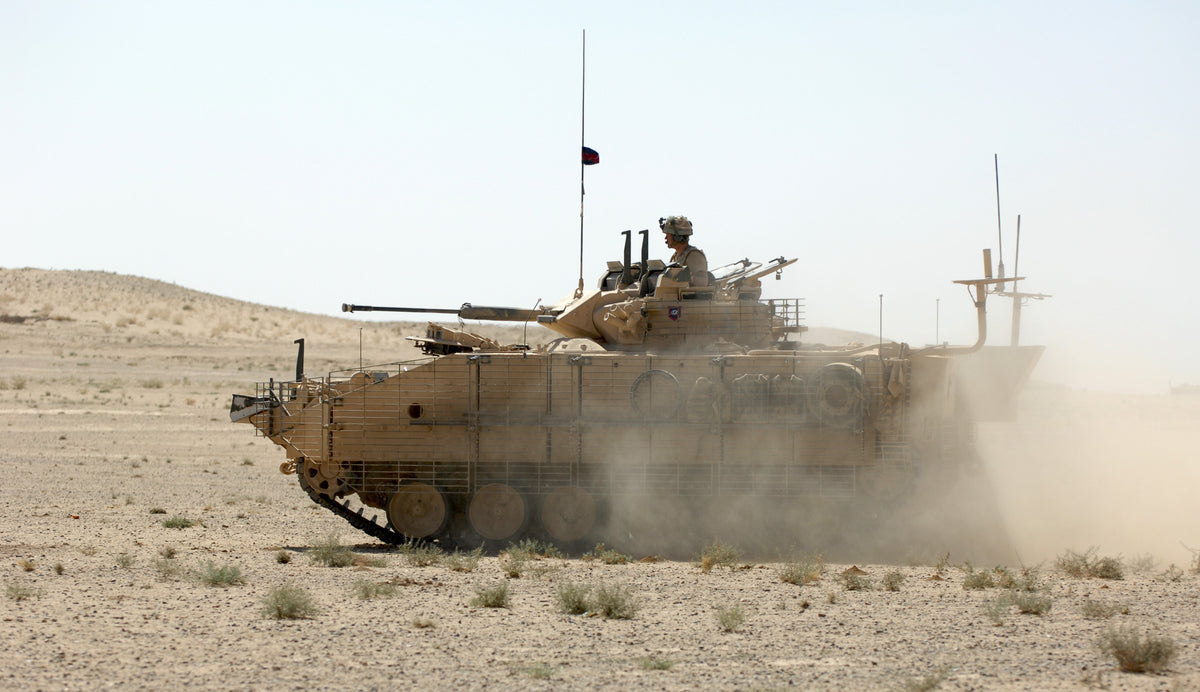
Warrior was designed for Cold War armoured warfare in Europe and ended up operating on Afghan desert tracks, roads and the edge of the Helmand Green Zone. That change of setting is the point of the story. Military vehicles are not used on the terrain their designers would prefer; they are used on the terrain the campaign gives them.
Where I fit into this story: My own background was infantry, reconnaissance and CIS/communications rather than serving as a Warrior crewman. On HERRICK 10/11 I served with 3 Platoon, A Company, 2 Royal Welsh, based at Minden Patrol Base in Musa Qalah. I therefore look at Warrior through the relationship between the vehicle, the infantry it supports, the routes available, communications and the practical friction that appears when a plan meets difficult ground. I will not turn that into experiences that belonged to another platoon or another crew.
At a glance
- Vehicle: FV510 Warrior Infantry Section Vehicle.
- Role: carry infantry under armour and support them with direct fire.
- Crew: commander, gunner and driver, with an infantry section carried in the rear.
- Main armament: 30mm RARDEN cannon with coaxial machine gun.
- Campaign problem: protected mobility and fire support in terrain shaped by canals, compounds, desert, roads and IED threat.
- My focus here: Helmand in 2009, when Warrior formed part of 2 Royal Welsh's Afghanistan story as well as the wider British campaign.
What an infantry fighting vehicle actually does
An infantry fighting vehicle is different from a tank and different from a simple armoured personnel carrier. Its purpose is to move infantry while giving the section armour, mobility, observation and fire support. Once the troops dismount, the vehicle remains part of the fight rather than becoming merely transport that has completed its job.
That distinction matters in Helmand. A Warrior could move a section rapidly through exposed ground, provide protected observation and support dismounted soldiers with its weapons. The infantry, in turn, could enter compounds, speak to local people, move through narrow spaces, search ground and deal with terrain the vehicle could not physically negotiate.
Why tracks mattered — and why they did not solve the terrain
Warrior's tracks gave it useful cross-country mobility. Open desert could offer room to manoeuvre away from a predictable road, and tracked vehicles could cross some broken or soft ground that challenged wheeled vehicles.
But Helmand was not an empty desert. The Green Zone was cut by irrigation ditches, canals, bridges, high compound walls and narrow routes. A vehicle that looked mobile on a map could still be funnelled toward a crossing point or track. Predictable movement is exactly what an enemy using improvised explosive devices wants.
From my reconnaissance background, the question I keep coming back to is not simply, “Can the vehicle cross country?” It is, “Where can it cross today, where are the obstacles, what routes are obvious, where can the infantry dismount, and what happens if the route becomes blocked?”
Warrior reaches Afghanistan
British armoured-infantry elements deployed Warrior during Operation HERRICK. Ministry of Defence reporting records Warriors being used for ground holding, route security and overwatch in Helmand and neighbouring Kandahar.
The vehicle became increasingly visible in the campaign as commanders sought protected mobility for troops operating in an environment where both small-arms fire and explosive threats shaped movement.
2009: why the Gallus design uses that date
The Gallus design is deliberately marked Helmand 2009. That is not a decorative date. Official records confirm that 2nd Battalion The Royal Welsh began its first Afghanistan deployment in February 2009 and that soldiers from the battalion served as Warrior drivers during that period. Later Ministry of Defence reporting also records B Company, 2 Royal Welsh, deploying with Warrior as an armoured-infantry battle group in 2010–11.
The date therefore belongs to a documented vehicle-and-unit story. It should not, however, turn the deaths of individual soldiers into marketing imagery. I keep their remembrance separately below.
What Warrior could give the infantry
- Protected movement: armour between the section and small-arms fire, fragmentation and some explosive effects.
- Observation: a raised, protected platform able to watch routes and likely threat areas.
- Direct fire: the 30mm cannon and machine gun could support troops when an identified target required engagement.
- Carrying capacity: people, ammunition, water, radios and equipment could be moved under armour rather than entirely on foot.
- Tempo: in suitable ground the vehicle could move a force more quickly than a foot patrol whose every metre might need to be searched.
None of those advantages made the infantry optional. The way I understand Warrior is as one part of a combined mounted-and-dismounted system.
The IED problem
Armour reduces risk; it does not remove it. Afghanistan demonstrated that very clearly. Insurgent bomb-makers built devices capable of damaging heavy military vehicles, while coalition forces changed protection, route choice, search methods and tactics in response.
Warrior received additional protection during the campaign. In June 2011 the Ministry of Defence described an upgraded vehicle surviving a serious IED strike at Durai East in Helmand. The incident illustrates the adaptation cycle: threat changes, protection changes, tactics change, and the enemy attempts to change again.
That is the mounted equivalent of the counter-IED story in Log 043. One article shows troops moving slowly enough to interrogate the ground on foot; this one shows the attempt to move people through that same threat under armour.
Overwatch: Warrior as part of a larger force
Official Ministry of Defence reporting gives examples of Warrior vehicles from armoured-infantry platoons moving to provide overwatch while reconnaissance and Afghan troops assaulted suspect compounds. That is closer to the vehicle's real value than a photograph of it standing alone.
The vehicle can observe, protect and support while other elements manoeuvre. Warrior is most effective when connected to an infantry plan, not treated as a self-contained weapon.
Communications: the part photographs do not show
A mounted force depends on communications between vehicles, dismounted sections and higher headquarters. That sounds obvious until people begin moving through compound walls, dead ground, noise and dust.
From my CIS background, the problem is maintaining a shared picture while the force changes shape. A section may be in the back of the vehicle, then dismounted on one side of a compound while the Warrior moves to overwatch somewhere else. The commander needs to know where friendly troops are, what they can see, what has changed and what support is required. The vehicle's mobility is useful only if information keeps pace with it.
Recovery, maintenance and logistics
Heavy tracked vehicles carry their own logistical gravity. They need fuel, ammunition, spares, trained crews, recovery capability and maintenance. Every deployment therefore includes a less visible network behind the fighting vehicle.
A breakdown in benign training is inconvenient. A breakdown on an exposed route can become a tactical problem for everyone sent to secure, recover and repair it. Reliability and recovery planning therefore belong in the operational story rather than in an engineering footnote.
Warrior and the ground of Musa Qalah
Helmand could reward and punish armour at the same time. Open desert provided space. The Green Zone restricted it. Roads enabled speed but created predictability. Bridges were useful but became obvious crossing points. High compound walls could shield infantry from view while preventing a vehicle from following them directly.
For the Musa Qalah part of this story, I go into my own HERRICK 10/11 service at Minden PB in Log 042 — Helmand Province. Logs 042, 043 and 044 work as three views of the same problem: how do people move through dangerous ground while retaining enough protection, awareness and freedom to act?
Warrior drivers remembered — Hunty and Pross
Private Richard “Hunty” Hunt served with 2 Platoon, A Company, 2 Royal Welsh. He had trained as a Warrior Armoured Infantry Fighting Vehicle driver and was also developing as a sniper. On 13 August 2009 he was seriously wounded by an explosion during a vehicle patrol near Musa Qalah. He died from his wounds at Selly Oak Hospital on 15 August 2009.
Private James “Pross” Prosser also served with 2 Platoon, A Company, 2 Royal Welsh and was a Warrior driver. On 27 September 2009 he was killed by an improvised explosive device while driving a Warrior in the Musa Qalah district.
They were not members of my 3 Platoon simply because we served in the same company and wider Musa Qalah period. I have kept that distinction explicit.
Chris “H” Harkett is remembered separately in the wider Helmand archive. He was C Company and died in March 2009, before my HERRICK 10/11 service. H was a personal friend of mine; that friendship is why he sits in my remembrance thread, not because I am trying to put him into my platoon or tour.
Related Gallus piece
The design tied directly to this article is the Helmand 2009 Warrior IFV T-Shirt — Operation HERRICK. It represents the documented vehicle, place and period. I do not use the names, images or deaths of Hunt or Prosser as sales material.
Sources & further research
- National Army Museum — Warrior IFV collection record
- Ministry of Defence — Royal Welsh soldiers return home from Afghanistan
- Ministry of Defence — Private Richard Hunt
- Ministry of Defence — Private James Prosser
- Ministry of Defence — upgraded Warrior protection and IED strike, 2011
- Ministry of Defence — Warrior overwatch during a Helmand operation
- Wikimedia Commons / MOD — featured Warrior image and OGL record
I describe Warrior's historical role and the way I understand it from infantry, reconnaissance, communications and tracked-vehicle experience. I do not turn that into tactical instructions for defeating explosive threats or into stories from Warrior crews that I did not personally live.
