


Muqtada al-Sadr and the Mahdi Army: Iraq, Basra and Operation TELIC

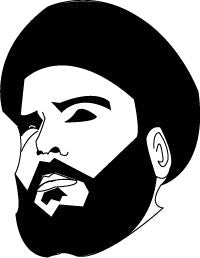
Muqtada al-Sadr became one of the most important Iraqi Shia political and militia leaders to emerge after the fall of Saddam Hussein. His movement combined religious authority, street-level organisation, nationalism and armed power. For British forces on Operation TELIC, the Mahdi Army became particularly important during the 2004 uprisings and the later struggle for control of southern Iraq.

Who was Muqtada al-Sadr?
Al-Sadr came from one of Iraq’s best-known Shia clerical families. His father, Grand Ayatollah Muhammad Sadiq al-Sadr, had built a large following before being assassinated with two of his sons in 1999 under Saddam Hussein’s regime. After the 2003 invasion, Muqtada inherited a powerful name and a network rooted particularly among poorer Shia communities.
The Mahdi Army
In 2003 al-Sadr’s movement developed an armed wing widely known in English as the Mahdi Army and in Arabic as Jaysh al-Mahdi. It filled part of the security and political vacuum created by the collapse of the Ba’athist state while opposing the continuing coalition presence.
The organisation was not simply a conventional military force. It was tied to mosques, neighbourhood structures and a political movement, and its level of central control varied across Iraq.
The 2004 uprisings
Tension escalated sharply in spring 2004 after the Coalition Provisional Authority closed al-Sadr’s newspaper and arrested one of his aides. Fighting spread through Baghdad and several southern cities. British forces in the south faced Mahdi Army attacks and a deteriorating security situation at the same time US forces were confronting major violence elsewhere in Iraq.
This is the context for battles such as Danny Boy and the wider change in TELIC from the comparatively short invasion phase to a much more difficult occupation and counter-insurgency environment.
Basra and southern Iraq
By the later years of the British deployment, militia power had become central to the security problem in Basra. The Mahdi Army and other armed groups competed for influence while Iraqi security institutions struggled with intimidation, infiltration and divided loyalties.
Charge of the Knights, 2008
In March 2008 Iraqi Prime Minister Nouri al-Maliki accelerated a planned Iraqi security operation in Basra known as Saulat al-Fursan, or Operation Charge of the Knights. The offensive targeted armed groups and criminal networks, with Mahdi Army elements central to the confrontation.
The operation was important for British strategy because Iraqi forces were now in the lead. UK forces provided support while the Iraqi government attempted to reassert state control over the city.
Why al-Sadr matters to the TELIC story
Al-Sadr’s movement demonstrates why the Iraq campaign cannot be understood as a simple contest between coalition forces and remnants of Saddam Hussein’s regime. Power after 2003 fragmented across religious parties, militias, tribes, state institutions, insurgent networks and local political interests. The British campaign in the south evolved inside that much more complicated environment.
Continue Operation TELIC
- Operation TELIC — Iraq campaign hub
- Complete British Iraq campaign guide
- Nouri al-Maliki and Charge of the Knights
- Battle of Danny Boy and the Al-Sweady Inquiry
