


Challenger 2 in Iraq 2003: British Armour in the Battle for Basra // Log 050
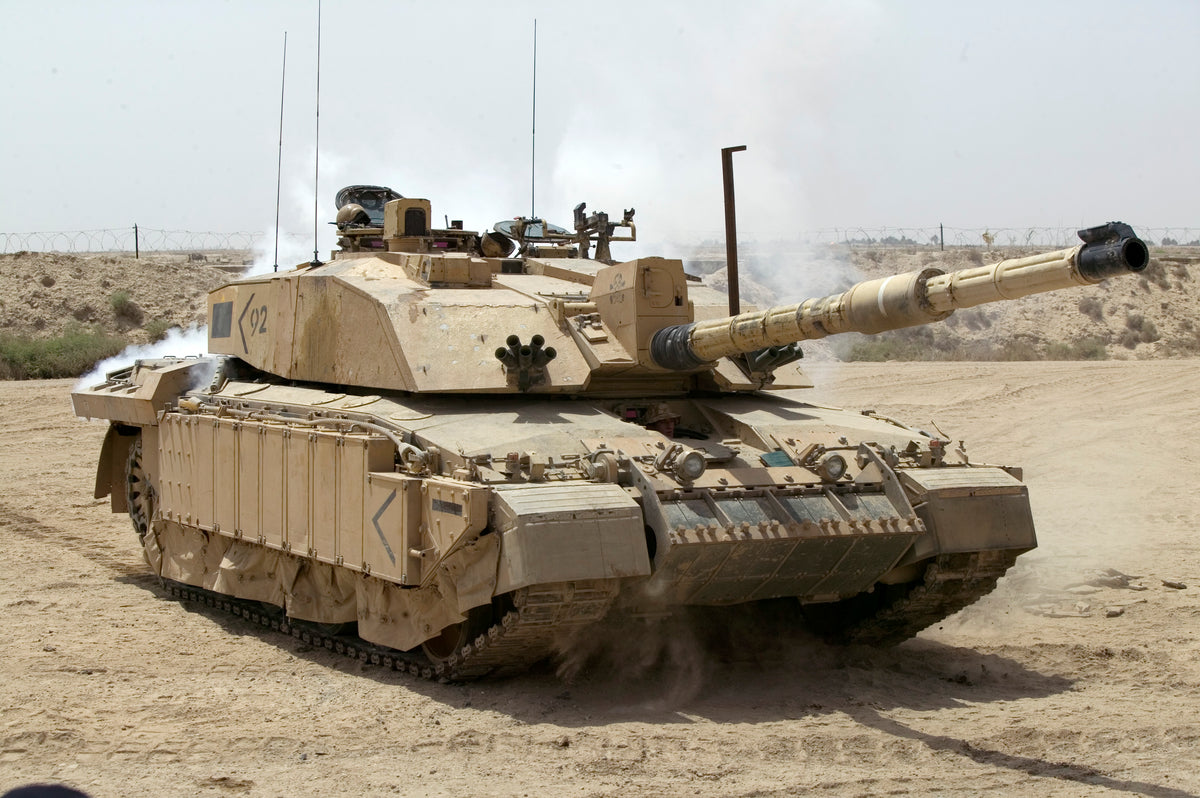
Challenger 2 went into Iraq with a reputation built mostly in trials and training. Around Basra in 2003 it earned a combat record. The story is normally told through armour-protection anecdotes and huge kill-ratio claims. There is a real core to that: British Challenger crews fought and won armoured engagements and the vehicles took a lot of punishment. But some of the cleaner internet stories have been repeated so often that people now treat them as fact whether they can be sourced or not.
I served on three later TELIC roulements. I did not take part in the invasion and I was not a Challenger 2 crewman. I am not going to pretend otherwise. What interests me, from my own technical and tracked-vehicle background, is what happens between a specification sheet and a vehicle actually being used in anger: communications, recovery, maintenance, identification and the way armour and infantry have to work together. The invasion account below comes from the documentary record, not from me trying to borrow somebody else’s war.

At a glance
- Vehicle: Challenger 2 main battle tank.
- Combat debut: Operation TELIC, Iraq, 2003.
- Main British armoured formation around Basra: 7th Armoured Brigade, 1st (UK) Armoured Division.
- Units operating Challenger 2 in the invasion included: The Royal Scots Dragoon Guards and The Queen’s Royal Lancers within the British armoured force.
- Main armament: 120mm L30 rifled gun.
- Campaign roles: destroying Iraqi armour and strongpoints, supporting infantry, controlling approaches and enabling entry into Basra.
- Critical lesson: excellent protection does not remove the dangers of identification, friendly fire, recovery, logistics or urban terrain.
Why a tank designed for Europe mattered in southern Iraq
Challenger 2 had been conceived for high-intensity armoured warfare. Southern Iraq offered open desert and long lines of sight in some places, but the Basra battlespace also contained irrigation features, industrial areas, roads, settlements and the city itself.
The combination of armour, thermal sights, mobility and a powerful main gun gave British commanders a way to dominate Iraqi armoured vehicles and fixed positions from protected platforms. But the closer the fighting moved toward Basra, the more obvious it became that a tank is only one part of the system around it.
Where Challenger fitted in the British order of battle
The British land component centred on 1st (United Kingdom) Armoured Division, commanded during the invasion by Major General Robin Brims. 7th Armoured Brigade was the heavy manoeuvre formation around Basra, combining Challenger 2 tanks with Warrior-mounted infantry and artillery, engineers, reconnaissance, logistics and other support.
The important word for me is combined. A tank can destroy an enemy position, but engineers may be needed to get it across an obstacle, infantry to clear ground it cannot see or enter, artillery and aircraft to suppress other threats, and recovery and logistics crews to keep the whole thing moving.
21 March: crossing into Iraq
One of the defining official images of the invasion shows a Queen’s Royal Lancers Challenger 2 crossing a defensive ditch over a bridge prepared by Royal Engineers while Fusiliers protected the breach. To me it is almost a diagram of combined arms: engineers create mobility, infantry protects the work and armour exploits the crossing.
That tells me more than treating the tank as some independent machine. Its performance mattered because it sat inside a larger system.
The Basra Box
British forces initially isolated Basra rather than driving directly into the centre. The aim was to secure the surrounding area, prevent Iraqi forces interfering with the coalition’s main advance north and gradually weaken regime control.
Challenger crews fought Iraqi armoured vehicles, engaged strongpoints and supported raids around the approaches. The National Army Museum records the Royal Scots Dragoon Guards fighting several armoured engagements around Basra during the invasion.
What about the famous “14–0” tank battle?
You see this everywhere online: Challenger 2s destroyed fourteen Iraqi tanks in one engagement without loss. The broader point—that British Challenger crews overwhelmingly defeated Iraqi armour around Basra—is well supported. The neat “14–0” version is much harder to pin to a strong primary or institutional source with the precision people repeat it.
Protection and survivability
Challenger 2’s armour proved highly resistant to the weapons Iraqi forces could bring against it. National Army Museum material describing tanks at Red 6, the “Gateway to Basra,” records crews showing damage from rocket-propelled grenades and other direct-fire weapons that had struck the armour.
Survivability is not the same thing as invulnerability. Tracks, sights, external equipment and mobility can still be damaged even if the crew compartment holds. Then somebody has to recover the tank, often in a bad place, while fuel, ammunition, maintenance and communications keep deciding whether it remains useful.
25 March 2003: friendly fire
The darkest Challenger 2 incident of the invasion came not from an Iraqi tank but from another Challenger.
On 25 March 2003, Corporal Stephen Allbutt and Trooper David Clarke of The Queen’s Royal Lancers were killed when their Challenger 2 was accidentally engaged by another British Challenger during a period of multiple contacts with Iraqi forces.
The Iraq Inquiry later discussed the incident in the context of Combat Identification equipment and urgent operational requirements. For me, it is the necessary corrective to any account that makes armour protection the whole story. A vehicle can be extraordinarily resistant to enemy weapons and still depend completely on identification, communications, situational awareness and disciplined fire control.
6 April: into Basra
On 6 April 7th Armoured Brigade launched the decisive move into the city on several axes. Tanks supported infantry battlegroups as British forces broke the remaining organised resistance and secured key routes and junctions.
National Army Museum material describes Challenger 2s holding Red 6, the “Gateway to Basra,” after the entry into the city. There is something striking about that transition. A machine designed for high-intensity armoured war was suddenly controlling a road junction at the edge of an occupation.
That change came quickly. Within days, the main problem was no longer Iraqi armour. British soldiers were dealing with looting, public order, infrastructure, policing and the political vacuum created by regime collapse. My later TELIC tours belonged to that completely different Iraq.
Tank versus city
Urban ground changes the relationship between armour and infantry. Buildings and walls shorten sight lines. Side streets create more angles. Civilians and friendly troops make target identification harder. A tank can dominate an open approach and still be blind to what is happening immediately behind a wall.
So I do not take “tanks win cities” from Basra. What I take from it is that protected direct fire and mobility gave the British force a major advantage when they were integrated with infantry, engineers, artillery, reconnaissance and air power.
After the invasion
Challenger 2 remained part of the British force in Iraq, but the campaign increasingly demanded different capabilities: patrol vehicles, infantry presence, intelligence, counter-IED work, training and support to Iraqi forces. The armoured victory of 2003 did not answer the political problems that followed.
That is why Log 048 and this article belong together. The tank helps explain how Basra was taken. My later experience in the wider Basra guide helps explain why taking the city did not settle the campaign.
Chronology
- 21 March 2003: Challenger 2s cross into Iraq with the British armoured force.
- Late March: British armour fights around the Basra approaches and isolates the city.
- 25 March: Corporal Stephen Allbutt and Trooper David Clarke are killed in a Challenger-on-Challenger friendly-fire incident.
- Late March–early April: repeated armoured and combined-arms actions weaken Iraqi resistance around Basra.
- 6–7 April: 7th Armoured Brigade enters and secures Basra.
- After 7 April: British forces transition rapidly from conventional combat to occupation and stabilisation.
Wear the history
I have kept the product separate from the casualty section above.
Challenger 2 Operation TELIC 2003 T-Shirt →
Sources and further reading
- National Army Museum — Iraq War: The invasion
- National Army Museum — Royal Scots Dragoon Guards
- National Army Museum — Challenger 2s at Red 6, Basra
- Ministry of Defence — Iraq operational fatalities
- Iraq Inquiry — report, including equipment and Combat Identification evidence
- MOD / Wikimedia Commons — Challenger 2 crossing into Iraq, OGL image record
I distinguish documented combat performance from popular numerical claims that are difficult to source. I include the 25 March friendly-fire loss because survivability, Combat Identification and human cost are part of the Challenger 2 story, not inconvenient footnotes.
