


Basra 2003–2009: Britain’s Main Iraq Front — Invasion, Occupation, Basra Palace & Withdrawal // Log 048
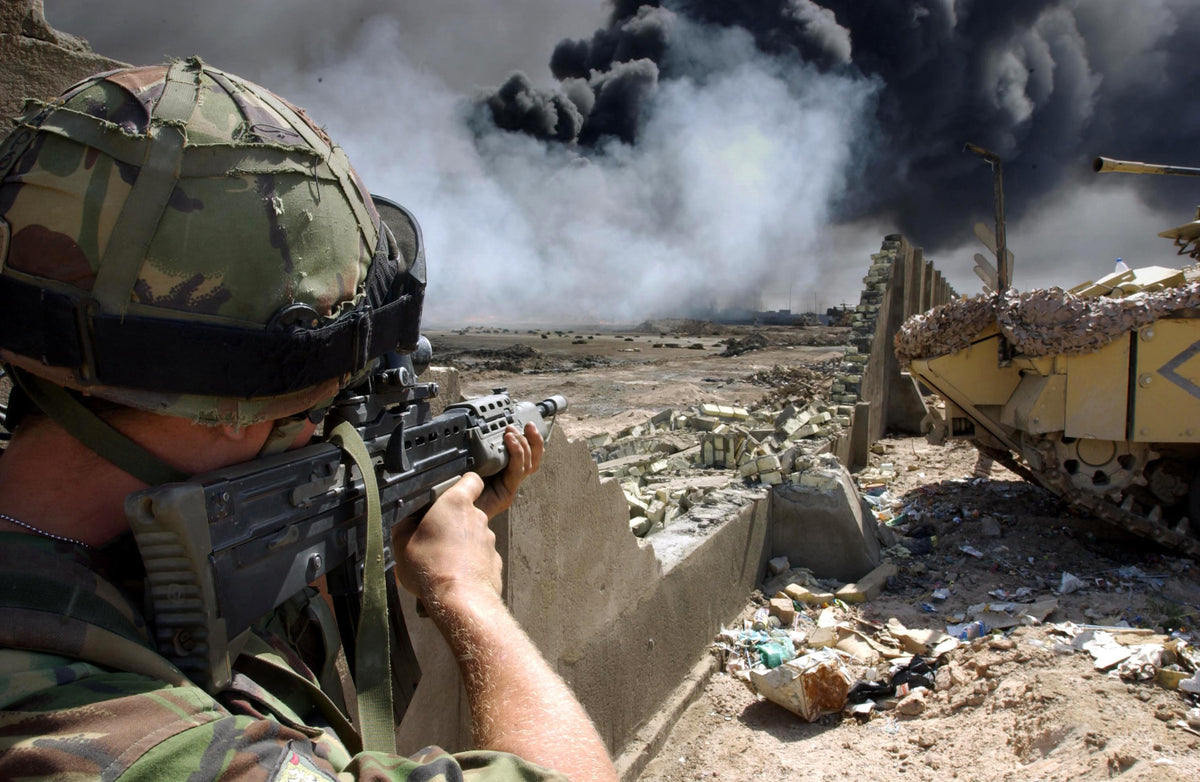
I do not remember Iraq as one campaign. I went there three times and each tour felt different enough to be a different country. I served on TELIC 3 with Patrols Platoon attached to C Company, TELIC 6 with B Company, and TELIC 10 with 3 Platoon, A Company. TELIC 3 was the shock of discovering what Iraq actually looked and felt like after Bosnia and Kosovo. TELIC 6 was comparatively benign. TELIC 10 was the only time in my military service when I can honestly say I was scared.
That progression matters when I write about Basra. Looking only at dates, unit names and handovers makes the British campaign seem much neater than it felt from the ground. Basra changed, the threat changed and our relationship with the city changed. So where I was there, I will say what I remember. Where I was not, I will stick to the record.

Why Basra mattered
Basra sits near the head of the Gulf on the Shatt al-Arab and close to Kuwait and Iran. It is tied to Iraq's oil economy, ports and southern road network. For Britain, it became the centre of a much wider responsibility covering Basra, Maysan, Dhi Qar and Al Muthanna.
On a map that can look compact. On the ground it was anything but. Roads, bridges, waterways, dense urban districts, open desert, oil infrastructure and the Iranian border all sat inside the same operational picture. Holding a base did not mean holding the city. Holding the city did not mean controlling the routes into it.
2003: winning the city was the easy part
During the invasion, British ground forces in the south centred on 1st (United Kingdom) Armoured Division. 7th Armoured Brigade became the principal British formation around Basra, while 3 Commando Brigade Royal Marines fought around Al-Faw and key oil infrastructure and 16 Air Assault Brigade secured other southern objectives.
British forces entered Basra decisively on 6–7 April 2003. Challenger 2, Warrior, infantry and coalition air power gave the force a huge conventional advantage. The city was taken far more quickly than the political and security problem that followed could ever be solved.
That distinction became obvious very quickly. Once the regime collapsed, troops who had been organised to defeat an army were suddenly dealing with looting, public order, infrastructure, policing, local politics, detention and the beginnings of an insurgency. Winning a battle and replacing a state are completely different jobs.
Log 050 — Challenger 2 and the Battle for Basra →
TELIC 3 — when Iraq first became real to me
TELIC 3 was a different world from the tours I had previously done in Bosnia and Kosovo. I knew almost from the start that it was going to be different. Even before you get into the contacts and the threat, the whole set-up in the Middle East felt different.
My tour was split between Basra and Al-Amarah. There were blast bombs, riots and running battles with the Mahdi Army. At times we were securing small patches of ground so Hercules aircraft could come in with supplies. We travelled up the route past Danny Boy repeatedly, before the PWRR fought the famous battle there on the following tour. CIMIC House and the Pink Palace were not names in a history book to me; they were part of the geography we were moving through.
There were also occasions when we deliberately tried to lure the enemy out rather than simply waiting for the next attack. TELIC 3 was where I experienced my first contacts and my first incoming mortar. There would be plenty more to come, but I still think there is something different about the first time. It is the point at which all the training and all the briefings stop being theoretical.
That is why I am cautious when the early occupation is described as though the south simply drifted from invasion into stabilisation. From where I stood, it already felt unstable, unpredictable and capable of turning violent very quickly.
2004: Al-Amarah and the Mahdi Army
The south was Shia-majority, but that never meant it was politically unified or automatically friendly to the coalition. Muqtada al-Sadr's Mahdi Army became one of the main armed challenges to British forces in 2004, particularly in and around Maysan.
On 14 May 2004, an insurgent ambush north of Al-Amarah developed into the engagement that became known as the Battle of Danny Boy. I had travelled that route on TELIC 3, but I was not at the battle and I will not write myself into it. The PWRR soldiers who fought it own that story.
Log 049 — Battle of Danny Boy and the Al-Sweady Inquiry →
TELIC 6 — a much quieter Iraq
When I went back on TELIC 6, it felt quite benign by comparison. A lot of what I remember was VCPs, helicopter VCPs and a few patrols along the Iran–Iraq border. It was still an operational tour and nobody treated it casually, but emotionally and tactically it did not feel like TELIC 3.
That difference is important because it reminds me not to write the whole campaign backwards from the worst periods. There were times when the temperature of the operation appeared to drop. If you only read a compressed chronology, you miss how different one roulement could feel from another to the soldiers actually doing it.
By 2007, the campaign had changed again
By TELIC 10, the British footprint in Basra was shrinking while attacks on British bases and movement remained intense. The Old State Building, Shatt al-Arab Hotel and Shaibah Logistics Base were among the sites handed over during 2007, with Basra Palace following in September. Basra Air Station became the main remaining fixed coalition base.
On paper, this was transition. On the ground, my memory of TELIC 10 is not of a campaign gently winding down.
TELIC 10 — the only tour where I was actually scared
TELIC 10 was the only time in my military service when I was actually scared. I do not say that for effect. I had already been in contacts, taken incoming fire and served on previous operational tours. This felt different.
Our platoon was normally in the first vehicles of the long convoy that resupplied Basra Palace. Getting there was not a routine drive. I remember it as having to fight our way in every time. Drones were used to mark targets and fast air carried out shows of force.
The Red Route, coming off the bridge into Basra, is one of the stretches that stays with me. We knew we were going to get hit. It was not a vague possibility that there might be an IED somewhere on the route. We expected direct hits on vehicles and we expected contacts. That certainty changes the atmosphere inside a vehicle before anything has even happened.
Reaching a base did not mean the danger switched off. We would hard-target out of the vehicles and move straight into hardened cover. Even crossing the bridge inside the Palace meant thinking about protection. Indirect fire became part of the background to life.
Basra was talked about at the time in extreme terms for the amount of mortar fire it was taking. I am not going to turn a memory into a league table and claim a statistic I cannot prove, but from where I stood it felt relentless. Even when we came back to the supposed safety of the APOD, rocket attacks continued. You could finish a patrol and still not feel that you had arrived somewhere genuinely safe.
For me, that is the biggest difference between TELIC 10 and the tours that came before it. TELIC 3 introduced me to Iraq and to contact. TELIC 6 could feel almost routine. TELIC 10 carried a sense of inevitability: you knew the route was going to hurt somebody, you knew the bases were going to be hit, and you still had to go.
The human cost of TELIC 10
That summer cannot be reduced to handover dates and attack statistics.
On 28 June 2007, Corporal Paul Joszko of 2 Royal Welsh and Private Scott Kennedy and Private James “Jamie” Kerr of The Black Watch / 3 SCOTS, both attached to 2 Royal Welsh, were killed by an improvised explosive device in Basra during route-security activity.
On 7 July 2007, Lance Corporal Ryan Francis of 2 Royal Welsh was killed when an IED struck the Warrior he was driving during an operation in Basra. Ryan was a personal friend of mine. I include that because it is part of my memory of this tour, not because his death needs making more dramatic than it already was.
On 6 August 2007, Private Craig Barber of 2 Royal Welsh was killed by small-arms fire while driving a Warrior during a night operation in the Al Fursi district. I have kept that distinction explicit because Craig's death should not be folded into the IED narrative simply because other losses that summer involved roadside bombs.
Palace to airport
British forces handed Basra Palace to Iraqi control in September 2007 and concentrated at Basra Air Station. Basra Province transferred to Provincial Iraqi Control in December.
There are two ways those events are often described. One is as a planned transition to Iraqi control. The other is as a British retreat from a city in which militia power had grown. I think the useful history is in understanding both arguments rather than pretending one slogan explains everything. What is undeniable is that the British posture changed materially: fewer fixed bases, less routine presence inside the city and a move toward overwatch and support.
2008: Charge of the Knights
In March 2008, Prime Minister Nouri al-Maliki launched Operation Charge of the Knights against militia networks in Basra. Iraqi forces initially ran into serious resistance and coalition support became important, including intelligence, surveillance, logistics, artillery and other capabilities.
I was no longer there, so this is where my first-person account stops and the documentary record takes over. The operation was Iraqi-led; British forces were neither the force storming back into Basra nor irrelevant spectators. Iraqi security forces eventually established greater control, while US support, British capabilities, political negotiation and militia decisions all formed part of the outcome.
2009–11: withdrawal and the formal end of TELIC
The main British combat mission in the Basra area ended in 2009, with the large-scale drawdown completed that summer. A smaller Royal Navy training mission continued under a later agreement until May 2011, which is why I distinguish the end of the main combat mission from the formal conclusion of Operation TELIC.
What Basra means to me when I look back
The clearest lesson I take from Basra is that tactical success and political success are not the same thing. British forces could win firefights, clear routes, seize ground and keep convoys moving. None of those things by themselves answered who should govern, how the police and state should function, how militias should be dealt with or what legitimacy a foreign military presence still had several years after the invasion.
My own three tours also stop me seeing Iraq as a single frozen memory. I remember the shock of TELIC 3, the relative quiet of TELIC 6 and the fear of TELIC 10. All three are true. Any history of Basra that makes the entire campaign sound uniformly calm or uniformly apocalyptic misses what changing roulements actually felt like.
Chronology
- 20 March 2003: coalition ground invasion begins.
- 6–7 April 2003: British armoured and infantry forces enter and secure Basra.
- 2003–04: occupation, public-order duties and growing militia resistance.
- 14 May 2004: Battle of Danny Boy near Al-Amarah.
- 2005–06: militia, explosive and cross-border concerns increasingly shape the campaign.
- 2007: British base footprint contracts under heavy pressure.
- 28 June–6 August 2007: the TELIC 10 losses remembered above.
- September 2007: Basra Palace handed over; UK forces concentrate at Basra Air Station.
- December 2007: Basra Province transfers to Provincial Iraqi Control.
- March 2008: Charge of the Knights begins.
- 2009: main British combat mission and large-scale withdrawal conclude.
- May 2011: final TELIC training mission ends.
Related Gallus pieces
The remembrance section above is deliberately complete before I link to any products.
- Basra 2003 Military Map T-Shirt
- Challenger 2 Operation TELIC T-Shirt
- Battle of Danny Boy T-Shirt
- Basra 2007 Street Scene T-Shirt
- Operation TELIC Basra & Al-Amarah T-Shirt
Sources and further reading
- National Army Museum — Iraq War: The invasion
- National Army Museum — April 2003 Basra assault material
- The Iraq Inquiry — Report
- House of Commons Defence Committee — UK Operations in Iraq
- House of Commons Defence Committee — southern Iraq, 2008
- Al-Sweady Inquiry
- Ministry of Defence — formal end of Operation TELIC
- Wikimedia Commons — Iraq War operations map and licence
I have kept my memories in the first person and limited them to things I have actually described. The wider campaign chronology remains source-led. Where my memory and the documentary history meet, I make that clear rather than pretending one soldier's experience explains the whole of southern Iraq.
