


Omaha Beach on D-Day: How the Assault Plan Broke Apart


At about 08:30 on 6 June 1944, the senior surviving Navy beachmaster on Omaha stopped further vehicle landings on the western part of the beach. Wrecked landing craft, disabled tanks and vehicles, mined obstacles and casualties were blocking the shoreline. Craft waiting offshore could not simply keep feeding vehicles into the same mess.
At almost the same time, Rangers were reaching the top of the bluff near Vierville. Elsewhere, other infantry groups were leaving the shingle and moving inland.
Both reports were true.
That is the part of Omaha that interests me most. Not whether the beach was a disaster or a success at 08:30, because it was already too fragmented for either word to describe the whole thing. The more difficult problem was that the battle ashore was changing faster than the system offshore could build a common picture of it.
The invasion plan depended on timing and information as much as firepower. Bombardment, tanks, engineers, infantry, beach-control parties and follow-on waves were supposed to work in sequence. Once boats landed in the wrong places, radios disappeared in the surf, exits stayed blocked and small groups began climbing between strongpoints, the timetable did not simply run late. Different parts of Omaha were now fighting different battles.
Before 06:30
The plan was detailed because it had to be. Omaha backed onto steep ground broken by a handful of draws that vehicles would need if the army was going to move inland in strength. Those exits were obvious defensive points. Infantry might scramble up somewhere else; a truck or tank column could not.
Heavy bombers were meant to damage the German defence before the first wave arrived. Much of their bombing fell inland. Naval gunfire did damage and disrupt positions, but it did not remove the defensive system. From offshore there was no reliable way to know that every position which had gone quiet had actually been destroyed.
At WN 62 above Easy Red, Franz Gockel was still there. He was eighteen, had been training as a roofer before military service and belonged to 3rd Company, Grenadier Regiment 726 of the 716th Infantry Division. His weapon was a captured Polish water-cooled machine gun. Nothing about that description sounds like the Atlantic Wall as a grand abstraction. It was still enough to kill men crossing open ground below him.
The German command picture was not especially clean either. Parts of Grenadier Regiment 726 had been tied into the defensive arrangements in a sector where the 352nd Infantry Division was also present. Later shorthand about the Americans expecting one division and meeting another makes the German side look more orderly than it was.
The sea had already started altering the American plan. Landing craft drifted. Men arrived wet and seasick. Some boats grounded short. Some missed their intended sectors. The assault force had been organised down to particular craft and strips of beach; the Channel did not respect the paperwork.
Dog Green and Easy Red were not the same battle
At roughly 06:30 the first assault craft reached the beach. At Dog Green, opposite the Vierville exit, A Company of the 116th Infantry came into devastating fire. Men were hit in landing craft, in the water and on the sand. Officers and NCOs disappeared from the chain of command in minutes. Survivors reached cover without many of the people and weapons they had expected to have around them.
That experience became one of the defining images of Omaha for good reason. It was real. A short distance along the coast, however, other groups were dealing with a different arrangement of ground, surviving German weapons, smoke and supporting fire.
Lieutenant John Spalding and Sergeant Philip Streczyk of E Company, 16th Infantry Regiment, landed around Easy Red. They were not walking into an easy sector. They were, however, among men who eventually found enough dead ground and enough space between strongpoints to start working towards the bluff rather than waiting for the formal exits to open.
A few hundred yards could therefore alter what support a platoon had, which weapon could see it and whether the next patch of ground offered cover. That was not the only thing deciding survival, but it was enough to make neighbouring accounts sound as though they came from different battles.
The tanks depended on decisions made before they touched France
The Duplex Drive Sherman story is usually compressed into one line: the swimming tanks were launched too far out and sank. Many did sink in the rough water. That was not what happened to every tank intended for Omaha.
Lieutenant Dean Rockwell, commanding an LCT flotilla, judged the sea too rough and chose to carry tanks much closer to shore rather than launch them according to the original plan. That was a local decision made from the water, before anybody ashore could ask for it. Tanks brought in that way reached Omaha while other infantry units landed with much less of the armoured support they had expected.
A Sherman sitting near one company did not help the men several hundred yards away who could not see it. Local availability mattered more than the total number of tanks in the operation.
The same thing happened repeatedly that morning. The plan remained useful as intent. Men kept abandoning parts of its method when the method no longer fitted what was in front of them.
The tide
The engineers did not have the luxury of waiting for the infantry picture to become clearer. German obstacles had been built across the tidal flat. As the water rose, many would become harder to see while remaining capable of ripping open landing craft.
Demolition teams came ashore into a beach already crowded with men seeking cover. Some teams landed away from their assigned lanes. Some lost explosives or specialist equipment. Infantrymen sheltered behind obstacles that engineers were trying to prepare for demolition. In one incident a mortar round struck prepared primacord and killed or wounded engineers and nearby infantry.
Several complete and partial gaps were opened anyway. The Special Engineer Task Force suffered very heavy casualties during the day. More important than the percentage was who and what disappeared with those casualties: a man carrying a particular charge, somebody who knew the intended lane, or equipment allocated to one job.
The water kept coming in while replacements were improvised.
By 08:30, landing craft offshore were trying to find usable approaches through obstacles and wreckage while infantry elsewhere was already on the bluff. The beachmaster's decision to stop vehicle landings was not evidence that nobody was getting inland. It was evidence that the shoreline itself had stopped functioning as the transport system the plan required.
What Gockel could see
From WN 62, Gockel could see men on the beach and in the water. He could fire into that part of the assault. He could not see the whole of Omaha and had no useful way of knowing which American groups were already finding routes around neighbouring positions.
That narrowness matters. Allied maps make a strongpoint look like one component in a defensive belt. For the man inside it, the battle was whatever could be seen through an embrasure or from a trench.
American troops moving between strongpoints gradually changed the geometry. Positions designed primarily to fire towards the sea and along the beach became much less comfortable once men appeared on their flanks or behind them. Some German positions continued firing even after American troops had passed inland nearby.
Gockel fought for hours and was later wounded in the hand. There was no clean moment when every weapon at WN 62 stopped and the battle moved to the next phase.
Explore this history
This Field Note has a directly related Gallus design and a wider campaign collection.
View the related Gallus design → | Explore D-Day & Normandy 1944 →
08:30
The Army's own post-war study described infantry leaving cover and moving towards the bluffs at half a dozen or more points during the first two hours. Near Vierville, Rangers began crossing the beach road at about 08:10. By around 08:30 some had reached the bluff top.
At 08:30 the Navy beach picture was grim enough for the senior surviving beachmaster to stop vehicle landings on western Omaha.
Those are not competing versions of the day. They are the same battlefield viewed from different jobs.
The beachmaster had to judge whether more landing craft and vehicles could physically get ashore without making the congestion worse. A platoon leader near the bluff needed to know whether the wire in front of him could be crossed. A destroyer captain offshore was looking for a German muzzle flash or a tank's tracer that might identify a target. V Corps needed information from all of them before it could claim to understand Omaha as a whole.
That information did not arrive at the same speed.
Radios had been drowned, lost or damaged. Naval shore fire-control parties had suffered casualties. Smoke and the bluff hid parts of the battlefield from ships. Units ashore were mixed. Reports could be correct when sent and already incomplete by the time somebody farther offshore acted on them.
Calling this simply command blindness is tempting, but too easy. Headquarters had a problem that the original timetable had not solved: there was no longer one Omaha situation to report.
Men were already above the beach
Streczyk's Distinguished Service Cross citation records him crossing the beach, helping cut wire, moving through mined ground and leading men towards high ground. Spalding later described the same part of the fight from nearby. Their accounts do not provide a perfect shared clock, and they do not need to. Men of E Company were moving inland while large numbers elsewhere remained close to the water.
First Lieutenant Jimmie Monteith, also of the 16th Infantry, spent part of the morning moving across exposed ground, gathering scattered troops and directing tanks. His Medal of Honor citation gives those actions a formal sequence. On the ground he was working with whatever men and vehicles remained available after the landing had mixed units together.
Unit names still mattered, but they were no longer a reliable description of who was physically standing together. Junior leaders took men they could find. Tanks engaged targets they could identify. Infantry climbed ground that had not been intended as a vehicle exit. Engineers opened lanes that were used by whoever reached them.
Some attempts failed. Men were stopped by mines, mortars and machine guns. Others got through. Nobody ashore had to wait until Omaha as a whole had been declared successful before trying the next piece of ground.
The destroyers did not wait for a perfect picture either
Naval gunfire had been supporting the assault since before H-Hour. The destroyers' role changed when captains looking at Omaha decided that the emergency for which they had been conserving ammunition was already in front of them.
Several destroyers moved much closer to shore on their own initiative, in some cases to roughly 800–1,000 yards. One came closer still. They were working with limited shore spotting because many of the radios intended to connect troops with naval gunfire had disappeared in the landing.
The improvisation could be crude. USS Carmick watched tanks firing towards the bluff, used their bursts to work out where the target was and fired at the same area. That is a very different picture from a fire-support plan operating through a clean communications chain.
At 09:50, after reports from the destroyers had begun reaching Rear Admiral John L. Hall's fire-support organisation, the order went out for the bombardment destroyers to close the beach. By then some captains had already made the decision for themselves.
The destroyer fire mattered. It should not be turned into a second myth in which the Navy suddenly saved an Army that had remained helpless until 09:50. American infantry was already above the bluffs in places, tanks were fighting and engineers had opened gaps. The ships added powerful direct fire to a battle that was already developing unevenly.
And the ships could still be wrong
Captain Joseph Dawson's G Company, 16th Infantry, moved inland towards Colleville-sur-Mer. By then the fighting no longer looked much like a beach landing. There were lanes, houses, hedges and German troops at close range.
Supporting naval fire later struck areas where American troops had already advanced. Dawson remembered the incident bitterly; the official Army account also records American casualties from friendly naval fire around Colleville.
The ships had large guns and an incomplete ground picture. Both things were true at once.
Dawson was later wounded when a sniper's bullet struck the stock of his carbine and fragments hit his legs. Monteith had also reached the high ground and was killed during later fighting after German troops attacked his position. Getting off the beach had not ended either man's battle.
The part of Omaha that stayed on the sand
Leo Scheer was a twenty-year-old Navy corpsman with the 7th Naval Beach Battalion. His landing craft was hit during the approach and he ended up in the water. Much of the medical equipment he was supposed to use was lost before he reached shore.
He later remembered taking first-aid material from dead men and using it on the wounded. There is no larger metaphor needed for that. He needed medical supplies and the dead had some.
While infantry moved inland, the beach had to become a supply route. Engineers were still clearing obstacles. Beach parties were trying to sort traffic. Wounded men needed to move seaward while ammunition, fuel, vehicles and reinforcements moved the other way. Wreckage occupied space needed by the next craft.
The halt to vehicle landings at 08:30 was therefore not the end of the landing programme. It was one local attempt to stop the programme from making its own problem worse.
Later, routes opened and traffic resumed. Roughly 34,000 American troops came ashore through Omaha during D-Day. That total is easy to read as a smooth accumulation. On the beach it arrived through gaps, delays, mislandings and repeated decisions about what could physically be put ashore next.
By evening
Omaha had not reached much of the ground scheduled for the end of 6 June. Some first-wave companies had been devastated. The principal vehicle exits opened later than intended. The American lodgement was shallow and irregular. German pockets remained close to ground American troops had already passed.
The landing was nevertheless secure enough for more men and material to keep coming in. There was no single point at which the original plan was restored. Much of it never was.
The often-used figure of around 2,400 American casualties at Omaha is still an estimate rather than a perfectly audited total. Men initially listed missing later returned; attachments complicated records; units themselves had been mixed and disrupted. Precision becomes difficult for the same reason the morning's command picture was difficult: the organisations doing the counting had been through the battle too.
After dark Scheer dug a narrow trench and tried to sleep. A shell burst close enough to throw sand over him. Inland, American units were still trying to establish exactly where neighbouring formations had ended up. Some German troops were still nearby.
There was no need for anyone on Omaha to understand the whole battle by then. They still did not.
Continue the D-Day series
- Operation Overlord: The Road to D-Day
- D-Day: Five Beaches Complete Field Guide
- Pegasus Bridge
- Merville Battery
- US Airborne on D-Day
Related Gallus design
Omaha Beach D-Day Coordinates T-Shirt →
A note on the evidence
Times on Omaha are not always reconcilable across unit reports, naval records, award citations and later recollections. I have kept the harder timings only where the official Army or Navy record supports them closely. Where accounts disagree, the disagreement is more useful than manufacturing a single minute-by-minute clock.
Continue exploring
Explore D-Day & Normandy 1944 → | View the related Gallus design →
Sources & further reading
- US Army Center of Military History — Omaha Beachhead, 6 June–13 June 1944. The main operational foundation for terrain, unit movements, obstacles and the development of the beachhead. Read the Army study →
- Naval History and Heritage Command — Destroyers at Normandy: Naval Gunfire Support at Omaha Beach. Particularly useful for the 08:30 beach-control picture, destroyer action and the limits of shore spotting. Read the naval history →
- Naval History and Heritage Command — H-031-1, D-Day: Operation Neptune. Used for the destroyers' independent decisions to close the beach and the later 09:50 order. Read the Navy account →
- First Division Museum — D-Day primary-source collection. Includes material from Joseph Dawson, John Spalding and other 1st Infantry Division witnesses. Primary sources →
- Congressional Medal of Honor Society — Jimmie W. Monteith Jr. Used for Monteith's documented movements and final action. Citation and biography →
- Franz Gockel testimony. Used for one German soldier's perspective at WN 62, with later memory kept distinct from near-contemporary evidence. Gockel testimony →
- Joseph Balkoski — Omaha Beach: D-Day, June 6, 1944. A useful modern secondary study and cross-check on unit movements and competing accounts. Publisher details →
CONTINUE THE STORY
More from this campaign
Read it, reference it or wear it — the related pieces are kept together here.
FEATURED DESIGN
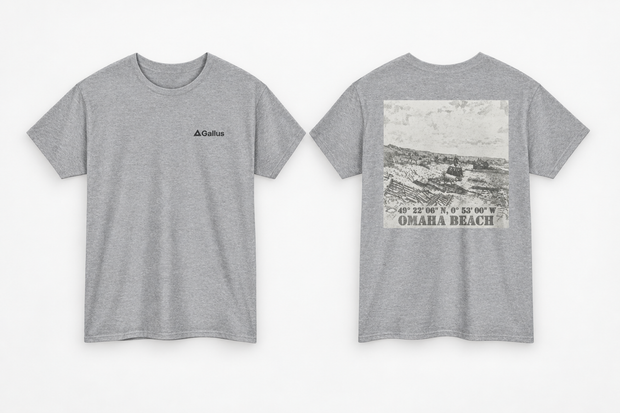
Omaha Beach Coordinates T-Shirt — D-Day 6 June 1944
€30,95 EUR
View the design →CAMPAIGN COLLECTION
D-Day & Normandy 1944
Stay with this subject instead of being dropped back into the full catalogue.
Explore the collection →FIELD NOTES
Get Omaha & D-Day Field Notes by email
New research, maps and campaign references as they are published. No daily sales barrage.
