


Brigadier-General Hugh Elles: Tank Corps Commander at Cambrai 1917

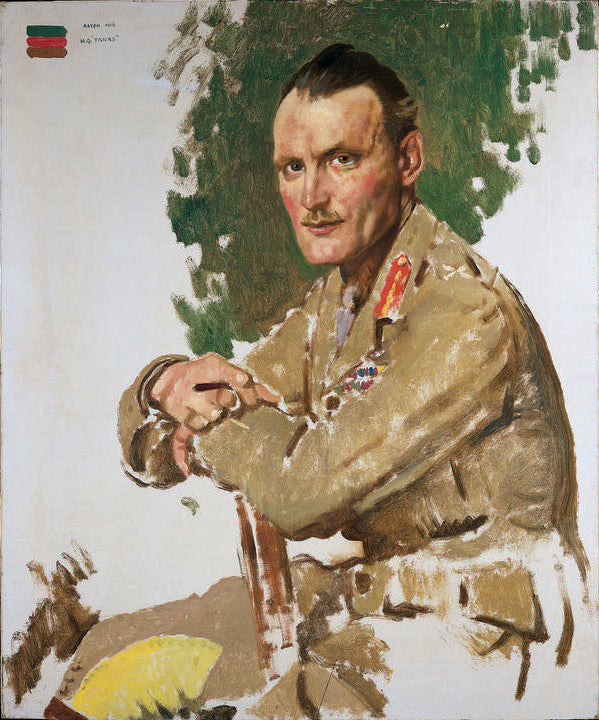
Major-General Sir Hugh Elles commanded the British Tank Corps during the Battle of Cambrai in November 1917. He is remembered partly for the dramatic image of a general going forward in a tank, but his real importance lies in the institutional problem behind that moment: turning an unreliable new weapon into a coherent corps that could operate with infantry, artillery, engineers and aircraft.

Before the Tank Corps
Elles was a Royal Engineer officer who had served on the Western Front and held staff appointments before becoming closely involved with the development of the British heavy tank force.
In 1916 he became commander of the Heavy Branch of the Machine Gun Corps, the organisation that evolved into the Tank Corps in 1917.
The tank problem
Early tanks offered something the Western Front badly needed: a means of crossing wire and trenches while providing protected mobile firepower. They also broke down, moved slowly, exhausted crews and were vulnerable to artillery and mechanical failure.
Elles therefore faced more than a technical challenge. The Tank Corps needed doctrine, training, maintenance, supply, recovery and a workable relationship with infantry and artillery.
Cambrai
The Third Army plan for Cambrai concentrated more than 400 tanks for the opening attack on 20 November 1917. There was no long preliminary bombardment. Tanks would crush paths through the wire and help infantry cross the Hindenburg Line's trench system.
Elles issued a Special Order to the Tank Corps before the battle and went forward in a Mark IV tank named Hilda.
What interests me is the command-and-support chain behind that image. A tank assault is only as good as fuel, ammunition, recovery, repair, routes, communications and the infantry-artillery plan around it. The same principle holds for any technical system in the field: the equipment is only one part of the capability.
Opening success and limits
The initial assault achieved major penetration. Tanks and infantry crossed positions that had resisted months of conventional trench methods elsewhere.
But losses, breakdowns, difficult ground and the shortage of fresh infantry reduced the ability to exploit. German forces counter-attacked on 30 November and recovered much of the lost ground.
Cambrai was therefore not proof that tanks had solved trench warfare. It was evidence that concentrated armour could transform the opening of an attack when integrated with other arms—and that exploitation and sustainment remained decisive.
After Cambrai
Elles continued to command the Tank Corps through the end of the war. British tank doctrine evolved further during 1918 as the army combined tanks with artillery, aircraft and infantry in increasingly sophisticated operations.
Related: Cambrai field guide — Log 025 · Julian Byng — Third Army commander at Cambrai
