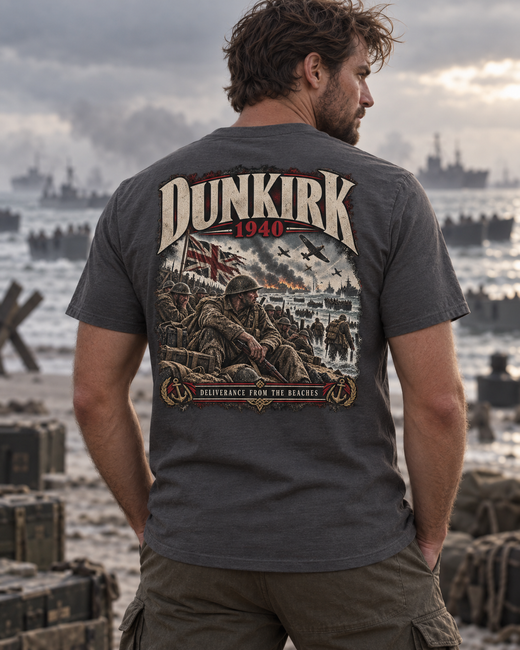
Dunkirk 1940: Complete Field Guide — Retreat, Operation Dynamo & Evacuation // Log 063

Field Note // Log 063
Dunkirk sits in British memory as a rescue story, and it was an extraordinary rescue. It was also a military defeat. Both statements can be true. The army that came home had left most of its heavy equipment in France, thousands of Allied troops were killed or captured, and French forces continued fighting while evacuation ships were already crossing back to England.
The short answer
Operation Dynamo began on the evening of 26 May 1940 and ended on the morning of 4 June. Around 338,000 Allied personnel were evacuated from Dunkirk according to RAF Museum figures. The evacuation saved the core manpower of the British Expeditionary Force and large numbers of French and other Allied troops, giving Britain the human foundation from which to rebuild an army.
It worked because ground troops held a shrinking perimeter, naval crews maintained an evacuation under air and artillery attack, RAF Fighter Command contested the sky, port and beach control kept men moving, and hundreds of smaller craft helped carry troops from shallow water and damaged harbour approaches to larger ships or across the Channel.
How the Allies ended up there
Germany attacked in the west on 10 May 1940. Allied armies moved into Belgium expecting the main danger there. The decisive German armoured drive instead came through the Ardennes and crossed the Meuse near Sedan. Panzer formations then raced toward the Channel, cutting the northern Allied armies away from the main French forces to the south.
Attempts to counter-attack were too limited to restore the front. By late May the BEF and Allied formations around it were being compressed toward the coast.
The perimeter bought time
No evacuation works if the enemy can simply walk onto the beaches. British and French units fought defensive actions along canals, villages and road lines to keep German forces away from Dunkirk. The perimeter contracted as troops were lifted out.
The French role is essential. French units continued defending parts of the perimeter and Dunkirk itself during the final stage, allowing more men to embark. The popular image of British troops rescued by British civilians misses a large part of the battle.
The mole, the beaches and the little ships
Dunkirk’s harbour had been badly damaged, but the long East Mole — a breakwater not designed as a normal passenger quay — became one of the evacuation’s most important loading points. Large ships could take men directly from it far faster than small boats could shuttle them from open beaches.
The “little ships” were real and important: yachts, lifeboats, launches, fishing vessels and other craft crossed or were used in the evacuation system. But the myth can accidentally shrink the Royal Navy’s role. Destroyers, minesweepers, transports and other naval vessels did the bulk of the long-distance lift and took severe losses.
Where was the RAF?
Soldiers on the beaches sometimes believed the RAF was absent because much of the fighting happened inland or high above them. In reality Fighter Command was heavily engaged. The RAF Museum records 177 RAF aircraft lost in the wider Dunkirk operations, including 106 fighters, against 132 Luftwaffe aircraft of all types.
Fuel and range limited how long fighters operating from southern England could remain over Dunkirk. The battle also taught lessons about patrol size and control that Air Vice-Marshal Keith Park would use weeks later in the Battle of Britain.
The halt order
One of the most persistent stories says Hitler deliberately stopped the Panzers because he wanted Britain to escape or hoped for peace. The real command situation was more complicated. German armoured units had advanced rapidly, suffered wear, encountered difficult ground and faced concerns about vulnerable flanks. Orders passed between Hitler, the army high command and field commanders, and some German armour paused while infantry caught up and Luftwaffe pressure continued.
Historians still debate how much the pause affected the final evacuation. What is not supported is the neat “mercy” story. German forces continued trying to destroy or capture the Allied armies.
What Britain saved — and what it lost
The most important thing brought home was trained manpower. Britain could manufacture or acquire new weapons and vehicles faster than it could replace an entire professional and Territorial field army.
The equipment loss was still immense: guns, trucks, tanks, engineering stores and ammunition were left behind. Dunkirk therefore did not turn defeat into a battlefield victory. It prevented defeat from becoming catastrophic.
The ordinary soldier’s experience
For a man waiting to embark, the strategic picture meant very little. The practical questions were more immediate: where is my unit, when do we move, is the tide in, can the ship get alongside, is that aircraft friendly, and will the next bomb land here?
Lines of exhausted soldiers formed under intermittent attack. Units destroyed equipment they could not take. Some men waded out chest-deep to boats; others marched along the mole. Discipline mattered because panic at a loading point could have killed more people than enemy action.
Myth check
“Dunkirk was a victory.” It was a successful evacuation from a major defeat. Churchill warned Parliament not to confuse evacuation with victory.
“Civilian little ships rescued the entire army.” They became the symbol, but the Royal Navy and larger vessels carried the majority of evacuees.
“The RAF abandoned the soldiers.” No. Fighter Command fought hard, often beyond sight of the beaches.
“Hitler let the British go.” There is no convincing evidence for a deliberate act of mercy. The halt emerged from operational and command factors, not humanitarian intent.
Why Dunkirk mattered
Britain survived May 1940 with an army to rebuild. That is the real miracle, if we want to use the word. It was not magic and it was not only luck. It was a fighting withdrawal followed by a maritime evacuation carried out while the perimeter was still under attack.
Sources & further reading
- RAF Museum — 1940 Timeline
- RAF Museum — The RAF’s Role in the Evacuation of Dunkirk
- RAF Museum — The Battle of France
- Hugh Sebag-Montefiore, Dunkirk: Fight to the Last Man.
Continue through the archive
Follow Dunkirk into the Battle of Britain, or return to the Second World War & Remembrance hub.
Related design: Dunkirk 1940 WW2 T-Shirt.
FIELD GEAR
From this Field Note
The products below are the designs already linked to this article. Prices are shown in the currency selected for your market.