


BATUK: Complete Field Guide — British Army Training in Kenya, Nanyuki, Laikipia & Archer’s Post
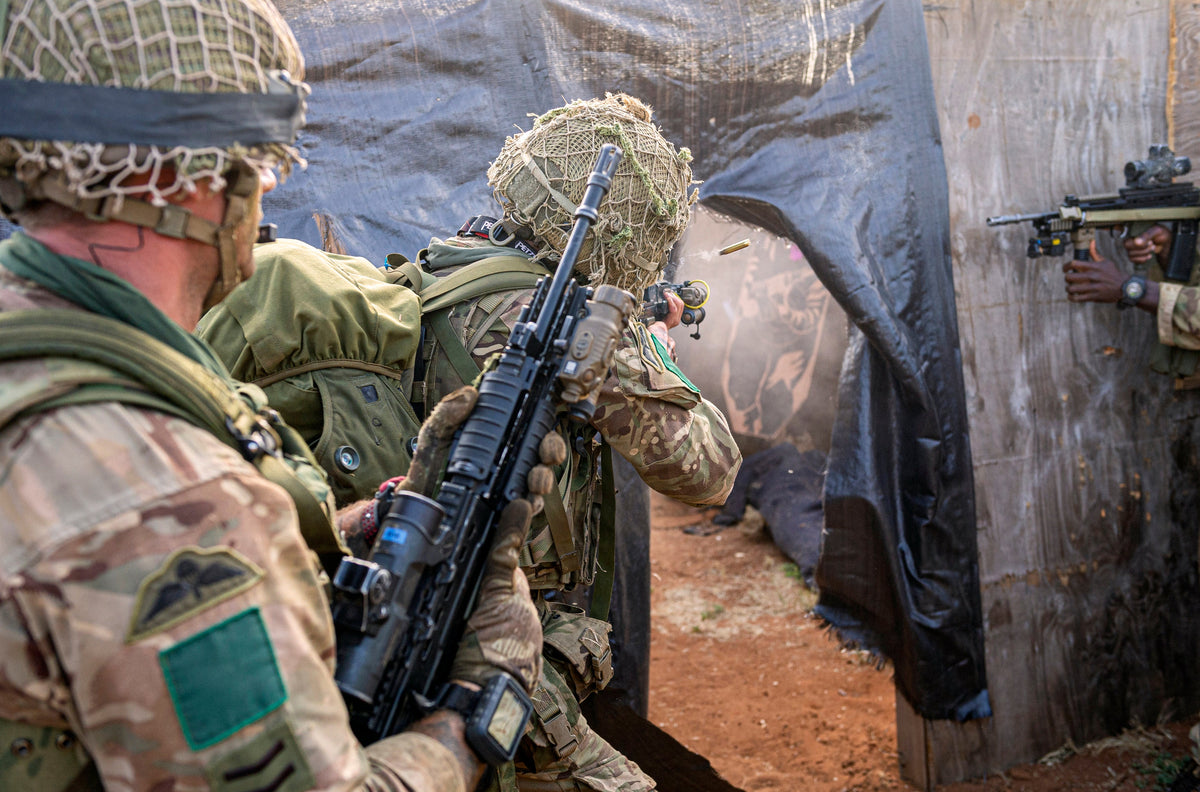
BATUK is not a battle honour and Kenya is not a British training backdrop.
The British Army Training Unit Kenya exists through a defence relationship with the Kenyan government, works alongside the Kenya Defence Forces and trains on a mixture of military and licensed land. For generations of British soldiers, however, BATUK is also remembered in a more immediate way: heat, dust, long moves, live-fire ranges, vehicles, animals, altitude, convoy discipline and ground that behaves nothing like Salisbury Plain.
An Iron Standard account needs both levels — the formal host-nation relationship and the soldier’s experience of the training area.

At a glance
- Name: British Army Training Unit Kenya — BATUK.
- Main base: Nyati Barracks, Laikipia Air Base East, near Nanyuki.
- Role: support demanding British and joint UK–Kenya military training.
- Host nation: Kenya.
- Principal partner: Kenya Defence Forces (KDF).
- Training: infantry, artillery, engineers, logistics, medical, combined activity and live fire.
- Key remembered areas: Laikipia training land and Archer’s Post in Samburu.
How long has Britain trained in Kenya?
The current BATUK organisation is part of a much longer post-independence defence relationship.
An official UK statement to the Kenyan parliamentary inquiry records a UK–Kenya defence agreement signed on 3 June 1964 as the start of the British Army’s training presence in independent Kenya.
From 1995 to 2007 the organisation was known as the British Army Training and Liaison Staff Kenya — BATLSK. From 2008 it became BATUK.
That distinction matters. “BATUK” is the current organisational name, not the name of every British exercise in Kenya since the 1960s.
Why Kenya?
The British Army’s own description calls BATUK its largest contingent of soldiers in Africa.
The value of the training environment is scale and difference. Units have to work in conditions that British home training areas cannot reproduce fully: heat, dust, altitude, different vegetation, long distances, unfamiliar wildlife and a host-nation operating environment.
That difference exposes habits. Water planning becomes harder to ignore. Vehicle maintenance changes. Dust affects weapons, optics and engines. Navigation errors grow more expensive when the next reference point is kilometres away.
Nanyuki and Nyati Barracks
BATUK headquarters moved from Kifaru Barracks in Nairobi to Nanyuki in 2009, initially using the Nanyuki Showground while a permanent base was developed.
Nyati Barracks, inside Laikipia Air Base East, became the permanent modern hub. The UK opened a major new training facility there in 2021 after a £70-million infrastructure programme.
The base includes headquarters, accommodation, messes, stores, workshops, welfare and support facilities. That infrastructure is the part soldiers see before the tactical training begins: reception, issuing, vehicle preparation, movement and the long process of getting a battlegroup ready to leave camp.
The training areas
The UK Defence Training Estate guidance lists multiple British-used training areas in Kenya. BATUK activity makes use of Kenyan gazetted areas and, under the defence agreement, designated areas licensed for training.
That legal distinction is important because the landscape is not an empty military reservation. Some training takes place on land with civilian, community, wildlife and livestock considerations.
Modern BATUK planning therefore involves Kenyan authorities, landowners, local leaders, wildlife organisations and range-safety staff as well as the exercising unit.
Laikipia
Laikipia is the centre of most BATUK activity and the location most closely associated with Nanyuki.
Its mix of open ground, broken terrain and long distances allows infantry and supporting arms to work through problems at a scale larger than most UK areas.
Recent UK–Kenya exercises have also used tactical engagement simulation, giving exercise control a live picture of movement and engagements rather than relying only on end-of-day reconstruction.
Archer’s Post
Archer’s Post in Samburu is another name that has entered British Army service memory.
DIO’s range-safety work specifically includes Archer’s Post Training Area alongside Laikipia. The annual Range Sweep programme is designed to locate and clear explosive remnants and keep both soldiers and local communities safer.
For an exercising soldier, the name often means something less administrative: dry ground, long convoy moves, range work and the sense of being very far from a UK training estate.
What an eight-week Kenya exercise is trying to do
The British Army states that, under the agreement with Kenya, up to six infantry battalions a year can conduct eight-week exercises.
The point is not eight weeks of continuous live firing. A package can include reception, acclimatisation, individual and collective training, field phases, live-fire progression, joint activity with KDF, validation and recovery.
The length gives commanders time to build complexity rather than jump straight from zero to a battlegroup attack.
Joint training with the Kenya Defence Forces
Modern BATUK is increasingly presented as bilateral rather than simply British training hosted in Kenya.
British and Kenyan troops train together in infantry, artillery and other roles. Exercise Haraka Storm has incorporated KDF elements and new simulation technology. British medical units have also worked with Kenyan military medical personnel and local communities.
Interoperability is not a slogan at field level. It means learning whether two forces use the same words for the same action, whether radios connect, how orders are understood and where equipment or doctrine differs.
Live fire
Kenya allows units to conduct live-fire training in terrain and heat that place real demands on people and equipment.
The training progression matters. Safety templates, arcs, danger areas, medical plans and communications have to be controlled before ammunition is introduced.
The more complex the exercise becomes — infantry, mortars, artillery, engineers and vehicles moving together — the more important the safety architecture becomes.
Ryan Small’s mortar-line view
The existing Gallus service-memory piece records Ryan Small’s experience as a Royal Welsh mortarman and the way indirect fire forces a soldier to read a training area differently.
A mortar detachment is constantly asking practical questions:
- Can the mortar line and its ammunition reach the firing point?
- What ground masks the position?
- Can the observer see enough to control fire?
- Will the radio link survive the distance and terrain?
- What arcs can be fired safely?
- How does ammunition get forward when the rate of fire increases?
That is the useful lived-experience layer. The training area stops being scenery and becomes a network of firing points, observation, routes and resupply.
Artillery in Kenya
Official imagery from Exercise Askari Storm shows L118 Light Guns firing in the Kenyan training area. Artillery adds another scale to the exercise: gun lines, command posts, observation, ammunition and airspace all have to be fitted into the same plan as infantry movement.
Large areas make it possible to rehearse those relationships more realistically than a small range where every element is compressed.
BATUK Artillery Training T-Shirt — Live-Fire Training in Kenya →
Convoys: the bit that looks boring until it fails
Training areas with long internal distances turn movement into a military problem.
A convoy has to manage spacing, route discipline, communications, breakdowns, recovery, fuel, water, security and timings. One vehicle fault can block a narrow route. One navigation error can put an entire packet late.
That is why convoy work is not dead time between exercise phases. It is part of the exercise.
BATUK Convoy Operations T-Shirt →
Heat, dust and altitude
Environmental stress changes decision-making.
Heat increases water demand and fatigue. Dust gets into weapons, engines, optics and clothing. Altitude can make exertion feel different for troops newly arrived from the UK.
None of those problems is dramatic in isolation. Together they punish bad routine.
Wildlife and civilians are part of the safety picture
Recent official BATUK safety guidance describes helicopter overflights before live firing to ensure training areas are clear of people, livestock and wildlife.
DIO works with Kenya Wildlife Service, community elders, local rangers, landowners and managers.
That is a reminder that an overseas training area operates inside someone else’s country and environment. Military realism does not remove the obligation to protect people and land outside the exercise.
Range Sweep and unexploded ordnance
Annual range clearance is a significant part of BATUK safety.
Live-fire training leaves an explosive legacy if rounds fail to function. Range Sweep exists to locate and dispose of that hazard.
This is not glamorous work, but it is part of the true lifecycle of military training: fire the range, record it, inspect it, clear it and hand the land back in a safe condition.
Community engagement
BATUK employs Kenyan staff and supports community projects, including medical outreach and infrastructure work.
Official UK material records around 600 permanently employed Kenyan nationals supporting the base’s day-to-day running.
Those relationships are part of the footprint. BATUK is not only the British soldiers who fly in for an exercise; it also includes the people who maintain, supply and enable the training year-round.
The defence agreement
British forces train in Kenya through bilateral defence agreements, not by unilateral right.
The agreement defines issues such as visiting-force status, exercises, designated training areas and cooperation with Kenyan authorities.
The legal and political framework is therefore part of the military story. Without it, there is no BATUK.
Scrutiny and accountability
BATUK has also faced serious public and parliamentary scrutiny in Kenya and the UK over conduct, environmental issues, land use, safety and the behaviour of visiting personnel.
The existence of formal inquiries is part of the contemporary record and should not be edited out of a serious history because it sits awkwardly beside the training narrative.
At the same time, allegations and individual cases have different evidential and legal statuses. This Field Note does not collapse them into a single judgement. The official inquiry material is linked below for readers who want the current institutional record.
Why soldiers remember Kenya
Most training memories are small.
A range. A dust cloud. A route that seemed to last forever. A vehicle fault. A herd on the horizon. A firing point. A water resupply that arrived later than you wanted.
Repetition turns those details into unit history. Years later, “Nanyuki” or “Archer’s Post” can unlock a complete period of service in one phrase.
BATUK is not BATUS
Gallus previously treated BATUK and BATUS together because both are major overseas British Army training environments. They should also be understood separately.
Kenya is a hot, varied East African training environment embedded in an active bilateral relationship with KDF and local communities. Suffield is prairie scale, historically dominated by armoured combined-arms manoeuvre and now being reused for new forms of joint experimentation.
Read BATUS — British Army Training at Suffield →
Related Gallus service-history pieces
Related designs
Sources & further research
- British Army — British Army Training Unit Kenya.
- UK MOD / DIO — Nyati Barracks.
- British High Commission Nairobi — UK/Kenya joint military training.
- British High Commission Nairobi — Haraka Storm and tactical engagement simulation.
- DIO — training-area safety and Range Sweep.
- UK–Kenya Defence Cooperation Agreement.
- Official BATUK inquiry written statement — historical and institutional background.
CONTINUE THE STORY
More from this campaign
Read it, reference it or wear it — the related pieces are kept together here.
FEATURED DESIGN
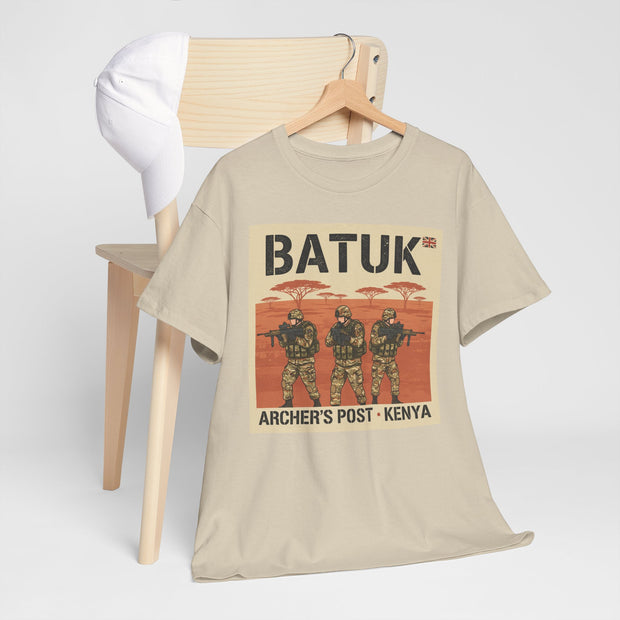
BATUK Archer’s Post T-Shirt — British Army Training in Kenya
€29,95 EUR
View the design →FIELD NOTES
Get new Field Notes by email
New research, campaign guides and useful references without a daily sales barrage.
