


BATUS: Complete Field Guide — Suffield, Alberta, Armoured Training & the British Army on the Prairie
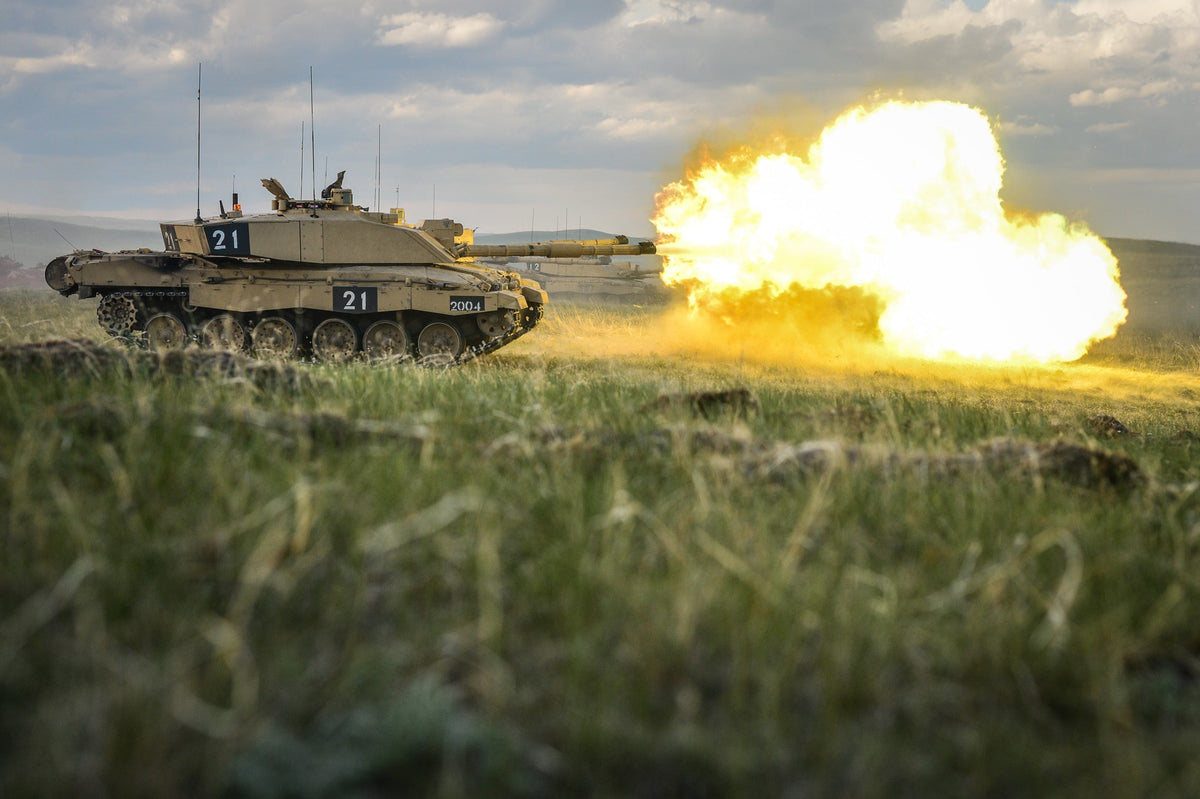
BATUS used to mean heavy armour, dust and distance. Challenger 2s and Warriors crossed an Alberta prairie big enough for a battle group to become genuinely dispersed. Artillery fired at ranges difficult to reproduce in Britain. Logistics, recovery and communications had to work over real distance rather than training-area distance.
That classic version of British Army Training Unit Suffield changed sharply after 2020. Heavy equipment was repatriated and large annual armoured packages stopped. But the story did not end. In 2026 British and Canadian troops were again using Suffield — this time to test drones, electronic warfare, AI-enabled command systems and recce-strike tactics.
BATUS has moved from one era of British Army training into another.

At a glance
- Name: British Army Training Unit Suffield — BATUS.
- Location: Canadian Forces Base Suffield, Alberta.
- British training began: 1972.
- Base area: approximately 2,700 square kilometres.
- Manoeuvre Training Area: approximately 1,588 square kilometres.
- Historic role: large-scale armoured and combined-arms live-fire training.
- Classic equipment: Challenger 2, Warrior, artillery, engineers and support fleets.
- Current direction: renewed British–Canadian experimentation and training including drones, electronic warfare and recce-strike.
Why Suffield exists
The land has a deeper military history than BATUS itself.
Canada and Britain acquired the large Suffield block during the Second World War for defence research, including chemical and biological defence work. In 1971 the two governments reached a further arrangement that led to the creation of CFB Suffield and the use of a large military training area by the British Army.
BATUS began training there in 1972.
Scale: the whole point
CFB Suffield is the largest military training area in Canada.
The Canadian government gives the base as roughly 2,700 square kilometres, with a Manoeuvre Training Area of about 1,588 square kilometres.
The number is impressive. The tactical consequence is more important.
At Suffield, an armoured battle group can spread out. Artillery can be separated from manoeuvre units. Logistics can sit far enough back that resupply takes time. Radio range and relay matter. A recovery vehicle can be genuinely distant from a broken tank.
Why British armour loved it
Britain has excellent training areas, but none offers the same combination of prairie scale and freedom for heavy combined-arms manoeuvre.
For decades BATUS allowed armour, mechanised infantry, artillery, engineers, air defence, logistics and equipment support to train together as a battle group.
The Canadian government describes BATUS as the British Army’s premier live-fire training establishment.
Classic BATUS
The version many veterans remember was built around an extensive permanent vehicle fleet in Canada.
Before the later drawdown, Canadian government material records more than 1,000 British vehicles at Suffield, including a full complement of Challenger 2 tanks and Warrior infantry fighting vehicles.
That mattered because units could fly into Canada and draw a training fleet rather than ship an entire armoured brigade’s worth of vehicles across the Atlantic every season.
Challenger 2 and Warrior
The Challenger 2 / Warrior pairing defined the visual memory of BATUS for years.
Tanks brought long-range direct fire and protection. Warrior carried armoured infantry who could fight mounted or dismounted. Engineers opened routes and obstacles. Artillery shaped the ground ahead. Logistics kept fuel and ammunition moving.
The exercise only made sense if those arms learned to operate as one system.
Prairie Storm and the training progression
Exercises such as Prairie Storm built units through live firing and force-on-force training.
MOD material from 2011 describes live-fire phases using GPMGs, AS-90 artillery, Challenger 2 and Warrior, followed by tactical engagement simulation that recorded simulated casualties and engagements.
The sequence matters: first prove weapons and drills under controlled live-fire conditions, then use simulation to create an enemy that thinks and fights back.
Why the prairie changes command
A map can hide distance.
On the prairie, a commander can physically lose the battle group across kilometres of open ground. Dust hides movement. Small errors in bearing become large positional errors. A radio net fills with reports from callsigns that may be nowhere near one another.
The empty-looking landscape makes coordination harder, not easier.
The Lone Tree problem
Sparse terrain makes tiny landmarks disproportionately important.
A lone tree, track junction, oil installation or mast can become the navigation reference for an entire exercise phase because there may be little else to describe.
That is how an otherwise ordinary object becomes part of unit folklore.
BATUS Lone Tree T-Shirt — Suffield Training Area Heritage →
Live fire at battle-group scale
Large-scale live firing is not simply “more weapons firing”.
It requires precise coordination of danger areas, arcs, ammunition, observers, airspace, movement lanes and safety staff. One unit may be firing while another manoeuvres to a position that will later become part of the same engagement.
Range safety therefore becomes a command system running alongside the tactical system.
Artillery and depth
Artillery gains meaning when the gun line is far enough away that communications, ammunition supply and movement matter.
On a compressed range the supporting arm can feel physically close to the infantry it supports. Suffield allows the distances to become more realistic.
That makes targeting, observation and command relationships easier to understand — and easier to get wrong.
Recovery: the part armoured manoeuvre cannot fake
Heavy armour breaks.
Tracks fail. Vehicles bog. Engines overheat. Components fail under load. The longer the movement and rougher the ground, the more important recovery becomes.
A battle group that can attack but cannot recover and repair its vehicles is not combat effective for long.
BATUS forced units to rehearse the ugly logistical side of armour at scale.
Fuel and ammunition
A Challenger 2 does not train on enthusiasm.
Armoured battle groups consume huge quantities of fuel and ammunition. Long distances magnify the demand because the support fleet itself burns fuel delivering fuel.
The prairie makes the logistic chain visible. Every kilometre forward stretches the distance back to replenishment.
Night on the prairie
At night, landmarks disappear and distance becomes harder to judge.
Night sights allow crews to detect and engage targets, but the commander still has to know where friendly vehicles are, how formations are aligned and whether a radio report corresponds to the ground picture.
Technology helps individuals see. It does not automatically give the formation shared understanding.
From Medicine Man to Afghanistan-era training
BATUS changed with operational priorities.
During the Afghanistan era, training shifted to include hybrid scenarios, counter-IED skills and force-on-force packages intended to reflect contemporary operations rather than only Cold War armoured warfare.
Exercise Prairie Thunder combined traditional kinetic training with tactical simulation and mission-focused preparation.
That flexibility is one reason Suffield remained useful long after the Cold War scenario that shaped classic BATUS had faded.
2020–2023: the drawdown
Large British training packages were halted during the pandemic and did not return in their previous form in 2021 or 2022.
The UK then repatriated Challenger 2 tanks, artillery and much of the heavy vehicle fleet. In 2023 the Canadian government recorded a British intention to reduce operations substantially and cease the old training model for at least two years.
For a time it looked as though the BATUS many soldiers remembered might have ended permanently.
BATUS was reduced — not erased
Canadian official material was explicit that BATUS was not formally closed.
The infrastructure, agreements and relationship remained. What disappeared was the old scale and permanent heavy fleet.
That distinction has become important again because British training has returned in a different form.
2026: Exercise Rhino Bizz
In 2026 the British Army reported a 350-strong British–Canadian force training at BATUS on Exercise Rhino Bizz.
The British element centred on 16 Air Assault Brigade, with 2 PARA and supporting artillery, engineers, signallers and medics working alongside 3rd Battalion Princess Patricia’s Canadian Light Infantry.
The focus was not a Challenger 2 battle-group attack. It was recce-strike: linking drones, electronic warfare, communications, AI-enabled processing, mortars, Javelin and infantry action.
Why Suffield still works for drones and EW
The same feature that made Suffield ideal for tanks makes it useful for modern technology: space.
The British Army stated that the prairie allowed drones to fly long distances, electronic-warfare systems to jam signals and troops to carry out live explosive strikes against a simulated enemy using similar technology.
Large geography creates realistic sensor and communications problems. You cannot test long-range finding and striking properly if the range boundary arrives first.
From armour to recce-strike
This does not mean tanks have become irrelevant or that BATUS has changed from “old warfare” to “new warfare”.
It means the training problem has moved.
Classic BATUS taught formations how to coordinate mass, firepower and logistics across space. Modern BATUS is exploring how to coordinate sensors, data, electronic warfare and precision effects across the same space.
The prairie remains the constant.
The BATUS Future Project
In 2025 the UK and Canadian prime ministers committed to work toward a new permanent arrangement for long-term use of BATUS through a “BATUS Future Project”.
The stated direction includes training, equipment development, test and evaluation and defence innovation.
That makes the current period a transition rather than a simple postscript to the armoured era.
Ryan’s training-area perspective
The existing Gallus training-area piece records Ryan Small’s mortar perspective: ground is remembered in terms of firing points, masking, observation, communications and ammunition flow.
Suffield magnifies those questions because distance creates consequences. A poor firing point can be kilometres from the next workable one. A broken radio link can isolate the observer. Ammunition resupply is a movement plan, not a short drive.
That is why veterans often remember training areas in technical fragments rather than scenic descriptions.
BATUS and BATUK are not interchangeable
Both became major overseas British Army training environments, but they solve different problems.
Kenya provides heat, varied ground, bilateral KDF training and a live host-nation environment. Suffield provides immense prairie scale, historically for armoured battle groups and now increasingly for experimentation.
Read BATUK — British Army Training in Kenya →
Why veterans still talk about it
BATUS is one of those place names that works like a password.
To someone who has never served there, “Suffield” is a town and a base. To a soldier who has done a package, it may mean weeks of dust, maintenance, live fire, prairie tracks, radios, vehicle states and people they have not seen for years.
Training areas become service history because ordinary repetition is what most military careers are actually made from.
Related Gallus service-history pieces
Related design
BATUS Lone Tree T-Shirt — Suffield Training Area Heritage →
Sources & further research
- Government of Canada — Canadian Forces Base Suffield / BATUS.
- DRDC Canada — Suffield history and 1971 British–Canadian agreement.
- DIO — Getting battle ready with BATUS.
- UK MOD — mechanised battle-group training at BATUS.
- British Army — Exercise Rhino Bizz, 2026.
- British Army — recce-strike, drones and EW at BATUS, 2026.
- UK–Canada joint statement — BATUS Future Project.
CONTINUE THE STORY
More from this campaign
Read it, reference it or wear it — the related pieces are kept together here.
FEATURED DESIGN
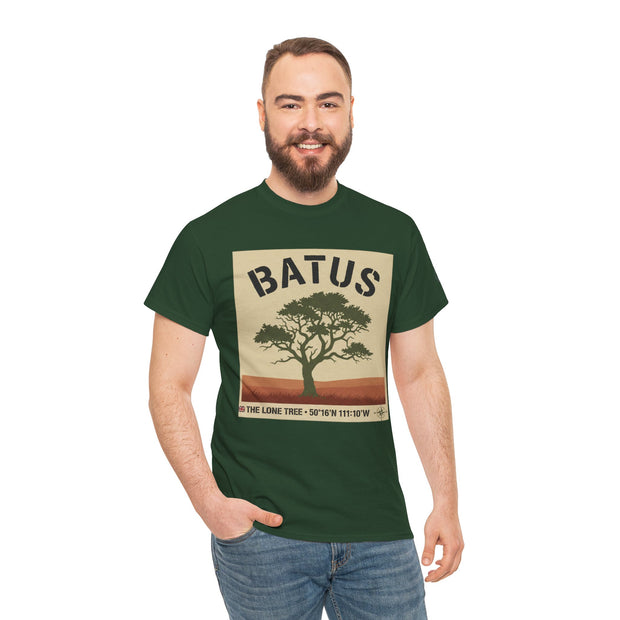
BATUS Lone Tree T-Shirt — Suffield Training Area Heritage
€29,95 EUR
View the design →FIELD NOTES
Get new Field Notes by email
New research, campaign guides and useful references without a daily sales barrage.
