


Utah Beach D-Day 1944: The Landings, Causeways & Cotentin Fight — Complete Field Guide
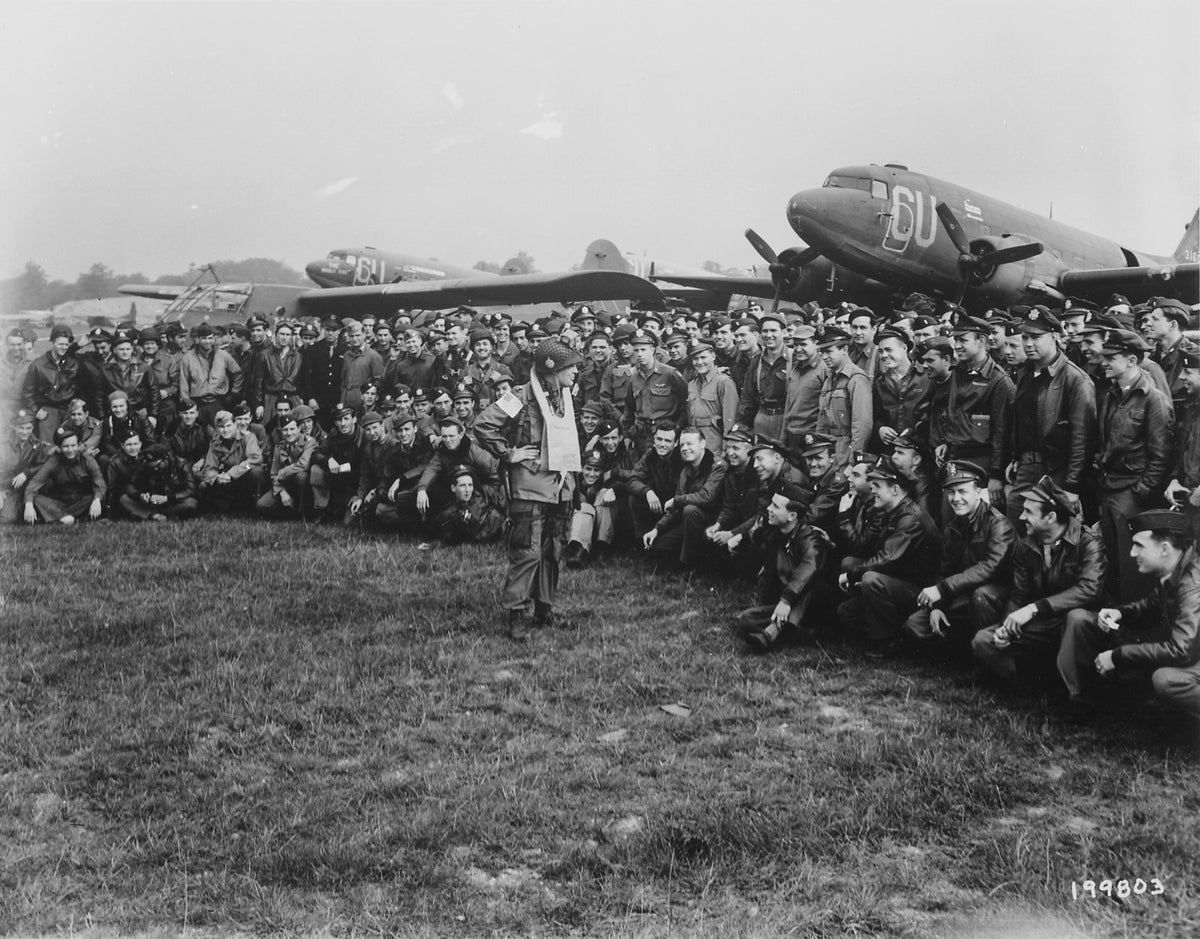
Utah Beach is often described as the easy American beach. Compared with Omaha, the casualty figures make that description understandable. They also make it misleading.
The first assault wave landed in the wrong place. Two control vessels intended to guide part of the approach had already been lost or disabled. The beach was backed by ground deliberately flooded by the Germans, forcing movement onto narrow causeways that could be covered by fire. Thousands of American airborne troops were scattered across the Cotentin during the night, often nowhere near their planned drop zones. Some drowned in flooded fields before firing a shot. North of the landing area, German coastal batteries remained dangerous. Offshore, ships and landing craft struck mines. Inland, men of the 22nd Infantry spent hours wading through marsh water deep enough to hide ditches that could put a fully equipped soldier over his head.
Utah worked because the parts that went wrong did not all go wrong in the same direction. A navigational error put the first wave opposite weaker defences. Naval officers altered the launch point of the amphibious tanks when the sea and delay made the original plan look wrong. Brigadier General Theodore Roosevelt Jr. accepted where he was and reorganised the attack from there. Engineers cleared the beach quickly. The airborne troops, despite enormous dispersion, disrupted German movement and seized enough of the exits inland for the seaborne assault to keep moving.
It was a successful landing. It was not a simple one.
At a glance
- Date: 6 June 1944.
- Operation: Neptune, the amphibious phase of Operation Overlord.
- US command: VII Corps, First US Army.
- Assault division: US 4th Infantry Division.
- Principal first-wave regiment: 8th Infantry Regiment, with the 22nd and 12th Infantry Regiments following.
- Armour: 70th and later 746th Tank Battalions among the armoured forces landed.
- Beach engineers: 237th and 299th Engineer Combat Battalions, Naval Combat Demolition personnel and supporting specialist units.
- Naval command: Assault Force U under Rear Admiral Don P. Moon.
- Airborne support inland: 101st and 82nd Airborne Divisions.
- Main immediate German coastal formation: 709th Infantry Division, including elements of Grenadier Regiment 919.
- Landing error: the first wave came ashore roughly 2,000 yards south of its intended beaches, astride Exit 2.
- 4th Infantry Division D-Day casualties: 197 in the official Army account; the 8th and 22nd Infantry Regiments together suffered 118, of whom 12 were fatalities.
- By the end of D-Day: more than 20,000 troops and around 1,700 vehicles had come ashore through Utah according to the official Army history.
Why Utah Beach was added to the invasion
Utah sat at the base of the Cotentin Peninsula, separated from Omaha by the Vire estuary and marsh country. Its inclusion in the final Overlord plan gave the Americans a direct route into the Cotentin and toward Cherbourg, whose deep-water harbour was strategically important to any prolonged campaign in France.
The price was isolation. A Utah force could not simply lean sideways into the formations on Omaha. It would land on a coast backed by inundated ground, with German forces between it and Cherbourg and with its southern flank dependent on closing the gap toward Carentan. That is why the airborne assault was not an optional flourish. It was part of the beach plan.
The 101st Airborne Division was tasked with securing routes inland from Utah and disrupting German reinforcements. The 82nd Airborne Division operated farther west around Sainte-Mère-Église and the Merderet crossings. The beach and airborne battles therefore have to be understood together even when they are covered in separate Gallus field guides.
The ground: a beach, a wall, then water
Utah's immediate beach was flatter and less dramatically dominated than Omaha, but that did not mean movement inland was free. Behind the dunes lay low ground that the Germans had deliberately flooded by controlling drainage and waterways. The inundations channelled traffic toward a small number of causeways.
To an attacker, that created a nasty geometry. Troops could land successfully, cross the seawall and then discover that the direct route to the next objective was waterlogged. Vehicles could not simply fan out across the fields. Causeways became the arteries of the invasion, which also made them obvious places for defenders to shell or block.
The official US Army study makes the problem clear. When elements of the 22nd Infantry could not use the northern route, some units had to wade roughly two miles through the flooded ground. The water was usually around waist depth, but ditches and holes were hidden beneath it and soldiers sometimes dropped into water over their heads. The 1st and 2nd Battalions later spent about seven hours in the marsh before reaching dry ground near Saint-Martin-de-Varreville. [1]
This is the first reason to retire the phrase “easy Utah”. Light beach opposition did not turn the countryside behind it into easy terrain.
The exits
The causeways running inland were numbered and linked the beach to the road network and villages beyond the flooded area. Exit 2, near La Madeleine, became the crucial artery on D-Day because the first wave landed opposite it rather than farther north as planned. Other exits were used or contested as the 4th Division expanded the beachhead.
The 101st Airborne's mission included securing these routes from the inland side. This was one of the cleverest pieces of the Utah plan: the seaborne troops would attack from east to west while airborne forces fought around the far ends of the causeways and road junctions. The difficulty was that parachute dispersion made the execution much less tidy than the map suggested.
What the Americans expected to face
The immediate coast was held by the German 709th Infantry Division, a static formation responsible for a large section of the Cotentin coast. Its units included Grenadier Regiment 919. The division contained a mixture of personnel: some experienced Germans, some older or medically downgraded soldiers and so-called Ost troops from areas occupied by Germany. That made the formation uneven, not harmless.
The German system relied on strongpoints, mines, beach obstacles, artillery and the flooded hinterland. The idea was not necessarily to line every yard with elite infantry. It was to make the coast hard to leave, slow the attackers on the causeways and allow artillery or reserves to strike a force trapped between sea and marsh.
Farther inland the Americans also had to reckon with the 91st Air Landing Division and 6th Parachute Regiment, among other formations. Those units matter especially to the airborne and Carentan battles. They are mentioned here because Utah cannot be judged solely by what happened in the first hundred metres of sand.
The American assault order
| Formation | Role |
|---|---|
| VII Corps | Lt. Gen. J. Lawton Collins' corps controlled the Utah/Cotentin operation. |
| 4th Infantry Division | Maj. Gen. Raymond O. Barton's division made the seaborne assault. |
| 8th Infantry Regiment | First assault regiment. Its 1st and 2nd Battalions formed the initial infantry wave, with the 3rd Battalion following. |
| 22nd Infantry Regiment | Follow-on regiment; elements attacked northward and others crossed the flooded hinterland. |
| 12th Infantry Regiment | Follow-on regiment committed through the beachhead and flooded ground. |
| 70th Tank Battalion | Provided key armoured support including DD amphibious tanks and tank-dozers. |
| 746th Tank Battalion | Additional armour landed during the build-up. |
| 237th & 299th Engineer Combat Battalions | Obstacle clearance, seawall gaps, mines, routes and assault-engineer tasks. |
| 1st Engineer Special Brigade | Organised the shore, movement, unloading and transformation of Utah from assault beach to logistics base. |
| 101st Airborne Division | Secured beach exits, road junctions and approaches in the Utah hinterland. |
| 82nd Airborne Division | Seized Sainte-Mère-Église and fought for the Merderet crossings and western flank. |
| Assault Force U | Rear Adm. Don P. Moon's naval force delivered and supported the Utah assault. |
Before Utah: Exercise Tiger
One of the darkest facts in the Utah story occurred six weeks before the invasion and on the other side of the Channel.
Exercise Tiger was intended as a full-scale rehearsal for Force U at Slapton Sands in Devon. The beach had been selected because its physical characteristics offered useful practice for the coming assault. Ships and vehicles were loaded much as they would be for the real operation, and the training was deliberately realistic. [4]
On the night of 27–28 April, German S-boats penetrated the escort screen of a convoy of eight LSTs. Three were torpedoed; two sank and another was badly damaged. The Naval History and Heritage Command gives at least 441 US Army and 198 US Navy dead in the attack and describes the overall cost of Exercise Tiger as more than 650 lives. That was more than the losses later suffered in the actual Utah landing. [4]
The detail is sobering for another reason. Force U learned from disaster. Communications, escort procedures, loading, control and landing arrangements were examined before 6 June. Rear Admiral Moon carried the weight of the rehearsal into D-Day. The polished Utah operation did not emerge from a flawless training programme. It emerged partly from mistakes paid for in lives.
Before the first landing craft: four men with knives
At 04:30, detachments from the 4th and 24th Cavalry Squadrons moved against the Îles Saint-Marcouf offshore. The Allies suspected that the islands might conceal an observation post or a means of controlling minefields.
Before the main detachment landed, four men armed only with knives swam in to mark the beaches. They found no enemy garrison, but the islands were heavily mined and casualties were suffered. By 05:30, 132 men had occupied the islands. [1]
It is a wonderfully strange way for the largest amphibious invasion in history to begin in this sector: before thousands of ships, aircraft, tanks and artillery pieces took over the scene, four soldiers went ashore in the dark carrying knives.
05:50 — the bombardment
At H-minus-40, the bombardment ships opened fire. The Ninth Air Force sent 276 B-26 Marauders over the Utah sector and dropped 4,404 250-pound bombs on seven targets. The official Army history notes that roughly one-third of the bombs fell between the high- and low-water marks. Utah's air attack was substantially more accurate than the heavy-bomber effort at Omaha. [1]
Seventeen fire-support craft equipped with rocket launchers joined the beach drenching. The result was smoke, dust and sand thrown high enough to make navigation more difficult just when the control craft needed clear landmarks.
That is an important D-Day pattern: support that helps in one way can hurt in another. Bombardment suppressed defenders. It also helped obscure the beach the landing craft were trying to identify.
The approach begins to go wrong
The first navigational trouble began before H-Hour. The secondary control vessel for Red Beach fouled its propeller on a dan buoy. The primary Red control vessel was then sunk, probably by a mine, while still more than 7,000 yards offshore. An LCT behind the Green control vessel also hit a mine and sank. [1]
That left one control vessel carrying an unreasonable amount of responsibility. Add a strong tidal current, smoke from the bombardment and the normal problems of steering formations of small craft in rough water, and the eventual error becomes easier to understand.
The DD tanks: somebody changed the plan
Eight LCTs carried four duplex-drive Sherman tanks each for the first assault. The plan called for them to be launched around 5,000 yards offshore. With the approach running late and the control situation deteriorating, the surviving Green Beach control craft brought them closer and the tanks were discharged at about 3,000 yards instead. [1]
That decision matters because Utah is often contrasted with Omaha by saying the swimming tanks “worked” at one beach and “failed” at the other. The sea did not suddenly become a different technology problem. Human judgement changed the exposure. Naval officers shortened the swim rather than insisting on a planned launch point that no longer made sense.
It is another recurring lesson of Utah: a deviation from the plan could be the correct decision.
06:30 — six hundred men in the water
The first wave comprised twenty LCVPs, each carrying a thirty-man assault team from the 8th Infantry. At around H-Hour the ramps dropped and roughly 600 men stepped into waist-deep water, with about 100 yards or more to wade before reaching dry sand. [1]
There was surprisingly little opposition at the exact moment of touchdown. That does not mean the men knew in advance that the landing would be light. They had crossed the Channel expecting an Atlantic Wall assault and had no reliable way of knowing which bunkers or guns were still alive.
Then came the bigger surprise: they were in the wrong place.
Two thousand yards south
The 1st and 2nd Battalions of the 8th Infantry had been assigned separate landing areas farther north. Instead they came ashore astride Exit 2, about 2,000 yards south of the intended point. [1]
The error could have wrecked the landing schedule. Companies had specific targets, routes and strongpoints. An amphibious plan depends heavily on getting particular units opposite particular pieces of terrain. Put the right battalion on the wrong beach and every line on the map suddenly points somewhere else.
At Utah, the wrong beach turned out to be better.
The obstacles were less dense and the immediate German defences were weaker than those opposite the intended landing areas. That was luck. Turning the luck into advantage was not.
Theodore Roosevelt Jr.
Brigadier General Theodore Roosevelt Jr., assistant division commander of the 4th Division, had asked to go ashore with the first wave. His first two requests had been denied; a written request was eventually approved. He landed with the assault troops and moved around the beach under fire organising men and commanders. His conduct later earned a posthumous Medal of Honor. [5]
Roosevelt was 56, suffered from heart disease and severe arthritis and walked with a cane. None of those details are necessary to make his decision impressive, but they make the scene unusual: one of the oldest senior officers on the invasion beaches was moving around among the first assault troops while younger men were still trying to work out where they had landed.
He went inland enough to identify the causeways, returned to the beach, conferred with Lieutenant Colonels Conrad Simmons and Carlton MacNeely, and reorganised the assault around the terrain actually in front of them. The line associated with the moment is short enough to survive its repetition: “We'll start the war from right here.” [1]
The value of the episode is not the quote. It is that Roosevelt did not waste time trying to drag an entire division sideways along a contested shore simply to restore the map. He preserved the objective and changed the route.
Arthur Jahnke: the view from WN5
One German defender gives us the opposite perspective. Lieutenant Arthur Jahnke was a young but experienced officer commanding part of the WN5 strongpoint around La Madeleine. He had served on the Eastern Front, been wounded and transferred to Normandy. US Army historical writing later described him as 24 years old on D-Day. [13]
WN5 was supposed to help control the area around the causeway and the beach. But the preparatory bombing and naval fire were far more effective here than on Omaha. The German defenders were shaken and equipment was damaged before the landing craft arrived. The 4th Division's first wave then came ashore south of the strongest intended killing ground.
Jahnke continued to fight until naval fire struck the position. The US Army historical account says he was knocked unconscious and partly buried by the blast of a shell from USS Nevada. Badly wounded, he was captured and evacuated to Britain aboard the same wider invasion fleet that had brought his opponents to France. [13]
His story is useful because it complicates another easy description of Utah. The immediate beach defence was not simply populated by unwilling men who all surrendered without a fight. Some positions were badly damaged and demoralised; some men surrendered; others fought until weapons, command or consciousness failed.
Explore this history
This Field Note has a directly related Gallus design and a wider campaign collection.
View the related Gallus design → | Explore D-Day & Normandy 1944 →
The beach engineers
Behind the assault infantry came a Beach Obstacle Task Force under Major Herschel E. Linn. Naval demolition personnel were responsible for obstacles below the waterline and Army engineers for those above it. Tank-dozers supported the work. [1]
The plan called for carefully phased teams to open eight fifty-yard gaps. Reality compressed the waves. Two LCTs were lost on the approach. One LCM carrying engineers was hit as its ramp dropped and six men were killed. Army and Navy demolition teams ended up arriving much more closely together than planned.
Each demolition man could be carrying around sixty pounds of explosives as he waded ashore. The expected obstacle pattern was also wrong: all three main bands were exposed rather than partly submerged. The teams took advantage of the situation and abandoned the limited-gap concept. Instead of merely cutting corridors, they began clearing the beach more broadly.
Within about an hour, the main beach obstacle problem had been cleared sufficiently for later waves. Of roughly 400 men involved in the task force, six were killed and thirty-nine wounded. [1]
That success is one reason Utah can look easy in hindsight. The obstacle belt did not disappear on its own. Men arrived carrying explosives and removed it quickly enough that the following waves inherited a much cleaner problem.
Blowing the seawall and opening Exit 2
Engineers also had to make the beach useful to vehicles. Companies of the 237th Engineer Combat Battalion blasted gaps in the seawall, removed gates and mines and began building routes through the dunes. Exit 2 became the principal D-Day traffic artery. [1]
German artillery could still reach the area. When fire began interrupting the entrance, engineers broke an alternative trail through fields to reduce the dependence on one obvious choke point.
This is less dramatic than a bayonet charge and far more important to the survival of the beachhead. By afternoon the invasion required roads more than hero photographs. Tanks, artillery, ambulances, ammunition and food all had to cross the same flooded strip.
The 8th Infantry moves inland
After two or three hours spent reducing immediate resistance and reorganising, the 1st and 2nd Battalions of the 8th Infantry began pushing inland by altered routes. Company-sized or smaller groups cleared local positions. Houses and road junctions were searched. By then more infantry waves were coming ashore and the beach was becoming a staging area rather than the front line.
The 3rd Battalion, 8th Infantry moved inland through Exit 2. The 3rd Battalion, 22nd Infantry headed north along the coast against remaining strongpoints. By 08:00 four infantry battalions were ashore; two more from the 22nd landed around 10:00. [1]
Ellison “Bill” Parfitt: an ordinary infantryman's Utah
Private First Class Ellison W. Parfitt served with E Company, 2nd Battalion, 22nd Infantry Regiment. His oral history is preserved by the Library of Congress Veterans History Project. Parfitt remembered landing on D-Day with Roosevelt nearby and later served as the general's bodyguard. [6]
Parfitt is useful for the Gallus approach because he was not a corps commander writing an official report. He was an infantryman, nicknamed “Big Foot” for his size 15 boots, who happened to be standing close to a famous general on a historic morning. His later recollections include fear, shooting and the burden of eventually giving orders that could get other men killed.
Those memories are later oral history and are treated here as such. They should not overrule a contemporary landing table on the exact minute a craft touched down. They do something the table cannot: they restore the human scale.
The marsh: seven hours in water
The 22nd Infantry's inland mission showed why beach casualty figures alone are such a poor measure of difficulty. The northern causeways were unusable or covered by enemy fire, while routes farther south were becoming congested. Elements therefore went into the inundations.
The official history says some troops spent about seven hours in the flooded ground before reaching solid land near Saint-Martin-de-Varreville. The water was generally waist deep, but drainage ditches and shell holes could drop a soldier suddenly below his depth. [1]
Think about the practical problem rather than the map symbol. A rifleman is carrying ammunition, weapon, helmet, webbing, food, entrenching tool and whatever specialist equipment has been distributed through the section. Clothing and boots fill with water. The bottom is unseen. The formation stretches and bunches. A man who steps into a ditch may need help immediately, and everybody around him is still trying to move toward a battlefield they cannot see.
The German flooding did not stop the invasion. It made ordinary movement exhausting and dangerous.
The airborne battle behind the beach
More than 13,000 American paratroopers from the 82nd and 101st Airborne Divisions were sent into Normandy during the night, with glider forces following. Cloud, navigation errors and German anti-aircraft fire scattered aircraft and parachutists. Some units landed miles from their planned zones. [7]
The chaos has produced a popular myth that the airborne plan simply failed. It did not. The divisions were badly dispersed, but dispersed groups attacked bridges, road junctions, artillery positions and headquarters across a much wider area than the Germans expected. Small mixed groups often followed the nearest officer or NCO and worked toward whichever recognisable objective they could find.
The 101st Airborne's most important contribution to Utah was securing and contesting the western ends of the beach exits. The 82nd's fighting around Sainte-Mère-Église and the Merderet helped protect the wider western flank. The cost and confusion were substantial, but the seaborne 4th Division did not emerge from Exit 2 into an untouched German rear area.
For the full airborne story, including Sainte-Mère-Église, La Fière, Dead Man's Corner and the fight toward Carentan, see Log 036 — US Airborne on D-Day.
Humanity at Angoville-au-Plain
One of the strongest documented examples of humanity between enemies in the Utah sector happened not on the sand itself but in the airborne hinterland at Angoville-au-Plain, less than ten miles inland.
Privates Robert Wright and Kenneth Moore, medics of the 501st Parachute Infantry Regiment, established an aid station in the village church. Most of their medical equipment had been lost in the jump. They worked through roughly seventy-two hours of changing control and shellfire. Weapons were left outside the church and casualties were treated according to need rather than uniform. Health.mil's account describes around eighty wounded crowded into the church: American, French and German. [8]
This is exactly the sort of story that needs careful sourcing because battlefield legends grow quickly. The important part does not need embellishment. Two unarmed medics maintained a treatment space while the battle moved around them, and German wounded received the same medical attention as Allied casualties.
A later US Army account of another medic in the area similarly recalls the church team treating Americans, French civilians and Germans with whatever supplies could be found. [9]
The naval battle off Utah
The landing is usually told from the ramps of the LCVPs, but the sea approach had its own casualties. Mines damaged or sank vessels, German coastal guns engaged ships and the bombardment force fired continuously against batteries and strongpoints.
The most famous loss was the destroyer USS Corry.
USS Corry: mine or German gun?
At about 06:33, Corry suffered a catastrophic explosion, lost power and broke amidships. Her official US Navy ship history records that she hit a mine beneath the engineering spaces. German accounts associated with the Crisbecq battery later claimed that shore gunfire sank her. [10]
Both claims belong in the story; they are not equally documented in the same way. The US Navy's official history records a mine event, while German battery histories preserve the garrison's claim of hits at the time of the sinking. The safest conclusion is therefore not to award the kill with certainty. Corry was under enemy fire when she was lost, and the precise cause has remained disputed.
The cruiser USS Quincy fired white-phosphorus rounds to screen the stricken destroyer while survivors entered the water. Rescue took place under continued shelling. [10]
Crisbecq: Walter Ohmsen's battery
North of the main Utah landing area, the German naval battery at Crisbecq—also known as Saint-Marcouf—was commanded by Oberleutnant zur See Walter Ohmsen. The site remained a serious problem after D-Day and resisted repeated attacks before being abandoned during the night of 11–12 June. [11]
Ohmsen's position is often folded into the beach battle as though the entire battery were simply overrun on the morning of 6 June. It was not. Naval bombardment and air attack damaged it badly, and American ground forces isolated and attacked it, but the fighting continued for days.
One of the more extraordinary details in later reconstructions is that Ohmsen requested fire from nearby German guns onto his own position when American troops penetrated the battery complex. The episode is carried in specialist Normandy histories and is consistent with the desperate defence of the site, but it should be treated as a battery-level account rather than turned into a dramatic invented conversation. [11]
When the battery was finally evacuated, wounded Germans were left behind with a volunteer medical orderly. That detail is another reminder that withdrawal orders and casualty evacuation rarely align neatly once a position is surrounded.
Why the German beach defence collapsed so quickly
The preparatory fires at Utah were effective enough to damage positions and shake garrisons. The first wave then landed at a weaker point than intended. Amphibious tanks arrived in useful numbers. Engineers cleared obstacles quickly. The assault was therefore able to generate momentum before the coastal defence recovered.
German static doctrine also had a structural weakness. Strongpoints could dominate specific pieces of beach but had difficulty responding when attackers emerged behind them through another route. Once the Americans penetrated past the immediate wall and began using Exit 2, the local defenders risked isolation.
None of this means every German simply ran. WN5, Crisbecq, Azeville and numerous inland actions show continued resistance. The issue was that the coastal system failed to hold a coherent line long enough for that resistance to turn into a successful counterattack.
By noon: the beach becomes a port
The entire purpose of an amphibious assault is to stop being an amphibious assault as quickly as possible.
Once the infantry moved inland, engineer and beach organisations began turning Utah into a logistics base. Vehicles were routed through gaps, mines were marked, unloading areas organised and casualties evacuated. By the official account, the Beach Obstacle Task Force had largely completed its main mission before noon. [1]
By the end of D-Day more than 20,000 troops and about 1,700 vehicles had passed through Utah. Elements beyond the 4th Division included tanks, tank destroyers, chemical mortar troops, artillery, engineer-special-brigade organisations and seaborne components intended to support the airborne divisions. [1]
The number is the real measure of the beach's success. A captured strip of sand is tactically interesting. A captured strip of sand that can pass thousands of men and vehicles inland becomes an invasion route.
Casualties: what exactly are we counting?
The official Army history gives the 4th Infantry Division 197 casualties on D-Day. Of these, the 8th and 22nd Infantry Regiments—both ashore before noon—suffered 118 casualties, including twelve fatalities. The divisional total also included sixty men missing when part of Battery B, 29th Field Artillery Battalion, was lost at sea. [1]
Those figures explain why Utah is routinely described as lightly opposed compared with Omaha. They should not be used as the casualty figure for the entire Utah operation. They do not include every sailor, airborne soldier, glider casualty, attached formation or loss incurred in the wider Cotentin fighting.
This distinction matters. When a source says “Utah Beach cost fewer than 200 casualties,” it may be describing the 4th Division's D-Day return. When another source gives a much larger number for the Utah sector, it may be including airborne formations or naval losses. Both can be internally correct while counting different populations.
Exercise Tiger versus the real beach
The comparison is startling enough to deserve its own note. The US Naval History and Heritage Command assesses the full Exercise Tiger death toll at more than 650. The 4th Division's D-Day casualty total at Utah was 197. [4]
It would be wrong to conclude that training was “more dangerous than D-Day” in general. Omaha alone destroys that comparison. But for Force U, the rehearsal catastrophe killed more Americans than the assault division lost on the actual landing day.
That is one of D-Day's strangest reversals.
Two men, same battlefield: Roosevelt and Jahnke
Roosevelt and Jahnke make an interesting pair precisely because their circumstances were so different.
Roosevelt was a senior American officer, old for an assault-wave participant, with decades of military and political experience. Jahnke was in his early twenties, already a combat veteran and wounded survivor of the Eastern Front. One came ashore carrying responsibility for an attacking division; the other waited in a prepared position for an invasion he knew must eventually come.
The air and naval bombardment changed both men's plans before they ever saw one another. Jahnke's defensive system was smashed and dislocated. Roosevelt's landing craft arrived two thousand yards from the intended beach. Neither got the battle he had been briefed for.
One adapted by moving the attack from the wrong beach. The other fought from a damaged strongpoint until he was incapacitated and captured.
That is not moral equivalence. Germany was occupying France and the Allies were there to end that occupation. It is simply the soldier-level truth that individuals on both sides had to make decisions inside plans that had already begun to collapse.
French civilians
The Utah hinterland was lived-in countryside, not an empty military range. Farms, churches and villages sat between flooded fields and German positions. French families had endured occupation, requisitioning and the construction of coastal defences before the invasion brought bombing, shellfire and airborne landings directly into their communities.
Angoville-au-Plain is the clearest example in this article because the civilians physically shared the medical space with wounded soldiers. French wounded were treated alongside American and German casualties in the church. [8]
Elsewhere, the liberation experience could be much less tidy. Allied bombing and artillery that destroyed German positions could also kill civilians or destroy homes. A history of D-Day that celebrates liberation but removes the civilian cost gives only half the story.
What Utah did not achieve on D-Day
Successful is not the same as complete. The 4th Division did not reach every first-day objective. The 12th and 22nd Infantry Regiments were slowed badly by flooded ground. German positions remained north of the beach. Airborne formations were scattered and some key crossings remained contested. The Utah and Omaha lodgements were not yet joined.
At the close of 6 June, higher headquarters still had imperfect information. VII Corps commander Collins remained aboard the command ship USS Bayfield while an advance headquarters moved ashore. The official history describes command at ground level as highly decentralised. [1]
That fits the whole character of the operation. Utah was successful not because headquarters retained perfect control but because local commanders kept enough common purpose while control was incomplete.
Keeping the beach open through the night
Late on D-Day, Rear Admiral Moon became concerned about losses among Force U shipping and considered a staff recommendation to suspend night landing operations. General Collins argued that the build-up had to continue without interruption. Moon agreed. [1]
That decision is easy to overlook. A beachhead is most vulnerable before it has enough artillery, ammunition, transport and fresh infantry ashore. Pausing because the sea approach was dangerous could have made the land battle more dangerous still.
What happened next
The beach assault opened the door; the Cotentin campaign still had to be fought.
US troops attacked the remaining coastal batteries and positions north of Utah. Crisbecq and Azeville required deliberate assaults. To the south, the Americans had to close the gap with Omaha by taking Carentan. To the west and north, VII Corps drove across the peninsula before turning toward Cherbourg.
Carentan became especially important because the two American beachheads could not remain separated indefinitely. Eisenhower and Bradley gave priority to closing the gap. The 101st Airborne fought through the approaches while German paratroops and later counterattacking forces resisted. [12]
Cherbourg eventually fell later in June, but the Germans had badly damaged its port installations. The campaign therefore reinforced another lesson of Overlord: seizing a harbour and being able to use it were two separate problems.
Myth: Utah was easy
Utah was easier than Omaha in terms of the immediate beach assault. That statement is defensible. “Utah was easy” is not.
The approach lost vessels to mines. The first wave landed in the wrong place. The hinterland had been flooded. Paratroops were scattered and some drowned. German batteries continued firing. Parts of the 22nd Infantry spent seven hours in marsh water. Fighting at the inland strongpoints, Merderet crossings, Carentan and the batteries lasted well beyond the morning.
The low casualty total on the sand was a success to explain, not proof that no serious problem existed.
Myth: Roosevelt's quote won the beach
Theodore Roosevelt Jr. made an excellent battlefield decision and his presence mattered. But reducing Utah to one general and one line does a disservice to everybody else.
The beach succeeded because bombardment had damaged the defence; Navy control officers adapted; tank crews reached shore; infantry companies reorganised; engineers cleared obstacles and exits; airborne troops fought around the far ends of the causeways; and the logistics organisation kept landing men and equipment.
Roosevelt's real achievement was not delivering a movie line. It was understanding that all those moving parts could still work from the beach they had actually reached.
Myth: landing in the wrong place was simply luck
The error was fortunate. That is not the same as saying the result was pure luck.
Current and smoke contributed to the navigational mistake. Lost control vessels reduced guidance. The actual landing area had weaker obstacles and defences. None of that was planned.
What followed was trained improvisation: identify the terrain, change the route, redirect following waves and keep the objective. Fortune created an opportunity. People exploited it.
Myth: Crisbecq definitely sank USS Corry
German battery accounts claim hits on Corry. The official US Navy ship history records a mine detonation beneath the engineering spaces. The destroyer was also being shelled as she sank. [10]
Unless better primary evidence resolves the question, a responsible account should say the cause is disputed rather than convert a wartime claim into certainty.
Myth: scattered airborne troops were useless
The airborne drops were badly scattered, which damaged planned concentration and caused real casualties. The dispersion also created German uncertainty and forced local defenders to react to American groups appearing across a wide area.
Many airborne objectives were achieved late, partially or by improvised groups. That is not the same as saying the airborne assault failed. The beach exits and inland road network were sufficiently disrupted for the 4th Division's build-up to continue.
One of the quietest lessons: logistics
The official engineer history of Neptune makes a point that should be obvious but is often absent from popular D-Day writing: after the initial fight, an amphibious beach becomes a supply project. Infantry can seize ground; somebody then has to deliver everything that allows that infantry to keep it. [14]
At Utah this transition happened rapidly. Beach exits were blown, traffic was routed, landing craft unloaded, damaged vehicles moved, mines cleared, casualties evacuated and units sorted for the march inland.
That work is not background. It is how a morning assault becomes an army in France.
Utah today
The modern beach is peaceful and broad enough that the original landing error can be difficult to appreciate without a map. The key is to look inland rather than only out to sea. The dunes are low. The land beyond them remains flat. Once you understand the flooded 1944 landscape and the importance of the causeways, the operational problem becomes much clearer.
The Utah Beach Landing Museum occupies the historic beach area and includes material on the landing, German defence, aircraft and naval operations. Nearby routes connect the beach to Sainte-Marie-du-Mont, Sainte-Mère-Église, Angoville-au-Plain and the wider airborne battlefield.
For somebody walking the ground, the most useful exercise is to trace Exit 2 inland. It turns the abstract phrase “secure the beach exits” into a physical problem: almost everything needed by the invasion had to move across a small number of narrow routes through ground that had deliberately been made difficult.
Recommended book
Joseph Balkoski, Utah Beach: The Amphibious Landing and Airborne Operations on D-Day, June 6, 1944. This is the anchor book for this Gallus deep dive because it treats Utah as one combined amphibious-and-airborne battle rather than separating the beach from the operations behind it. The revised Stackpole edition was published in February 2025 and runs to 404 pages. [15] Publisher details →
Continue the D-Day series
- Log 032 — Operation Overlord: The Road to D-Day
- Log 033 — D-Day: Five Beaches Complete Field Guide
- Log 036 — US Airborne on D-Day
- Major General Maxwell Taylor — 101st Airborne, Utah Beach Exits & the Road to Carentan
Related Gallus design
Utah Beach D-Day T-Shirt 1944 →
Continue exploring
Explore D-Day & Normandy 1944 → | View the related Gallus design →
Sources, evidence notes & further reading
- Historical Division, War Department. Utah Beach to Cherbourg, 6 June–27 June 1944, American Forces in Action. The principal contemporary/near-contemporary operational spine used here for the landing sequence, navigational error, bombardment, engineers, 4th Division movements, flooded terrain, casualties and D-Day build-up. HTML transcription: Chapter III — The Landings on Utah Beach →
- National Archives and Records Administration. “Records Relating to D-Day,” including Operation Neptune reports, Overlord reports and the VII Corps report Utah Beach to Cherbourg. NARA research guide →
- US Naval History and Heritage Command. “Operation Neptune: The U.S. Navy on D-Day.” Used for naval command structure and the role of Force U, minesweepers, bombardment ships, landing craft and naval beach organisations. NHHC →
- US Naval History and Heritage Command. “Exercise Tiger: Disaster at Slapton Sands” and H-Gram 029. Used for the Utah rehearsal, S-boat attack and casualty figures. Exercise Tiger →
- United States Army. Theodore Roosevelt Jr. Medal of Honor citation, General Orders No. 77, 28 September 1944. Official citation →
- Ellison W. Parfitt Collection, AFC/2001/001/4654, Veterans History Project, American Folklife Center, Library of Congress. E Company, 2nd Battalion, 22nd Infantry Regiment, 4th Infantry Division. Used as later personal testimony, not as a substitute for contemporary timings. Collection →
- United States Army. Operation Overlord heritage material on the 82nd and 101st Airborne Divisions and their role behind Utah. Army D-Day history →
- Defense Health Agency / Health.mil. “D-Day Medics: Heroes Who Treated the Wounded,” account of Robert Wright and Kenneth Moore at Angoville-au-Plain, including treatment of American, French and German wounded. Health.mil →
- United States Army. “No time for nerves: D-Day through the eyes of a combat medic.” Luther Pepping's recollections include the Angoville church aid station and treatment of wounded regardless of nationality. US Army →
- US Naval History and Heritage Command. DANFS entry for USS Quincy III, containing the official US Navy account of Corry's mine explosion and subsequent rescue under fire. NHHC →
- Marc Laurenceau / D-Day Overlord. Crisbecq battery history, used as a specialist secondary source for Walter Ohmsen's garrison, the multi-day defence and the battery's account of its fighting. Where this conflicts with the US Navy record on USS Corry, the conflict is retained. Crisbecq battery →
- Historical Division, War Department. Utah Beach to Cherbourg, chapter on the Battle of Carentan, used for the urgent post-D-Day requirement to join the Utah and Omaha beachheads. Carentan chapter →
- US Army Center of Military History, Army History retrospective on D-Day, used for the account of German lieutenant Arthur Jahnke at Utah, his wounding and capture. The source is retrospective and is treated accordingly. Army History →
- Historical Section, ETOUSA. NEPTUNE: Training, Mounting, the Artificial Ports, engineer administrative history. Used for the logistics principle that an assault beach rapidly becomes a specialised port and depot. Engineer history →
- Joseph Balkoski. Utah Beach: The Amphibious Landing and Airborne Operations on D-Day, June 6, 1944, Stackpole Books, revised trade paperback, 4 February 2025, 404 pp., ISBN 9780811776974. Publisher →
- Library of Congress Veterans History Project. “D-Day: On the Beach” collection. Used to identify additional first-person Utah testimony and to cross-check unit/service information. LOC collection →
Evidence note: “Utah Beach casualties” can mean different things in different sources. The 197 figure used above is the official history's D-Day total for the 4th Infantry Division, not every casualty in the wider Utah/airborne/naval sector. Personal interviews are labelled as later recollections. The cause of USS Corry's loss is left disputed because the official US Navy mine account and German battery claim do not fully agree. No later individual account is treated as an audited operational record.
FROM THIS CAMPAIGN
D-Day & Normandy 1944
CONTINUE THE STORY
More from this campaign
Read it, reference it or wear it — the related pieces are kept together here.
FEATURED DESIGN
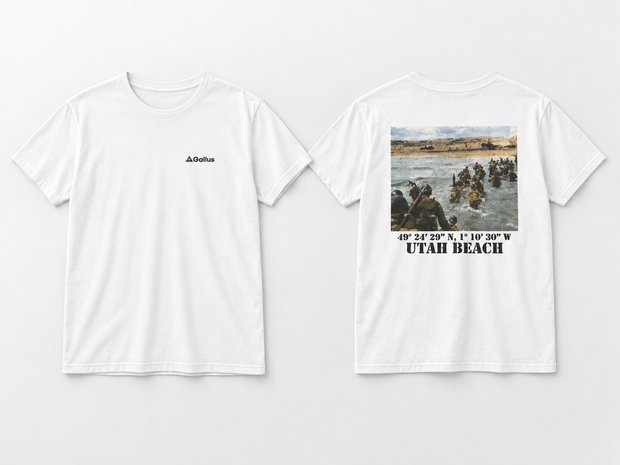
Utah Beach 6 June 1944 T-Shirt — D-Day Normandy
€30,95 EUR
View the design →CAMPAIGN COLLECTION
D-Day & Normandy 1944
Stay with this subject instead of being dropped back into the full catalogue.
Explore the collection →FIELD NOTES
Get new Field Notes by email
New research, campaign guides and useful references without a daily sales barrage.
