


Hundred Days Offensive 1918: Amiens to the Armistice — Complete Campaign Field Guide

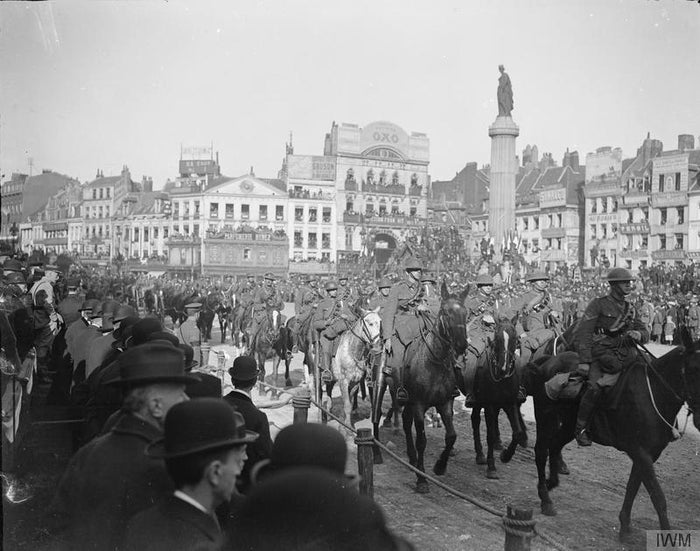
The Hundred Days were not one uninterrupted charge from Amiens to victory. They were a sequence of Allied offensives that repeatedly forced the German Army from prepared positions between August and November 1918.
The campaign began with the Battle of Amiens on 8 August and ended with the Armistice on 11 November.
Amiens
The opening attack combined surprise, tanks, artillery, aircraft and infantry on a scale that shocked the German High Command. Gallus covers the battle in detail in Battle of Amiens 1918.
Beyond one breakthrough
Rather than repeat the trench-offensive pattern of attacking until exhausted, Allied commanders shifted pressure along the front. British, Dominion, French and American armies forced Germany to commit reserves repeatedly.
Breaking the Hindenburg Line
By September the Allies were assaulting the Hindenburg defensive system. Canal crossings, artillery preparation, tanks and infantry cooperation were needed to breach positions Germany had prepared over years.
Explore this history
Continue from this Field Note into the closest Gallus campaign and military-history collection.
Explore D-Day & Normandy 1944 →
Logistics and movement
As the battlefield became mobile again, supply problems changed. Railheads and depots had to move forward; destroyed bridges and roads slowed artillery and ammunition; horse transport remained vital despite mechanisation.
German morale and manpower
Germany faced falling morale, heavy casualties, shortages and declining confidence in victory. This did not mean German units stopped fighting; many defensive actions remained fierce.
Coalition warfare
The campaign was genuinely multinational. British armies included Canadian, Australian, New Zealand and other imperial formations, while French and American forces attacked on adjoining fronts under increasingly coordinated Allied command.
Armistice
Germany sought an armistice as military defeat combined with political crisis at home. Fighting continued until 11:00 on 11 November 1918.
Why the Hundred Days mattered
The campaign demonstrated the mature form of Allied combined-arms warfare: artillery, infantry, tanks, aircraft, engineers, signals and logistics working in repeated operations rather than relying on one decisive weapon.
Continue exploring
Sources and evidence used
- National Army Museum — 1918: Year of Victory.
- British, French, Canadian, Australian and American official histories of the 1918 campaigns.
Related Field Notes
FROM THIS CAMPAIGN
World War 1



CONTINUE THE STORY
More from this campaign
Read it, reference it or wear it — the related pieces are kept together here.
FEATURED DESIGN

Amiens 1918 T-Shirt — First World War Battle
€30,95 EUR
View the design →CAMPAIGN COLLECTION
World War 1
Stay with this subject instead of being dropped back into the full catalogue.
Explore the collection →FIELD NOTES
Get new Field Notes by email
New research, campaign guides and useful references without a daily sales barrage.
