


Hundred Days 1815: Complete Campaign Field Guide — Elba, Ligny, Quatre Bras, Waterloo & Wavre // Log 019
The Hundred Days was a political restoration compressed into a military deadline. Napoleon returned from Elba in March 1815. By June, the great powers of Europe were committed to removing him. He therefore attacked the two nearest Coalition armies before the full weight of Austria and Russia could reach France.
For the diplomacy, Bourbon Restoration and Congress of Vienna, start with Log 018 — The Political Road to the Hundred Days. This article follows the campaign from Napoleon’s return to his second abdication.
March–May: rebuilding an army under a clock
Napoleon inherited experienced officers, veterans and a functioning French military system, but he did not inherit the enormous imperial armies of earlier campaigns. He had to rebuild formations, secure arsenals, restore command relationships and defend several possible invasion fronts.
The Coalition could eventually place forces vastly larger than his own in the field. Napoleon’s only realistic strategic opportunity was to gain local superiority before those armies concentrated.
The armies in the Low Countries
Two major Allied forces stood nearest France. Wellington commanded a multinational Anglo-Allied army spread across the western part of the Netherlands. Blücher’s Prussian army lay further east. Their cantonments reflected supply and political requirements more than ideal battlefield concentration.
Napoleon assembled the Army of the North and planned to drive through the seam between them. The operational idea was classic Napoleon: concentrate rapidly, separate enemy armies, defeat each in turn.
15 June: the Sambre and Charleroi
French forces crossed the Sambre and entered Charleroi. The advance created immediate uncertainty at Allied headquarters. Wellington had to determine whether Napoleon’s main effort threatened Brussels more directly from the west or was already driving between him and Blücher.
The French strategic advantage was initiative. The Coalition advantage was that Wellington and Blücher had already agreed to support one another.
16 June: two battles on the same day
Ligny
Napoleon attacked Blücher near Ligny and won his last battlefield victory. The Prussians suffered heavy casualties and were forced to retreat. Yet they were not destroyed. Their staff, particularly under Gneisenau, directed the retreat toward Wavre — north, and still within supporting distance of Wellington — rather than east away from the campaign.
That decision became one of the most important operational events of the Hundred Days.
Quatre Bras
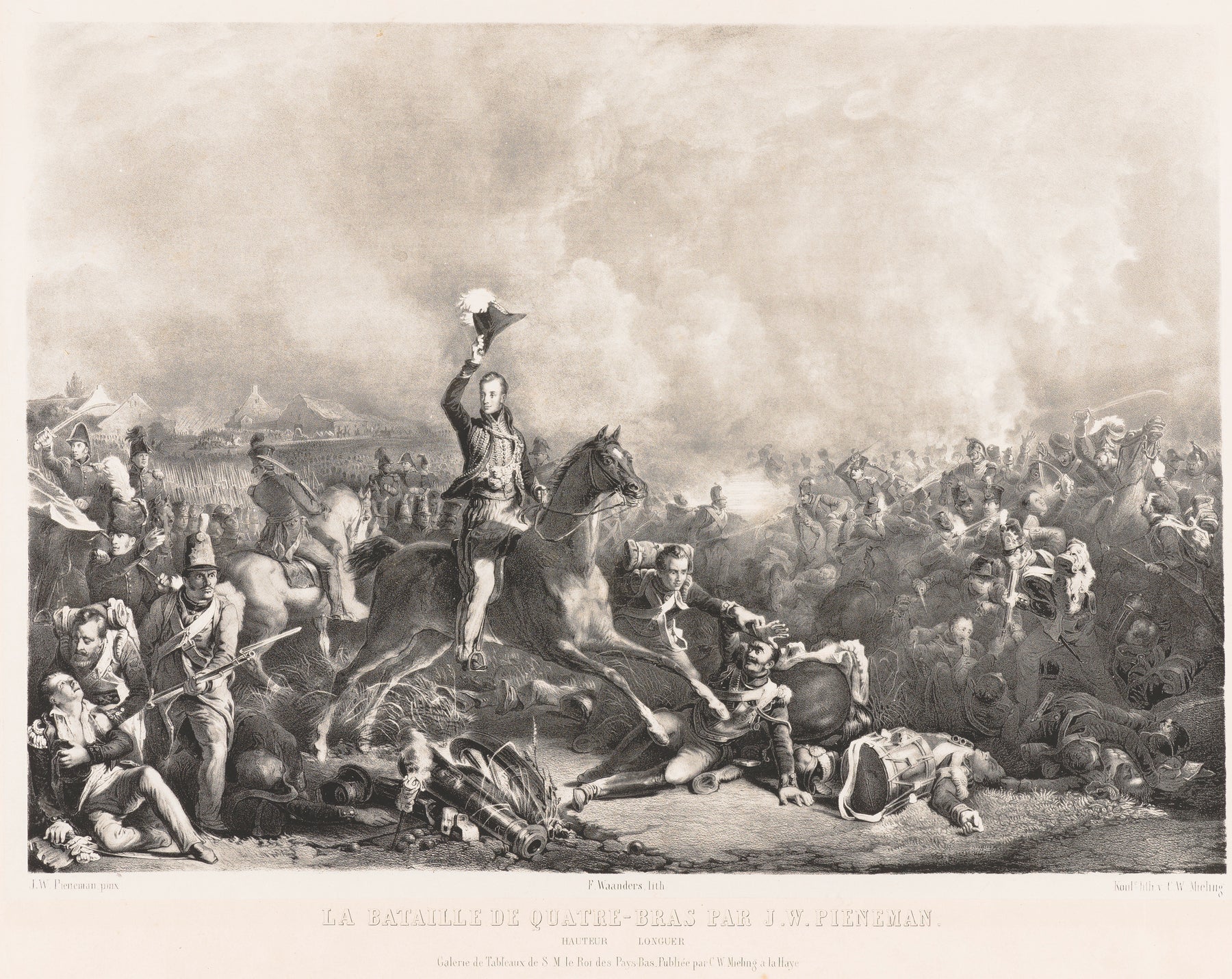
At the crossroads of Quatre Bras, Marshal Ney attacked Wellington’s developing position. The fight was confused and reinforcement-driven. The French failed to seize the crossroads early enough to prevent the Allied army concentrating.
By evening Wellington still held Quatre Bras, but the Prussian defeat at Ligny meant he could not stay there indefinitely. The two Coalition armies had been hit separately, but Napoleon had failed to convert that separation into the destruction of either one.
The missed opportunities after Ligny
Napoleon detached Marshal Grouchy with roughly 33,000 men to follow the Prussians. The central campaign controversy is not simply whether Grouchy should have “marched to the sound of the guns” on 18 June. The larger question begins earlier: how quickly did French headquarters identify the true direction of the Prussian retreat, and how effectively did Napoleon maintain contact with an enemy army he had defeated but not broken?
By the time Grouchy was firmly engaged around Wavre, substantial Prussian forces were already moving toward Wellington.
17 June: retreat, pursuit and rain
Wellington withdrew from Quatre Bras to the Mont-Saint-Jean position south of Waterloo. French cavalry pursued. Heavy rain turned roads and fields into mud and complicated movement for men, horses, guns and supply.
Blücher confirmed that he intended to support Wellington. Wellington’s decision to stand on 18 June depended on that promise becoming actual movement.
18 June: Waterloo
The Waterloo battle guide deals with the action in detail. At campaign level, four points matter:
- Napoleon had failed to remove the Prussians from the campaign at Ligny.
- Wellington chose ground where he could hold long enough for support to arrive.
- French attacks consumed time and reserves without breaking the Anglo-Allied army.
- Prussian arrival transformed Napoleon’s battle from a single-front attack into a fight for survival on two connected fronts.
Read Log 006 — the complete Waterloo field guide →
18–19 June: Wavre
While the decisive battle developed at Waterloo, Grouchy fought Thielmann’s Prussian III Corps around Wavre. The French achieved local tactical success, but strategically the action could not reverse what had happened to Napoleon’s main army.
Wavre matters because it prevents the campaign being reduced to a morality tale about one marshal. Grouchy was executing orders against a real Prussian force. The failure was at the level of campaign control: Napoleon had insufficiently prevented the main Prussian mass from moving west toward Wellington.
The retreat
After the Imperial Guard failed and the Prussians broke into the French right around Plancenoit, the Army of the North collapsed into retreat. Prussian pursuit continued through the night.
Napoleon returned to Paris. His political room for manoeuvre had disappeared. The Chambers were unwilling to sustain another open-ended imperial war after the defeat.
22 June: second abdication
Napoleon abdicated for the second time. He later surrendered himself to the British and was sent to Saint Helena, far beyond the possibility of another return like Elba.
Louis XVIII returned to France and the Vienna settlement moved from wartime negotiation into the post-Napoleonic European order.
Campaign timeline
- 26 February 1815: Napoleon leaves Elba.
- 1 March: lands in France.
- 20 March: enters Paris; Louis XVIII has fled.
- 25 March: Britain, Austria, Prussia and Russia renew their alliance.
- 15 June: French cross the Sambre and seize Charleroi.
- 16 June: Ligny and Quatre Bras.
- 17 June: Wellington retreats to Mont-Saint-Jean; heavy rain.
- 18 June: Waterloo; Wavre begins.
- 19 June: fighting at Wavre ends after news of Waterloo.
- 22 June: Napoleon abdicates again.
Commanders and the campaign problem
Napoleon needed a rapid sequence of decisive victories before the Coalition’s superior resources could converge. Wellington needed to avoid being isolated from the Prussians while preserving the road to Brussels. Blücher and his staff had to recover from Ligny quickly enough to remain strategically useful. Ney had to seize Quatre Bras before Allied reinforcement made that increasingly difficult. Grouchy had to keep contact with a retreating Prussian army whose direction was initially uncertain.
The campaign is therefore a study in time, information and coalition coordination as much as battlefield tactics.
Why the Hundred Days failed
Napoleon’s operational idea was rational. His problem was that victory at Ligny was incomplete, Quatre Bras was not secured in time, French pursuit failed to stop the Prussians recovering toward Wavre, and the Coalition retained enough mutual trust to reunite operationally on 18 June.
Waterloo was the decisive battle, but the conditions for Waterloo were created by the preceding three days.
