


Dayton 1995 to IFOR: How Bosnia Moved from UNPROFOR to NATO Peace Enforcement
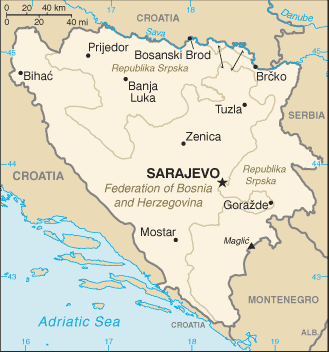
The Dayton Peace Agreement changed the military problem in Bosnia. UNPROFOR had operated during an active war; IFOR deployed after a negotiated settlement with a stronger mandate to enforce key military terms.
That transition matters because it explains why the international force after December 1995 looked different in scale, posture and authority from the blue-helmet mission that preceded it.
Why the war reached negotiation
By 1995 the military and diplomatic situation had changed sharply. Bosnian Serb forces had suffered battlefield reverses, Croatian and Bosnian government forces had gained ground, NATO had conducted air operations, and international pressure intensified.
Negotiations at Dayton, Ohio, produced the General Framework Agreement for Peace. It was formally signed in Paris in December 1995.
From UNPROFOR to IFOR
The UN mission was replaced by the NATO-led Implementation Force, IFOR, under Operation Joint Endeavour. Around 60,000 troops deployed internationally. Britain provided a substantial contingent.
IFOR's tasks included separating former belligerents, overseeing the transfer of territory, monitoring heavy weapons and creating the military conditions in which the peace agreement could take effect.
Explore this history
Continue from this Field Note into the closest Gallus campaign and military-history collection.
Explore Campaigns & Operations →
A stronger military mandate
Unlike UNPROFOR's more limited peacekeeping framework, IFOR operated under a robust NATO command structure and rules intended to enforce the military annexes of the agreement. The parties had signed a settlement; the mission was now to make compliance real on the ground.
That did not remove risk. Mines, unexploded ordnance, weapons, displaced civilians and local hostility remained serious problems.
British tasks
British forces patrolled sectors, monitored cantonment and weapons arrangements, protected movement routes and worked alongside other NATO contingents. Engineers faced a huge mine and infrastructure problem. Logistics units supported a force operating through winter in damaged terrain.
Peace enforcement is not nation-building
IFOR's military purpose was deliberately bounded. Political reconstruction, refugee return, elections and civil institutions involved other organisations. The military force could provide security conditions but could not by itself resolve the political causes of the war.
From IFOR to SFOR
After IFOR's one-year mission, NATO transitioned to the Stabilisation Force, SFOR. The international military presence continued at a lower strength while Bosnia's political institutions developed under the peace agreement.
Why the transition matters
The Bosnia experience became influential in later debates about peacekeeping and intervention. One lesson was straightforward: mandate, political settlement and military means have to align. A force with limited authority inside an active war faces a different problem from a force enforcing a signed peace.
Continue exploring
Sources and evidence used
- NATO records on IFOR, Operation Joint Endeavour and SFOR.
- Dayton Peace Agreement texts and military annexes.
- National Army Museum — Bosnia.
- UK Ministry of Defence records on the Balkans deployment.
