Battle of Stalingrad 1942–43: Complete Field Guide — City Fighting, Uranus & Surrender // Log 058

Field Note // Log 058
Stalingrad is one of those battles that gets reduced to a single word: turning point. That is true, but it hides what the battle actually was. For the men inside the city it was not a sweeping map-arrow campaign. It was cellars, stairwells, rubble, factories, trenches cut through gardens and a river crossing under fire. For the commanders outside it, the decisive move eventually came not from another assault on the city centre, but from striking the weaker Axis armies guarding the German flanks.
The short answer
The battle ran from the German arrival on the Volga in August 1942 to the final surrender of the encircled Axis forces on 2 February 1943. Hitler wanted Stalingrad for strategic and political reasons: it sat on the Volga, protected the northern flank of the drive toward Caucasian oil, and carried Stalin’s name. The Soviet Union turned the city into a defensive anchor, then used Operation Uranus in November to smash the Romanian-held flanks and encircle the German Sixth Army. The result destroyed a major German field army and ended the idea that the Wehrmacht could simply keep advancing east until the Soviet state collapsed.
Why Stalingrad mattered
Germany’s 1942 summer offensive drove south toward the Caucasus and east toward the Volga. The plan stretched German forces across a vast front. Stalingrad became increasingly important as the campaign developed. Controlling the river traffic mattered, but so did denying the Soviets an industrial city and protecting the long northern flank of Army Group A in the Caucasus.
The political symbolism made the military logic worse. Once both dictators attached their names and prestige to the city, withdrawing became harder to contemplate. What began as an operational objective became a test of will.
Who fought
The German spearhead was General Friedrich Paulus’s Sixth Army, supported in the wider battle by elements of Fourth Panzer Army under Hermann Hoth. Romanian, Italian and Hungarian armies covered long stretches of the Axis flanks. On the Soviet side, Lieutenant-General Vasily Chuikov’s 62nd Army became synonymous with the defence inside Stalingrad, while the wider Soviet front system brought in enormous forces for the counter-offensive. Generals Georgy Zhukov and Aleksandr Vasilevsky were central to planning the strategic response, and Konstantin Rokossovsky’s Don Front later tightened the ring around the trapped Axis troops.
The ground soldier’s battle
Urban fighting strips away many of the advantages that look overwhelming on paper. Tanks lose room to manoeuvre. Artillery can reduce buildings without necessarily removing defenders from basements and cellars. Observation becomes difficult. A strongpoint can be one floor, one workshop or one ruined wall.
Chuikov’s troops fought close to the Germans whenever they could, making it harder for German aircraft and artillery to attack without risking their own men. The factory district — Red October, Barrikady and the Tractor Factory — became a separate battlefield of smashed machinery, walls and workshops. Mamayev Kurgan changed hands repeatedly. The Volga was not a safe rear area; Soviet reinforcements and supplies had to cross it under shelling and air attack.
The popular nickname Rattenkrieg, the rats’ war, captures the closeness but can make the fighting sound almost romantic. It was not. Men slept beside the dead, fought in dust and smoke, struggled for water and ammunition, and could measure progress in rooms rather than miles.
Operation Uranus — the battle changes shape
By November the Germans held much of the ruined city, but the Soviet command had been building forces on the exposed flanks. On 19 November 1942 Soviet armies attacked the Romanian Third Army north-west of Stalingrad. A second blow followed south of the city the next day. The Axis flank formations were short of effective anti-tank weapons and spread over long sectors. Soviet armoured and mechanised forces drove into the rear and met near Kalach, closing the ring.
More than 200,000 Axis troops were trapped. The exact figure depends on which formations and support personnel are counted, but the operational fact is not disputed: Sixth Army had become an encircled force.
Why didn’t Sixth Army break out?
This remains one of the battle’s biggest arguments. Paulus was under direct orders to hold. Hermann Göring’s Luftwaffe promised an air supply on a scale it could not sustain, especially in winter weather and against Soviet fighters and anti-aircraft guns. Field Marshal Erich von Manstein’s relief effort, Operation Winter Storm, reached toward the pocket in December but never opened a corridor.
It is easy with hindsight to say Sixth Army should simply have marched out. The reality was harder: fuel was scarce, many vehicles and horses were already lost or starving, wounded men filled the pocket, and a breakout would have meant abandoning heavy equipment. Even so, Hitler’s refusal to authorise withdrawal while there was still some possibility of movement turned a disaster into destruction.
Surrender
By January, food, fuel and ammunition were running out. Frostbite and disease added to battlefield casualties. The Soviet Operation Ring compressed the pocket. Paulus surrendered the southern part on 31 January 1943. The remaining northern group surrendered on 2 February.
About 91,000 exhausted Axis personnel went into Soviet captivity according to commonly cited Soviet and post-war figures. Only a small fraction eventually returned home. Casualty totals for the entire Stalingrad campaign vary dramatically because sources use different dates and geographical boundaries and may include civilians, Axis allies, prisoners and Soviet losses across multiple fronts. Any neat single total should therefore be treated with caution.
Myth check
“Stalingrad alone won the war.” No. It was a decisive strategic and psychological reversal, but the Eastern Front remained enormous and the war continued for more than two years.
“The Germans lost because of winter.” Winter made everything worse, but the army was trapped by Soviet operational success, overextension and poor strategic decisions. Weather did not create the encirclement.
“The city itself was the only decisive ground.” The fighting inside Stalingrad mattered because it fixed German forces. The destruction of Sixth Army came from the Soviet attacks on the flanks outside the city.
What changed
After Stalingrad, Germany never recovered the same strategic freedom in the east. The Wehrmacht could still launch dangerous offensives — Kursk followed in 1943 — but the broader initiative had moved toward the Red Army. Just as important, the belief that German victory was inevitable had been broken.
For ordinary soldiers, that grand strategic sentence came at a terrible price. Stalingrad was a battle of endurance long before it became a symbol.
Sources & further reading
- United States Holocaust Memorial Museum — The Soviet Union and the Eastern Front
- United States Holocaust Memorial Museum — World War II in Eastern Europe, 1942–1945
- Antony Beevor, Stalingrad.
- David M. Glantz and Jonathan M. House, To the Gates of Stalingrad and the subsequent Stalingrad trilogy.
Continue through the archive
See the Second World War & Remembrance Field Notes hub or the complete Second World War campaign guide.
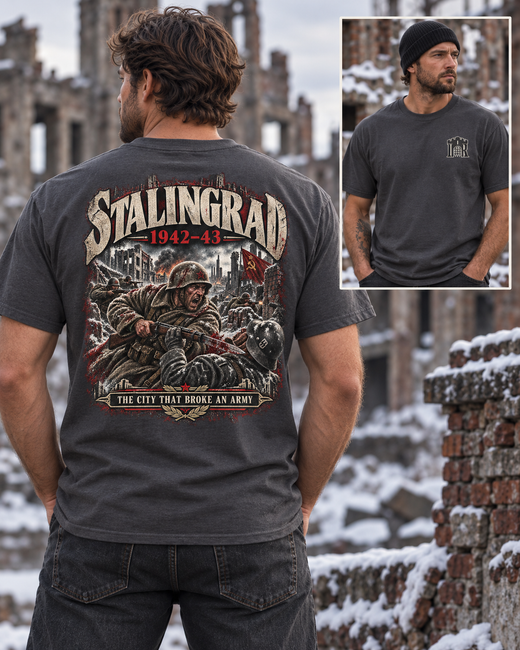
Related design: Stalingrad 1942–43 WW2 T-Shirt. The history comes first; the design is there for readers who want to carry the subject beyond the page.
SHOP THIS FIELD NOTE
 Stalingrad 1942–43 WW2 T-Shirt | Eastern Front History Tee€29,95 EURView design →
FIELD GEAR
From this Field Note
The products below are the designs already linked to this article. Prices are shown in the currency selected for your market.