Battle of Midway 1942: Complete Field Guide — Intelligence, Carriers & Turning Point // Log 060

Field Note // Log 060
Midway is often told as a miracle: America broke the Japanese code, waited behind a curtain and sank four carriers. That version is not completely wrong, but it is too tidy. Intelligence created the opportunity. Pilots, deck crews, scouts, commanders, weather, timing and luck decided whether that opportunity became a victory.
The short answer
Between 3 and 7 June 1942, with the decisive carrier fighting on 4 June, the US Pacific Fleet defeated a Japanese operation intended to seize Midway and draw American carriers into destruction. Admiral Chester Nimitz knew enough of the Japanese plan through communications intelligence to place three US carriers — Enterprise, Hornet and the hurriedly repaired Yorktown — north-east of Midway. Japan brought four front-line carriers: Akagi, Kaga, Soryu and Hiryu. By the end, all four Japanese carriers were lost. The United States lost Yorktown.
Why Japan came to Midway
Japan had won a breathtaking run of victories since December 1941, but Pearl Harbor had not removed the American carriers. Admiral Isoroku Yamamoto wanted to destroy them. The Midway operation was designed to seize the atoll and create the sort of crisis that would bring the remaining Pacific Fleet carriers into battle.
The plan was elaborate, with forces scattered across a wide area and a simultaneous operation in the Aleutians. Complexity mattered because it reduced the ability of Japanese formations to support one another once surprise disappeared.
The intelligence battle
Station HYPO at Pearl Harbor, led by Commander Joseph Rochefort, and Pacific Fleet intelligence under Lieutenant Commander Edwin Layton pieced together Japanese intentions from partially read JN-25 traffic, message patterns and other information. The famous deception involving Midway reporting a shortage of fresh water helped confirm that the Japanese designator “AF” meant Midway.
More importantly, the analysts estimated when the attack would come. Nimitz used that knowledge to reinforce Midway and position his carriers where the Japanese did not expect them.
Calling Midway simply a codebreaking victory still sells the intelligence work short. It was analysis, traffic reading, language expertise, operational judgement and a commander willing to act on an estimate that could never be perfect.
4 June — first strike
Japanese aircraft struck Midway early on 4 June. The island’s defenders fought back and launched aircraft against the carriers, but those early attacks achieved little. Vice-Admiral Chuichi Nagumo now faced a difficult problem: preparing another attack on Midway while also dealing with reports that American naval forces might be nearby.
American carrier groups were already launching. Coordination was poor. Squadrons became separated. Torpedo aircraft arrived without adequate fighter cover and suffered appalling losses. The old story says their sacrifice deliberately pulled the Japanese combat air patrol down to sea level so the dive-bombers could attack. In reality it was not a planned combined-arms sequence. The attacks were fragmented. Their pressure did contribute to Japanese disruption, but chance and timing mattered.
Five minutes that need context
US dive-bombers from Enterprise and Yorktown reached the Japanese carriers at a catastrophic moment. Akagi, Kaga and Soryu were hit and eventually lost. This is sometimes written as though the Japanese flight decks were covered with fuelled aircraft waiting to launch, an image modern scholarship has challenged in detail. The essential point remains: the carriers were in the middle of a demanding cycle of recovering, arming, refuelling and handling aircraft when bombs arrived.
Hiryu survived the first attacks and struck back, crippling Yorktown in two separate attacks. Later that afternoon American aircraft found Hiryu and fatally damaged her as well.
The human machinery of a carrier battle
A carrier battle depends on hundreds of people who never see the enemy. Armourers move bombs and torpedoes. Fuel crews work around aviation spirit and hot engines. Deck parties shift aircraft in seconds. Radio operators pass incomplete reports. Plotters try to turn sightings into positions. Pilots navigate over open ocean knowing that missing the carrier on return can be fatal.
Midway was fought by aircraft, but the aircraft only worked because a floating industrial system kept launching and recovering them under pressure.
After the carriers
Yorktown was later torpedoed by the Japanese submarine I-168, which also sank the destroyer USS Hammann while she was assisting the carrier. Yorktown finally sank on 7 June. Japan had lost Akagi, Kaga, Soryu and Hiryu, together with aircraft, trained aircrew and experienced carrier personnel that were extremely difficult to replace.
Myth check
“The Americans could read everything.” No. US intelligence had partial access and built estimates from incomplete material. Nimitz still accepted considerable risk.
“Midway was pure luck.” Luck mattered, particularly in reconnaissance, timing and the arrival of the dive-bombers. But luck only mattered because intelligence had put American carriers in position and crews were able to exploit the moment.
“Midway instantly made the US Navy dominant.” No. Guadalcanal and the battles that followed remained desperate. Midway removed four elite Japanese carriers and stopped a major offensive, but the Pacific war was far from decided.
Why it mattered
Japan could replace ships over time, but it could not quickly replace the accumulated experience of pre-war carrier aviation. Midway did not end Japanese offensive power on its own, but it changed the balance and handed the United States strategic room it badly needed.
The lesson is less romantic than “miracle.” Good intelligence created a chance. People then had to act fast enough, accurately enough and bravely enough to use it.
Sources & further reading
- US Naval History and Heritage Command — Battle of Midway
- NHHC — Battle of Midway, 4–7 June 1942
- Jonathan Parshall and Anthony Tully, Shattered Sword.
- Craig L. Symonds, The Battle of Midway.
Continue through the archive
Return to the Second World War & Remembrance hub.
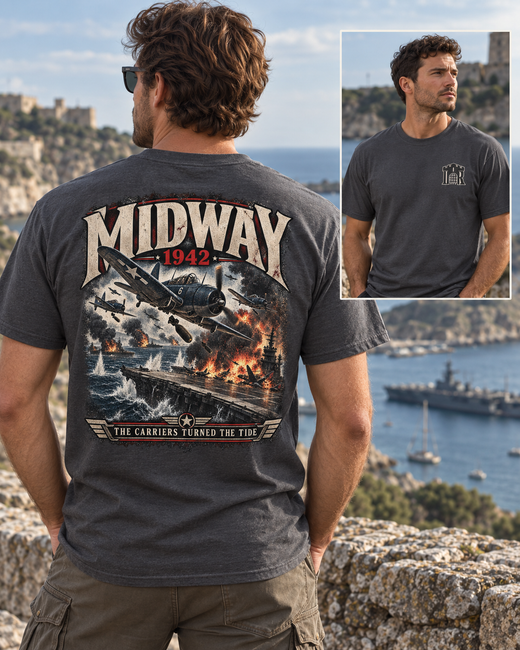
Related design: Battle of Midway 1942 WW2 T-Shirt.
SHOP THIS FIELD NOTE
 Battle of Midway 1942 WW2 T-Shirt | Pacific Naval History Tee€29,95 EURView design →
FIELD GEAR
From this Field Note
The products below are the designs already linked to this article. Prices are shown in the currency selected for your market.