Iwo Jima 1945: Complete Field Guide — Landings, Suribachi, Tunnels & Cost // Log 059

Field Note // Log 059
Most people know Iwo Jima through one photograph. That is understandable — Joe Rosenthal’s image of the second flag-raising on Mount Suribachi became one of the defining pictures of the war. The problem is that the photograph can make the battle look finished on 23 February 1945. It was not. Most of the killing was still ahead.
The short answer
Operation Detachment began with the US Marine landings on 19 February 1945 and the battle continued into late March. The American objective was a tiny volcanic island with three airfields on the direct route between the Mariana Islands and Japan. Lieutenant-General Tadamichi Kuribayashi rejected the usual Japanese idea of destroying the invasion at the waterline. Instead, roughly 21,000 defenders were dug into a deep network of caves, tunnels and mutually supporting positions designed to make every yard expensive.
Why Iwo Jima?
Iwo Jima lay about halfway between the Marianas and the Japanese home islands. American planners expected its capture to remove a Japanese warning and fighter base, provide an emergency landing field for B-29 bombers, and potentially support fighter escorts and air-sea rescue.
Those arguments were real, but the scale of the benefit remains debated. The US Naval History and Heritage Command now explicitly notes that some pre-invasion assumptions about the island’s usefulness did not hold up as strongly as expected. That does not erase the battle or the courage involved; it makes the history more honest.
The beach
The first problem was the ground itself. Iwo Jima’s volcanic ash did not behave like firm sand. Men struggled for footing and vehicles bogged. Digging a proper fighting position could be miserable. The beaches became congested with men, equipment and damaged landing craft while Japanese artillery and mortars, largely withheld during the first moments, began firing from concealed positions.
Kuribayashi’s defence had been built to survive the enormous pre-invasion bombardment. Bunkers were linked, guns were hidden, and troops were ordered to avoid wasteful mass attacks. The result was not the quick beach battle some planners had hoped for, but a deliberate fight into prepared ground.
Suribachi was not the end
Mount Suribachi dominated the southern end of the island and fell on 23 February. The flag-raising mattered enormously to morale, but the main Japanese defensive system extended north through broken ridges, caves and fortified terrain.
The 3rd, 4th and 5th Marine Divisions had to grind through positions that could appear cleared and then come alive again from hidden entrances. Flamethrowers, demolition charges, tanks, artillery and close air support were all used. The battle was less about one dramatic assault than repeated small actions: finding an aperture, suppressing it, sealing or clearing it, then doing the same again under fire.
The soldier-level reality
On a map Iwo Jima is tiny. On foot, under fire, it was enormous. A few hundred metres could contain multiple hidden firing points. Units lost leaders and replacements quickly. Evacuating wounded men over exposed ground was itself a combat task. The heat from weapons, the sulphur smell, volcanic dust and the constant closeness of the enemy made the island physically and mentally exhausting.
Japanese soldiers faced an equally grim situation. Kuribayashi knew relief was not coming. Water was scarce, medical treatment deteriorated and the tunnel system that gave protection also became a prison as American forces isolated strongpoints.
The cost
According to the US Naval History and Heritage Command, Operation Detachment cost US forces 6,871 killed and 19,217 wounded. Of roughly 21,000 Japanese defenders, only a few hundred were taken prisoner during the battle; thousands more were killed, with some survivors remaining hidden after organised resistance ended.
Those numbers are why arguments about the island’s strategic value matter. Questioning the planning case is not disrespectful. If anything, the scale of the sacrifice makes it more important to ask whether commanders’ assumptions were right.
Myth check
“The famous flag was raised under fire in the final moments of the battle.” No. It was the second flag raised on Suribachi on 23 February, and the battle continued for weeks.
“Iwo Jima was unquestionably essential because thousands of B-29s landed there.” The island was used for emergency and diversionary landings, rescue operations and other purposes, but historians continue to debate whether the operational value justified the cost. NHHC’s own assessment is more cautious than the old textbook version.
“Japanese defence collapsed once Suribachi fell.” The opposite. The hardest northern positions remained.
What Iwo Jima tells us
The battle shows the problem of attacking a prepared defence where the enemy has accepted that survival is unlikely. Firepower can suppress, smash and isolate, but somebody still has to go forward and confirm the position is actually clear.
It also warns against reading history backwards. We know the photograph, the memorial and the eventual Allied victory. The Marines landing on 19 February knew none of that. They saw a black beach and a hostile island that still had to be crossed on foot.
Sources & further reading
- US Naval History and Heritage Command — Battle of Iwo Jima
- Robert S. Burrell, The Ghosts of Iwo Jima.
- Derrick Wright, The Battle for Iwo Jima 1945.
Continue through the archive
Go back to the Second World War & Remembrance hub or read the complete campaign guide.
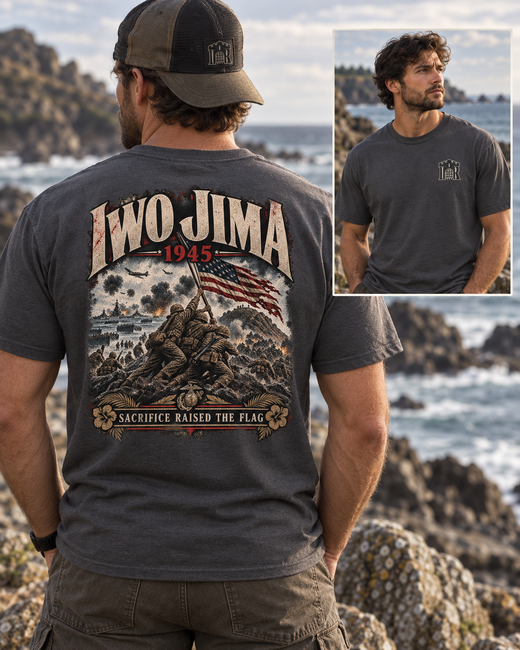
Related design: Iwo Jima 1945 WW2 T-Shirt.
FIELD GEAR
From this Field Note
The products below are the designs already linked to this article. Prices are shown in the currency selected for your market.