El Alamein 1942: Complete Field Guide — Eighth Army, Axis Defence & Breakthrough // Log 062

Field Note // Log 062
El Alamein is often presented as Montgomery versus Rommel, two generals facing each other across the desert. That makes a good poster, but it is not how armies win battles. El Alamein was artillery crews, engineers cutting lanes through minefields, infantry clearing positions at night, tank crews trying to find gaps, supply columns keeping fuel and ammunition moving, and a multinational Eighth Army wearing down a German-Italian force that could no longer replace its losses easily.
The short answer
The Second Battle of El Alamein began on the night of 23 October 1942 and ended with the Axis retreat in early November. The battlefield was unusually constrained: the Mediterranean lay to the north and the Qattara Depression blocked a major armoured outflanking move to the south. That forced both sides into a relatively narrow front.
Lieutenant-General Bernard Montgomery’s Eighth Army had spent weeks rebuilding, training and stockpiling. Rommel’s Panzerarmee Afrika had formidable defensive experience but serious supply problems. The Allied plan was to break into the Axis minefield belt, force a battle of attrition and then push armour through once the defence had been worn down.
Why here?
Earlier in 1942 Axis forces had captured Tobruk and driven deep into Egypt. They were finally halted at the First Battle of El Alamein in July. The geography gave the defenders something the Western Desert often lacked: secure flanks.
When Montgomery took over Eighth Army in August, he inherited a force that had been retreating and badly shaken. He did not immediately launch a grand offensive. He trained, reorganised and built supply. Rommel’s attempt to turn the position at Alam Halfa in late August failed, leaving the Axis army short of fuel and with little room for another major gamble.
A coalition army
Eighth Army was not simply “the British.” British formations fought alongside Australians, New Zealanders, South Africans, Indians and other Allied contingents. That matters both historically and tactically. Different divisions had different recent experience, equipment and roles, but they were operating inside one army plan.
Opposite them stood German and Italian formations. Popular culture often gives all the credit to the Afrika Korps and treats Italian troops as a footnote. That is lazy history. Italian infantry, artillery, armour and paratroopers held substantial sectors and fought hard in many positions despite equipment and supply disadvantages.
Operation Lightfoot
The offensive opened with a huge artillery concentration on the night of 23 October. Infantry moved into the minefield zones while engineers worked to create lanes for armour. The operation’s name came from the idea that infantry could pass over anti-tank mines too light to trigger them, though anti-personnel mines, wire, shelling and defended gaps made the reality far more dangerous than the nickname suggests.
The minefields — sometimes described as the Devil’s Gardens — were not just belts of explosives. They were part of a system covered by guns, infantry and anti-tank positions. Clearing a lane while under observation is slow. Keeping the lane marked at night is harder. Moving hundreds of vehicles through it without traffic chaos is harder again.
The battle bogs down
Montgomery’s first plan did not produce an immediate clean breakthrough. That is important. El Alamein was won through persistence and the ability to keep feeding the battle. Axis counter-attacks cost tanks and fuel the defenders could not easily replace.
In the north, the 9th Australian Division attacked toward the coast and forced Rommel to commit strength to contain it. The Australian War Memorial notes how fierce fighting around places such as Thompson’s Post and the Saucer drew German attention northwards. This helped weaken the line elsewhere.
Operation Supercharge
On 2 November the Allies launched Operation Supercharge against a sector designed to open the final path for armour. The fighting remained costly, but the Axis position was becoming unsustainable. Rommel sought permission to withdraw. Hitler initially ordered him to stand, another example of political interference making a bad operational position worse.
By 4 November the retreat was underway. Eighth Army had broken the Axis line and began pursuing westward.
What it felt like at ground level
Desert warfare is often imagined as wide open and clean. El Alamein was neither. Dust cut visibility. Mines restricted movement. Night attacks separated men from units. Vehicle crews lived with mechanical failure as well as enemy fire. Water mattered constantly. Artillery could be seen from miles away at night, but knowing where a shell burst did not mean you knew where the next one was going.
The logistics behind the front were decisive. Montgomery had numerical and material superiority, but that advantage only mattered because fuel, shells, replacement tanks, food, water and spare parts reached the fighting formations.
Myth check
“Montgomery simply overwhelmed Rommel with numbers.” Allied superiority was important and should not be hidden. But converting superiority into a breach through mines and prepared defences still required planning, engineering and sustained fighting.
“It was Britain versus Germany.” No. Both armies were multinational. The Australian, New Zealand, South African, Indian and Italian roles deserve to be visible.
“El Alamein alone ended the North African war.” No. Operation Torch began on 8 November in Morocco and Algeria, creating pressure from the west. Axis forces fought in Tunisia until May 1943.
Why it mattered
El Alamein was the first major British-led land victory over a German field army in the war and transformed morale. It also ended the Axis threat to Egypt and the Suez Canal. But the more useful lesson is practical: the battle was won by building combat power, forcing attrition where the opponent could least afford it, and refusing to confuse a slow start with failure.
Sources & further reading
- National Army Museum — The Struggle for North Africa, 1940–43
- Australian War Memorial — El Alamein Battles
- Niall Barr, Pendulum of War: The Three Battles of El Alamein.
- Jonathan Fennell, Combat and Morale in the North African Campaign.
Continue through the archive
Return to the Second World War & Remembrance hub.
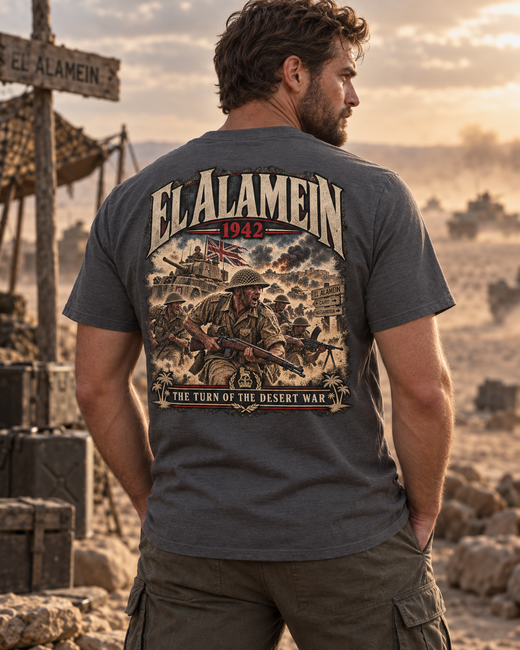
Related design: El Alamein 1942 WW2 T-Shirt.
FIELD GEAR
From this Field Note
The products below are the designs already linked to this article. Prices are shown in the currency selected for your market.