


1st (UK) Armoured Division in the Gulf War 1991: Desert Sabre, Challenger 1 & the Ground Offensive
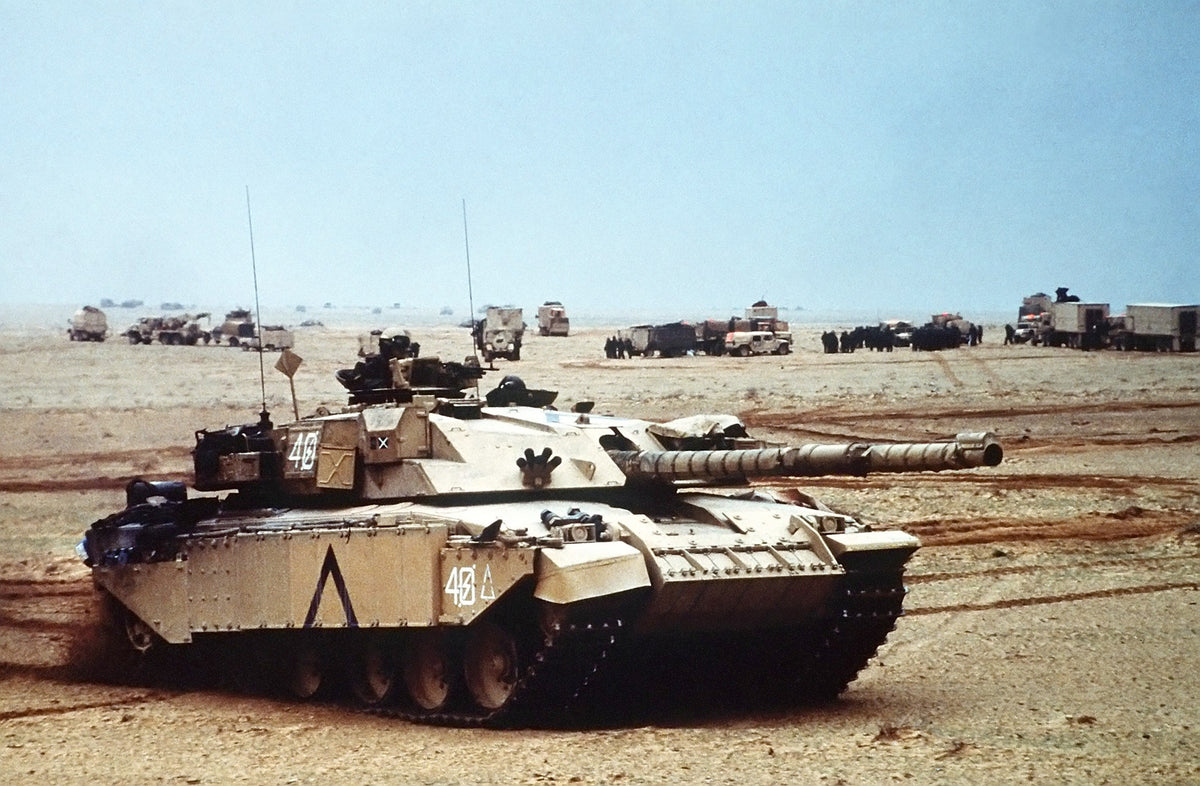
The British Army's principal Gulf War formation, 1st (UK) Armoured Division, fought a fast-moving armoured campaign that looked very different from the static threat NATO had spent decades preparing to meet in Germany.
Under Operation GRANBY, the division joined the US-led coalition ground offensive in February 1991. Its battlefield operation is often known by the British title Operation DESERT SABRE.
For the wider campaign, see Operation GRANBY 1990–91.
From Germany to Saudi Arabia
Much of the division came from the British Army of the Rhine. Units had trained for armoured war against the Warsaw Pact. In the Gulf they had to adapt equipment, logistics and tactics to desert distances, dust and extreme temperatures.
The formation
The division included two principal armoured brigades with Challenger 1 tanks, Warrior infantry fighting vehicles, self-propelled artillery, engineers, air defence, reconnaissance and a large logistics tail. Exact unit attachments changed during deployment.
The coalition plan
The ground offensive began on 24 February 1991 after weeks of air attack. The British division operated within US VII Corps on the western side of the main coalition manoeuvre, advancing into Iraq and engaging Republican Guard formations.
Explore this history
Continue from this Field Note into the closest Gallus campaign and military-history collection.
Explore Campaigns & Operations →
Armour and tempo
Challenger crews operated at long range with thermal sights, while Warrior gave armoured infantry protected mobility. The pace was demanding: navigation across featureless desert, fuel consumption, vehicle recovery and ammunition resupply all mattered as much as gunnery.
Fighting through Iraqi positions
British units attacked prepared positions and armoured formations during the advance. Iraqi resistance varied. Some units fought; others surrendered in large numbers after the air campaign and rapid coalition breakthrough.
The result was not evidence that armoured warfare had become easy. Coalition air superiority, training, sensors, artillery and logistics created an enormous advantage.
Challenger 1
The campaign strengthened the Challenger's reputation for long-range tank gunnery. Claims about specific 'record' tank kills are often repeated and should be treated carefully unless tied to identifiable unit records and sighting reports.
Logistics
Every kilometre of advance consumed fuel, track life, food, water and ammunition. Recovery and repair units had to keep pace. A successful armoured thrust is therefore a moving supply problem as much as a tactical manoeuvre.
Ceasefire
The ground campaign lasted roughly four days before a ceasefire was declared on 28 February. The brevity of the offensive can hide the months of preparation and the scale of the force assembled beforehand.
Continue exploring
Sources and evidence used
- National Army Museum holdings, including 1st (UK) Armoured Division Operation GRANBY/DESERT SABRE campaign maps.
- British Army and Ministry of Defence Gulf War records.
- Coalition and US VII Corps operational histories.
